

A genuine end of tenancy cleaning guarantee promises a free re-clean, usually within 24 to 72 hours of your agent flagging an issue, or a refund if that re-clean does not fix the problem. It does not rewrite deposit law or override the inventory report. If your agent flags cleaning at checkout, act fast: photograph everything, check it against the move-in inventory, and notify your cleaning provider immediately. Some cleaning providers publish a 72-hour re-clean guarantee for this scenario.
TL;DR:
- A re-clean guarantee typically covers a return visit within 24 to 72 hours to address flagged issues, but does not include deep stains or pre-existing damage.
- Exclusions such as heavy staining, structural issues, or pre-existing damage mean the guarantee may not apply if these problems are not missed on the move-in inventory.
- Reporting issues promptly and with photographic evidence within the guarantee window is essential for a successful claim, with no guarantee cover if reported too late.
- The guarantee's scope should be checked in detail for what rooms and items are covered, and whether additional fees apply for exclusions like outside glass or heavy stains.
- A trusted provider like Book My Cleaning offers a fixed-price service with a transparent 72-hour re-clean guarantee, vetted staff, and online booking to support timely, well-documented dispute resolution.
Table of Contents
- What "end of tenancy cleaning guarantee" actually means
- What's actually covered, and what usually voids the guarantee
- How guarantees interact with UK deposit law and fair wear and tear
- What to do the moment your agent flags a cleaning issue
- Book My Cleaning's guarantee, and what tenants should check it against
- What a guarantee actually costs, and why it's rarely the deciding factor
- What happens if a re-clean guarantee claim gets denied
- Why a clear, written re-clean window matters more than marketing language
- Book online in minutes and get the re-clean guarantee built in
- Where to check the legal detail yourself
- Sources
- FAQ
What "end of tenancy cleaning guarantee" actually means
The phrase gets used loosely, but three distinct promises hide underneath it, and they behave very differently when your agent raises a problem.
A re-clean guarantee is the most common. The provider sends someone back to fix whatever the agent flagged, at no extra cost, within a defined window. A deposit-back guarantee is broader marketing language implying the clean itself will secure your deposit, which no cleaning company can honestly promise since deposit deductions are the landlord's legal call, not the cleaner's. A money-back promise sits somewhere between the two: a partial or full refund if the re-clean also fails to satisfy the agent.
The gap between these matters more than the marketing copy suggests. A re-clean guarantee only costs the provider labour and time. A money-back promise costs them revenue, so weaker operators tend to advertise re-cleans dressed up in deposit-back language, hoping you won't notice the difference until it's too late to matter.
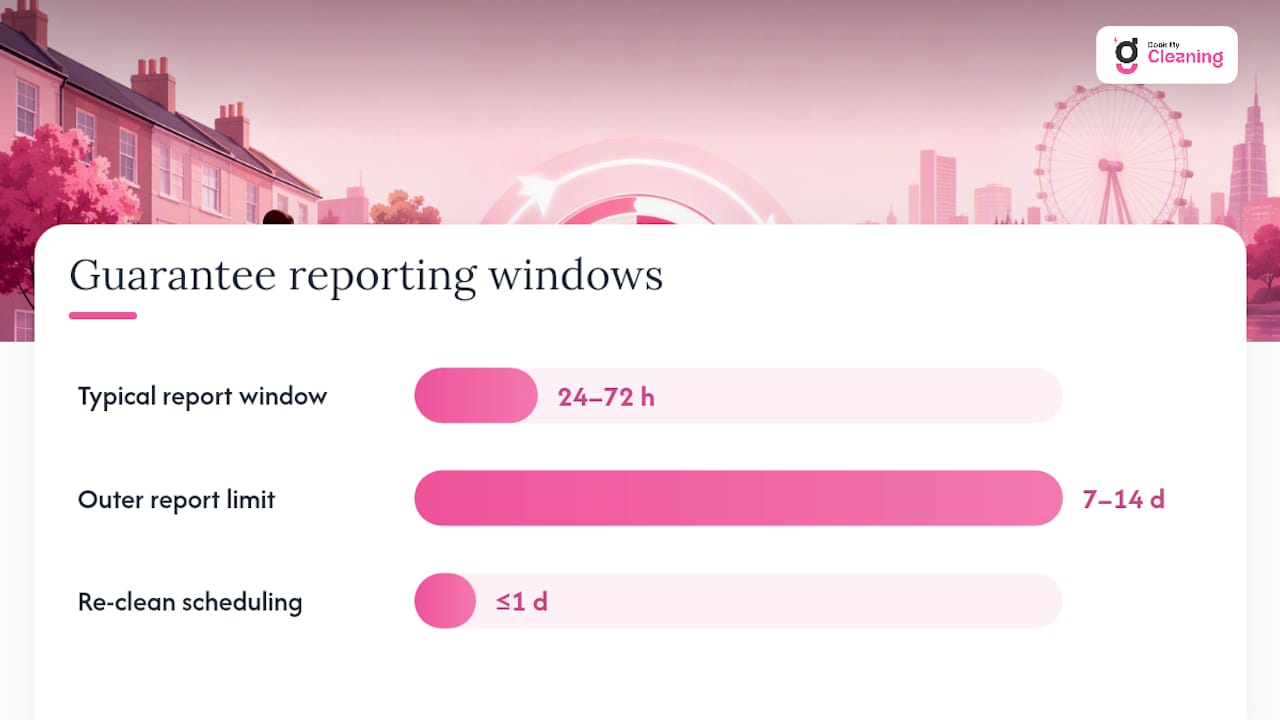
Reporting windows vary by provider, though most fall into recognisable bands:
- 24 to 72 hours from the inspection or checkout report, the most common window for triggering a re-clean.
- 7 to 14 days as an outer limit some providers allow for the tenant to notify them, particularly when the agent's own inspection report is delayed.
- Same-day or next-day scheduling for the actual re-clean visit once you've reported the issue, which matters if your final walk-through and key handover are only days apart.
Before you book anything, read the guarantee terms the way you'd read a phone contract, not a leaflet. Check the scope: does it cover carpets, ovens, and windows, or just general surfaces? Check for exclusions: pre-existing damage and heavy staining are almost universally carved out. Check whether there's a call-out or trip fee for the re-clean visit itself, which some providers quietly add even though the labour is "free". And check whether the guarantee requires photographic proof from you before they'll act, because if it does, you need those photos taken before you leave the property, not after.
What's actually covered, and what usually voids the guarantee
Most reputable providers publish a room-by-room checklist, and it's worth comparing that checklist against what your tenancy agreement expects before you book. A detailed end of tenancy cleaning checklist gives you something concrete to hold both your cleaner and your agent to.
Here's what a standard guarantee typically covers, room by room:
- Kitchen: inside the oven, inside the fridge and freezer, extractor hood, worktops, cupboard fronts and interiors, and the sink and taps descaled.
- Bathrooms: sanitising toilets, baths and showers, limescale removal from tiles and screens, and mirror and mould treatment where accessible.
- Living areas and bedrooms: floors vacuumed and mopped, skirting boards wiped, radiators dusted, and light fittings cleaned.
- Windows: interior glass and sills, though exterior glass is usually a separate paid add-on rather than part of the core guarantee.
- Fixtures: bins emptied and wiped, door handles and switches sanitised, and cobwebs removed from ceiling corners.
The exclusions matter just as much as the inclusions, and this is where most disputes actually happen. Guarantees almost never cover pre-existing damage, things that were already scuffed, stained or broken when you moved in. They exclude heavy staining that needs specialist restoration, such as burnt carpet fibres or set-in wine stains that require chemical treatment beyond a standard clean. They exclude structural issues like damp, mould caused by poor ventilation rather than neglect, or peeling paint. And they exclude rubbish removal beyond the booked scope, so if you leave furniture or bags of belongings behind, that's a separate charge, not a guarantee failure.
This is exactly why your move-in inventory report matters so much. It's the only document that proves what condition the property was in before you touched it, which means it's also the document that decides whether a mark on the carpet is a cleaning failure (covered) or pre-existing damage (not covered).
Pro Tip: Photograph every room against your move-in inventory on the day you collect your keys, not just when you move out. A "before" photo from day one is worth more in a dispute than any amount of arguing after the fact.

How guarantees interact with UK deposit law and fair wear and tear
A cleaning guarantee is a commercial promise you buy from a private company. It sits entirely outside the legal framework that governs your deposit, and understanding that distinction saves a lot of confused arguments with agents.
Under the Tenant Fees Act 2019, landlords cannot require tenants to pay for professional cleaning as a blanket contractual condition, and any deposit deduction has to be reasonable and backed by evidence. Deposits themselves must sit in a government-approved protection scheme, and deductions are only lawful for damage that goes beyond fair wear and tear, not for the ordinary decline that comes from someone living in a property for a year or two, under the Housing Act 2004.
So a cleaning guarantee doesn't create new legal rights, and it doesn't remove the landlord's right to claim for genuine damage. What it does is reduce your practical risk: if the agent flags something, you have a contractual route to get it fixed fast, rather than arguing from scratch with no leverage.
Evidence is what actually decides deposit disputes, not guarantee wording. Agents and landlords typically need to show:
- The original inventory report with dated photos from move-in.
- Comparable photos taken at checkout showing the disputed issue.
- Receipts or invoices for any professional cleaning or repair carried out afterwards.
A prompt, documented re-clean gives you exactly that third piece of evidence. It shows you took the complaint seriously and corrected it, which strengthens your position enormously if the dispute ever reaches formal adjudication.
What to do the moment your agent flags a cleaning issue
Speed and paper trail win these disputes. Here's the sequence that actually protects your deposit when an inspection goes wrong.
- Get specifics from the agent immediately. A vague "the flat wasn't clean" note is useless to you; ask exactly which rooms and which items failed, ideally in writing or email.
- Take time-stamped photos on your phone of the disputed areas, and pull up your move-in inventory alongside them to check whether the issue was already there.
- Notify your cleaning provider within the guarantee window. Most re-clean guarantees require you to report within 24 to 72 hours of being told about the problem, so don't sit on it over a weekend.
- Arrange the re-clean promptly and confirm who needs access, the agent, the landlord, or you directly, since a missed access appointment can eat into your reporting window.
- Keep every email, message and receipt. Contemporaneous evidence, photos, inventories and written communication, is exactly what a deposit-scheme adjudicator relies on most heavily if the case escalates.
If the re-clean still doesn't satisfy the agent, ask for a written reason stating precisely what remains unsatisfactory. Vague dissatisfaction doesn't hold up in adjudication; specific, itemised complaints do. At that point you can raise the matter with your tenancy deposit scheme's adjudication service, and your file of photos, inventory comparisons and re-clean receipts becomes the backbone of your case.
Pro Tip: Never let an agent's verbal complaint stand alone. Ask them to email you the specific issues before you book a re-clean; it protects you if they later claim the re-clean "still wasn't good enough" without saying why.
Book My Cleaning's guarantee, and what tenants should check it against
Book My Cleaning publishes a 72-hour re-clean guarantee on its end of tenancy service, alongside fixed pricing shown before you book and no hidden fees added afterwards. Cleaners are vetted and DBS-checked, arrive in uniform, and the company reports a 4.9-star rating from over 2,300 cleaned homes.
Here's why those specific terms matter against what agents actually expect at inspection:
- A 72-hour response window matches the upper end of what most letting agents consider a reasonable timeframe to fix a flagged issue before a check-out deadline passes.
- Transparent fixed pricing means there's no ambiguity about what's included, which avoids the "that wasn't in scope" argument that derails so many disputes.
- DBS-checked, vetted cleaners address the access and trust concern agents raise when a re-clean requires letting someone back into a property that's technically already handed over.
- Online booking creates a timestamped record of when the service was booked, which itself becomes useful evidence if a dispute drags into adjudication.
Picture two realistic scenarios. In the first, an agent's checkout inspection flags a greasy oven and limescale in the bathroom two days before final key handover. The tenant reports it the same afternoon, the re-clean happens the next morning, and the agent signs off before the handover deadline, deposit released in full. In the second, the agent claims a carpet stain that turns out to be documented in the move-in inventory photos. The tenant points to the inventory, the claim is dropped, and no re-clean is even needed, the paper trail did the work.
What a guarantee actually costs, and why it's rarely the deciding factor
A genuine re-clean guarantee is almost always built into the price of the end of tenancy cleaning service itself rather than sold as a separate add-on. Some providers' end of tenancy cleaning runs within a certain price range depending on property size and scope, with a re-clean guarantee sometimes included in that fixed price, not as an extra line item.
That matters because some providers in this market do charge separately for guarantee cover, effectively selling you insurance against their own poor performance. Treat that as a warning sign rather than a value-add. A provider confident in its own standards builds the guarantee into the base price because they don't expect to need it often.
Where costs do genuinely rise is scope creep beyond the standard checklist. Carpet cleaning, for instance, is priced separately at £32 per room, and heavy limescale treatment or paint splash removal are typically quoted as add-ons rather than folded into a standard clean. If your property has heavier wear than average, factor those extras into your booking upfront rather than discovering them as surprise charges after an inspection flags them.
The other cost to weigh is opportunity cost, not cash. A cheap clean with no meaningful guarantee might save you £20 or £30 at booking, but if it fails inspection and you're scrambling for a re-clean with days left before handover, that saving evaporates fast against the stress of a delayed deposit return.
What happens if a re-clean guarantee claim gets denied
Disputes escalate in a fairly predictable order, and knowing the sequence in advance stops you from panicking when a provider pushes back.
Start by asking the provider for their written reasoning for the denial. A legitimate refusal will point to something specific: the issue falls outside the checklist scope, it matches pre-existing damage on your inventory, or you reported it outside the guarantee window. If that reasoning holds up against your own photos and inventory, the claim was probably fair.
If it doesn't hold up, and you believe the provider is wrong, your evidence file becomes the argument. Contemporaneous photos, the original inventory, your booking confirmation, and every email exchange with both the agent and the cleaning provider form the case you'd present to a tenancy deposit scheme adjudicator if the underlying dispute is actually about your deposit rather than the cleaning company's service. Adjudicators lean heavily on dated evidence over verbal claims from either side.
Separately, if you feel the cleaning company itself has broken its own published guarantee terms, most reputable providers have an internal escalation route, a manager review, before you'd need to consider a formal complaint through consumer protection channels or a small claims process. Keep that route as a last resort; the vast majority of guarantee disputes resolve at the re-clean stage precisely because providers would rather send someone back than lose a review.
Why a clear, written re-clean window matters more than marketing language
The biggest mistake tenants make is trusting the phrase "guarantee" without checking what it actually promises in writing. A guarantee that says "customer satisfaction guaranteed" tells you nothing enforceable. A guarantee that says "free re-clean within 72 hours if any checklist item is missed, reported with photos" tells you exactly what happens and when.
Before booking any end of tenancy clean, ask three questions. What's the exact scope, room by room, so you know what's covered before an agent flags anything? What's the reporting window, and does it start from your report or from the agent's inspection date? And what evidence do they require, photos, the inventory, a written description, before they'll act?
Letting agents respond well to paper trails and badly to vague promises. A provider with a published, specific guarantee gives you leverage in exactly the moment you need it, at the inspection, with days ticking down before handover. Prioritise the written terms over the slogan on the homepage every time.
— Book
Book online in minutes and get the re-clean guarantee built in
Booking an end of tenancy clean with Book My Cleaning takes under a minute online, with fixed pricing shown before you commit and no card required to reserve a slot. The end of tenancy cleaning service runs from £109 to £339 depending on property size, includes the published 72-hour re-clean guarantee as standard, and is carried out by vetted, DBS-checked cleaners who turn up in uniform.
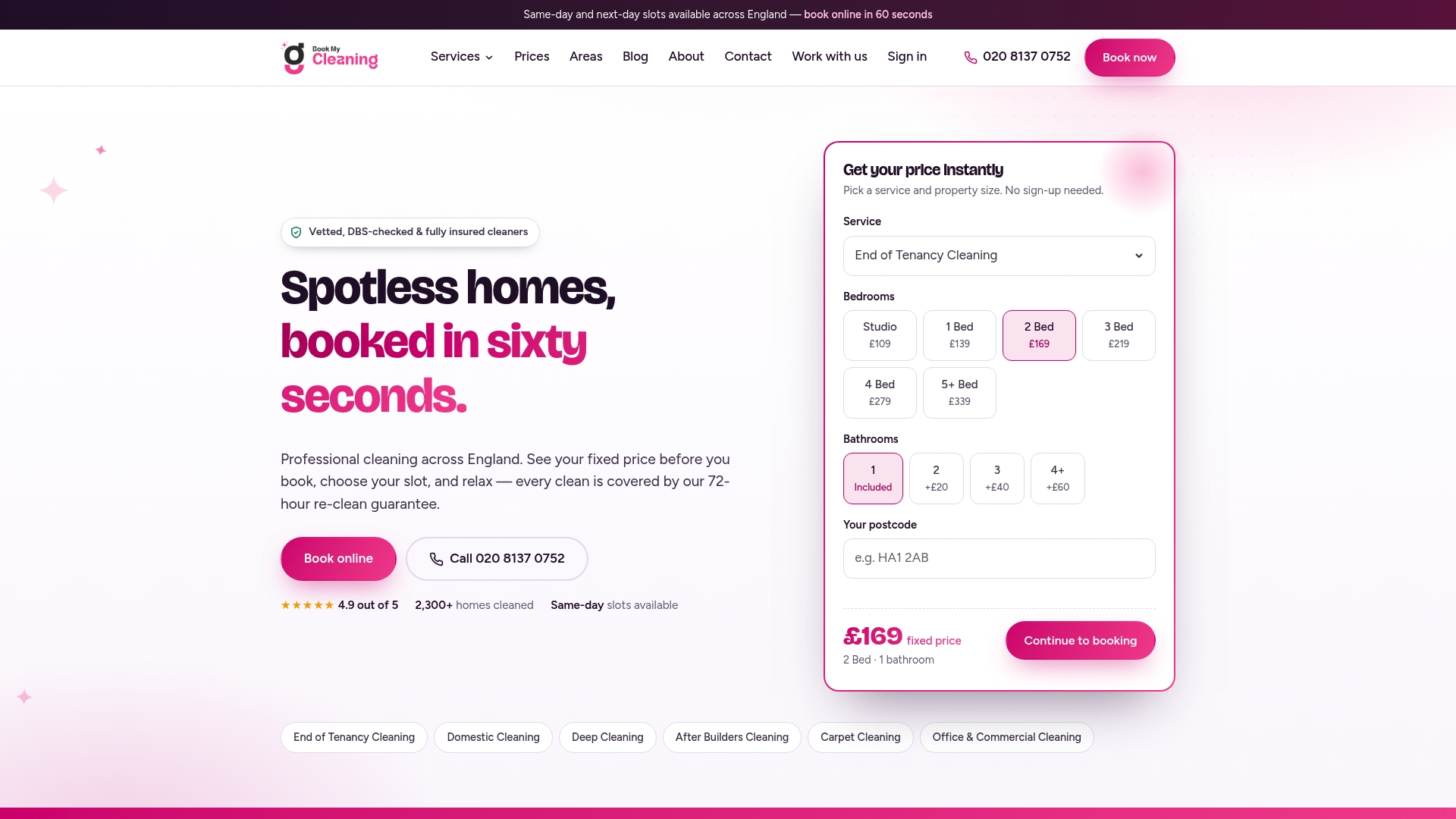
At checkout, select "End of Tenancy" as your service type rather than a standard domestic clean, since that's what triggers the checklist and guarantee terms built for inspection standards rather than routine upkeep. Same-day slots are often available if your handover date is tight, and the full breakdown of fixed prices for every room and add-on, from oven cleans to carpet treatment, sits on the pricing page so there are no surprises after the clean is done. If your checkout inspection is looming, book the slot now and keep the confirmation email as your first piece of evidence.
Where to check the legal detail yourself
The claims in this article about deposit deductions and cleaning clauses come from primary government sources, and it's worth reading them directly rather than taking any provider's word for it. The Tenant Fees Act 2019 guidance covers what landlords can and cannot charge tenants for. The Housing Act 2004 provisions on tenancy deposit protection set out the legal framework for deposit schemes and deductions. For disputes that reach adjudication, the Tenant Fees Act collection on gov.uk links through to the individual deposit protection schemes and their claims processes.
Sources
- Tenant Fees Act 2019: guidance for landlords, agents, tenants and payments
- Housing Act 2004 — Tenancy deposit protection and related provisions
FAQ
Is professional end of tenancy cleaning legally required in the UK?
No. Landlords cannot legally require tenants to pay for a professional clean as a blanket contractual condition, under the Tenant Fees Act 2019. Tenants must still return the property in a reasonably clean state comparable to the move-in inventory, but there's no law forcing you to use a professional service specifically.
Can a landlord charge a cleaning fee at the end of a tenancy?
A landlord can only deduct from your deposit for cleaning if the property is left in a worse condition than the move-in inventory recorded, beyond fair wear and tear, and they must evidence that with photos or receipts under the Housing Act 2004. A flat fee charged automatically regardless of actual condition is not lawful.
Do landlords have to clean between tenants?
There's no specific legal duty forcing landlords to professionally clean between tenancies, but the property must meet basic habitability standards for the incoming tenant. Most landlords do arrange a clean between tenancies partly to reset the inventory baseline for the next check-in.
How long do I have to report a cleaning problem to claim a re-clean guarantee?
This varies by provider, but most re-clean guarantees require reporting within 24 to 72 hours of the issue being flagged, with Book My Cleaning offering a 72-hour window. Reporting late, even by a day, can void the guarantee, so notify the provider as soon as your agent raises a concern.
What does Book My Cleaning's end of tenancy service cost?
Book My Cleaning's end of tenancy cleaning is priced from £109 to £339 depending on property size, with the 72-hour re-clean guarantee included in that fixed price rather than charged separately.