
Fragrance-free cleaning means a home is cleaned without any perfume or masking scent added to the products. The best way to get it is to read the label for "parfum", choose products that say "fragrance-free" rather than just "unscented", and tell whoever cleans for you exactly what you want, in writing, before the visit. This guide covers all three, plus the mistakes that undo a fragrance-free clean.
TL;DR
- "Fragrance-free" and "unscented" are not the same thing. Unscented products can still contain chemicals that mask smells.
- In the UK, detergent labels must list perfumes if they are added, so check for the word "parfum" on the pack.
- "Fragrance-free" does not automatically mean non-toxic, hypoallergenic or eco-friendly.
- Never mix vinegar with bleach or hydrogen peroxide, and ventilate whatever you use.
- If you are a tenant, a fragrance-free clean still has to match the check-in standard, so keep your evidence.
Table of Contents
- Fragrance-free or unscented: the difference that matters
- How to read a UK label
- Fragrance-free is not the same as non-toxic or eco-friendly
- Cleaning effectively without fragrance
- Room-by-room: where fragrance hides
- If you pay a cleaner: how to brief them
- Perspective: why a clear brief beats a clever product
- Tenants: fragrance-free and the deposit
- What professional cleaning costs
- Book a clean with a clear brief
- Common mistakes to avoid
- FAQ
- Sources
Fragrance-free or unscented: the difference that matters
The two labels sound identical, but they are not. The US Environmental Protection Agency's Safer Choice scheme explains that fragrance-free means no fragrance materials or masking scents are used, while unscented generally means chemicals may be used to neutralise or mask other ingredients' odours. That is a US scheme, but the logic applies to any shelf in the UK.
Medical experts take the same line. Because "unscented" is not a strictly defined term, a product carrying it may still contain fragrance chemicals used for masking, and fragrance-free products are considered the safer choice for people prone to sensitivities.
So if you are searching for unscented cleaning products because someone in your home reacts to perfume, treat "unscented" as a starting point and look for "fragrance-free" or "no perfume" wording, then confirm on the ingredients list.

Why people ask for it
The usual reasons are practical rather than fashionable:
- Someone in the household has eczema or reactive skin.
- A member of the family gets headaches or a tight chest around strong smells.
- A new baby or a pet is in the home (our guide on keeping pets safe while you clean covers the pet side).
- Colleagues in a shared office have complained about air fresheners and scented sprays.
- You simply prefer a home that smells of nothing, rather than of "fresh linen".
For eczema specifically, NHS guidance for hand eczema advises very mild fragrance-free soap and fragrance-free hand cream, and avoiding perfumed moisturisers. Great Ormond Street Hospital adds that looking after the skin barrier matters, and that avoiding perfumed products and harsh environmental factors such as hard water and central heating is part of managing it. If you or your child has a diagnosed skin condition, ask your GP or dermatology nurse which products suit you. This article is not a substitute for that advice.
How to read a UK label
UK law helps you here. Under the detergents regulation as it applies in Great Britain, perfumes must be listed on the label if they are added, whatever the concentration, and allergenic fragrance substances must be named above 0.01% by weight. The pack must also give a website address where the full ingredient list can be read.
A quick checklist at the shelf:
- Look for "parfum". If it appears, the product is perfumed. The word used for a perfume is "parfum", as labelling guidance for the GB market sets out.
- Scan for named allergens. Substances such as limonene or linalool, where listed, are fragrance allergens.
- Ignore the front of the pack. "Fresh", "gentle" and "natural" are marketing words. The ingredients list is the evidence.
- Use the website on the pack. If the on-pack list is thin, the full list is online.
- Check every product, not just the main spray. Washing-up liquid, hand soap, dishwasher tablets, toilet cleaner and laundry detergent all carry fragrance.
The gap to watch is the one between a product that is fragrance-free and one that merely smells faint. A pleasant, mild odour on the label's first impression is a reason to read the ingredients again, not a reason to relax.
Fragrance-free is not the same as non-toxic or eco-friendly
This is the mistake most buyers make. Removing perfume solves one problem. It says nothing about the rest of the formulation.
The EWG Verified criteria for cleaning products for 2026 make the distinction clear: fragrance-free certification requires no fragrance or scent-imparting materials, while separate criteria cover issues such as pH and environmental release. In other words, a product can be fragrance-free and still be strongly alkaline or acidic.
UK industry guidance is equally cautious about big claims. The Cleaning and Hygiene Suppliers Association says "non-toxic" can mislead without qualification, because toxicity depends on concentration, volume and method of use, and "natural" does not automatically mean safer. It also notes that "eco-friendly" may describe only the product, not its packaging, manufacture or use.
There is a related finding on indoor air. A University of York study, reported in 2024, looked at 10 regular and 13 green cleaners and found that green cleaners generally emitted more monoterpenes, which can raise secondary pollutants such as formaldehyde after use. Monoterpenes are scent compounds, which is a good argument for choosing products with no added fragrance at all rather than "natural" fragrance such as citrus or pine.
| Label wording | What it tells you | What it does not tell you |
|---|---|---|
| Fragrance-free | No fragrance or masking scent added | Whether it is mild, non-toxic or eco-friendly |
| Unscented | The product has little or no smell | Whether masking chemicals were used |
| Natural | Marketing language, not a standard | That it is safer or gentler |
| Eco-friendly | A claim about some aspect of the product | Packaging, manufacture or use impact |
| Hypoallergenic | A claim about lower allergy risk | That you will not react to it |
Cleaning effectively without fragrance
Perfume does no cleaning. A fragrance-free clean works the same way any good clean does: the right product, the right contact time and the right cloth.
Build a short, plain kit
You do not need a cupboard of sprays. A small set covers most of a home:
- A fragrance-free washing-up liquid or mild detergent for general surfaces.
- A fragrance-free multi-surface spray for worktops and bathrooms.
- Microfibre cloths, which lift dirt with water alone on many surfaces.
- A descaler or limescale product only where you have hard water deposits.
- Fragrance-free laundry detergent, and no fabric conditioner unless it is fragrance-free too.
The Health and Safety Executive's general principle for chemicals at work is to eliminate a harmful product or use a safer one first, before relying on other controls. At home the same thinking applies: fewer products, used properly, beats a full shelf.
Do not mix products
A fragrance-free home is not a risk-free one if the products are combined. The rule is simple: one product at a time, rinse between them.
The pairing people ask about most is vinegar. The American Cleaning Institute's Brian Sansoni, quoted by Reader's Digest, says mixing products can irritate airways and burn skin, eyes, throat and lungs. The same article lists three things never to combine with vinegar:
- Hydrogen peroxide, which forms peracetic acid, a corrosive irritant.
- Bleach, which gives off harmful fumes.
- Other cleaners, where the reaction is unpredictable.
If you have used one product, rinse the surface with water before applying another. Open a window while you work.
Ventilate and store sensibly
Fragrance-free products still release vapours, and storage matters. Trade guidance based on HSE advice recommends well-ventilated storage areas with a through draught. At home that means a cupboard with the doors able to breathe, lids tightly closed, and nothing stored in a damp, hot spot. Keep every product in its original container so the label stays with it.

Skip the air fresheners
Plug-ins, scented candles and room sprays reintroduce exactly what you removed. If a room smells stale after cleaning, open a window, wash the fabric that holds the smell, and clean the source: the bin, the fridge, the drain or the mattress. Deep cleaning of soft furnishings does more for odour than a spray ever will.
Room-by-room: where fragrance hides
Kitchen. Washing-up liquid and dishwasher tablets are the biggest sources. Wipe worktops with a fragrance-free spray, then a damp cloth. Inside the oven and fridge, a baking soda paste and warm water cover most marks without perfume. For a busy workplace kitchen, our six-step daily office kitchen routine shows how to give each task an owner.
Bathroom. Toilet cleaners and limescale sprays are heavily scented. Choose a fragrance-free descaler, apply it, give it the contact time on the label, then rinse well. Do not mix it with bleach.
Bedrooms. Laundry is the main culprit. Wash bedding in fragrance-free detergent and skip scented conditioner and "linen sprays". A mattress deep clean removes dust and stains without adding scent.
Floors and carpets. Carpet shampoos and deodorising powders are often perfumed. If you have a household member with a sensitivity, ask exactly what is being used before anyone starts.
After building work. Fine dust is the real issue, not fragrance. Our guide to builders' dust and your health explains safe clean-up, and it is worth keeping the scented products out of the picture while the air settles.
If you pay a cleaner: how to brief them
A fragrance-free request fails most often because it was never made clearly. A cleaner arriving with their usual products will use them unless told otherwise.
Before the first visit:
- Say what you need and why. "Fragrance-free only, a child has eczema" is clearer than "nothing too strong".
- Name the products. Either ask what will be used and check the label, or leave your own fragrance-free products out and say so.
- Put it in writing. An email or a note on the booking means the instruction travels with the job and does not rely on one conversation.
- Keep the area ready. Clear floors and put valuables away so the cleaner can focus on the work; our guide on preparing for cleaners in UK homes has a simple list.
- Check afterwards. Walk through while the cleaner is still there if you can, and mention anything that smells perfumed.
For offices, the same discipline applies at contract level: write the product requirement into the specification. Our piece on turning ecolabels into tender rules shows how to do that.
Perspective: why a clear brief beats a clever product
We clean thousands of homes, and the same thing keeps coming up: the customers who are happiest are the ones who knew exactly what they were getting before we arrived.
Fragrance-free is a good example. It is not a product choice so much as a specification. You want a particular result, with particular limits, and you want it written down. That is why we publish fixed prices online, send cleaners in uniform who are vetted and DBS-checked, and work from written checklists rather than guesswork.
If a visit does not meet the standard, our 72-hour re-clean guarantee is there to put it right. We would rather you told us about a sensitivity at booking, in writing, than discovered a problem afterwards. A clear brief protects you, and it lets the cleaner do the job properly the first time.
Book
Tenants: fragrance-free and the deposit
If you are leaving a rental, avoiding scented products does not lower the standard you must meet. The Tenancy Deposit Scheme says cleaning disputes turn on evidence that the property was less clean at the end of the tenancy than at the start. A comprehensive check-out report clearly linked to the check-in report is the strongest evidence, and detailed invoices or quotes can also help.
That gives you a simple plan:
- Keep your check-in report and photos from the start of the tenancy.
- Clean to that standard, with fragrance-free products if you prefer them. Smell is rarely what a dispute is about. Grease, limescale, marks and dust are.
- Keep the invoice or booking confirmation if a professional does the clean.
Our professional cleaning checklist for tenants sets out what is standard and what counts as extra, and the move-in cleaning checklist is useful at the other end of a tenancy, when you arrive and want the new place clean on your terms.
What professional cleaning costs
Fixed prices make it easier to plan. These are the prices published on our prices page:
| Service | Price |
|---|---|
| Domestic cleaning | £17.50 to £20.95 per hour |
| Deep cleaning | £119 to £329, one-off |
| End of tenancy cleaning | £109 to £339, one-off |
| After builders cleaning | £159 to £419, one-off |
| Carpet cleaning | From £32 per room |
| Mattress deep clean | £30 per mattress |
| Upholstery or sofa cleaning | £25 per item |
| Inside oven | £25 |
| Inside fridge or freezer | £15 |
Office and commercial cleaning has no published price, because it depends on the site. The final price for each home service depends on the property size and the add-ons you choose.
Book a clean with a clear brief
If you want a home cleaned to a defined standard, we offer fixed-price booking online, with all products and equipment provided, written checklists and same-day slots in many cases. You see the price before you book, and you do not need a card or deposit to reserve.
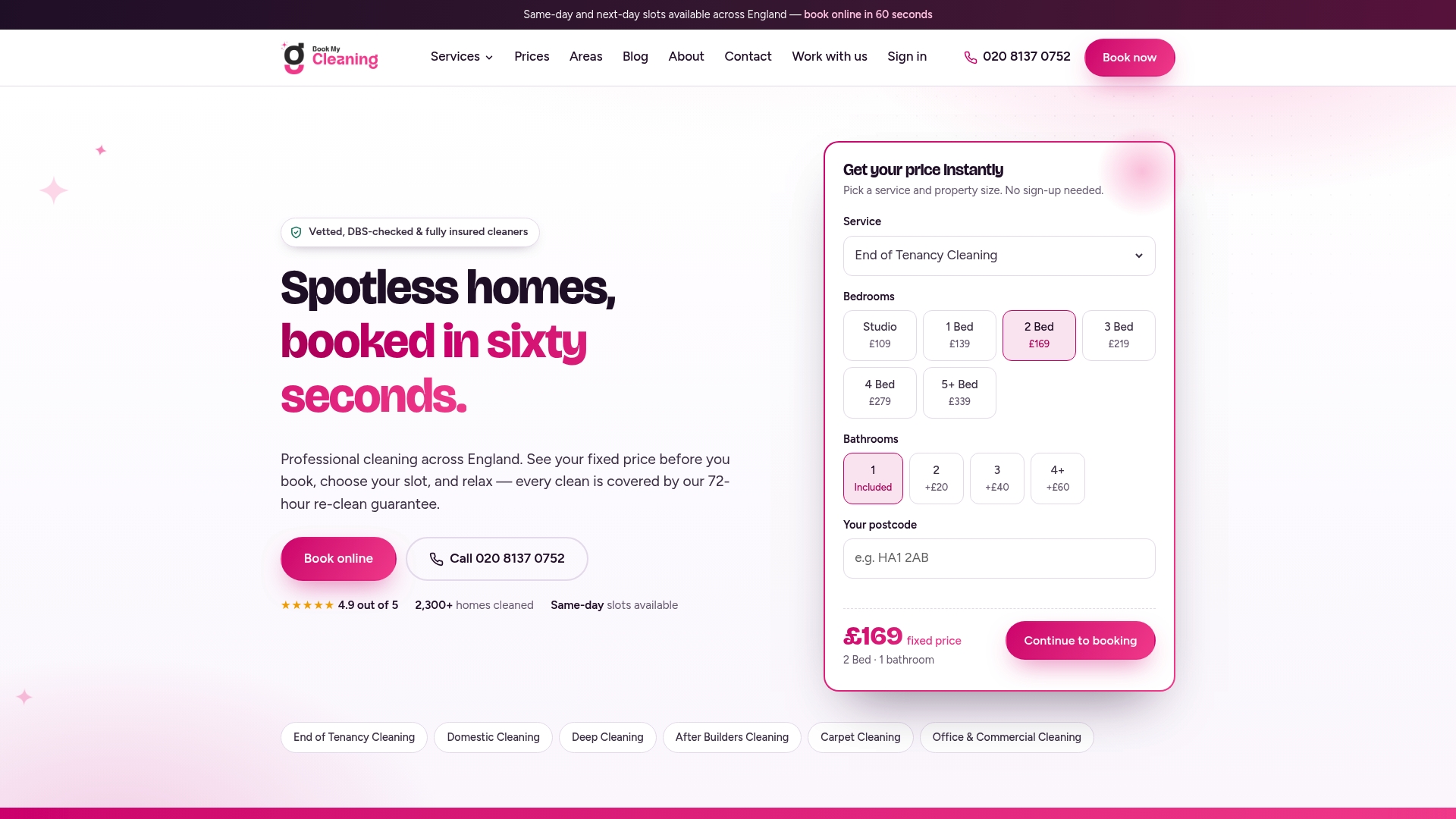
For a regular cleaner, see our domestic cleaning in Stanmore, from £17.50 an hour. Leaving a rental, look at end of tenancy cleaning in Edgware, from £109. For carpets and rugs, there is carpet cleaning in Kingsbury, from £32 a room. Put any sensitivity in your booking notes and confirm the arrangement with the team before the visit. You can also start from our main booking page.
Common mistakes to avoid
- Trusting "unscented" alone. Check the ingredients for "parfum".
- Assuming natural means safe. Naturally occurring substances can be harmful, and scent compounds from natural sources still count as fragrance.
- Forgetting the small products. Hand soap, dish tablets and fabric conditioner are often the ones left perfumed.
- Mixing products to boost them. Vinegar with bleach or hydrogen peroxide is the classic error.
- Re-scenting afterwards. A plug-in undoes the work.
- Not saying anything. If you do not tell the cleaner, you will get their usual products.
FAQ
Are unscented and fragrance-free cleaning products the same?
No. Fragrance-free means no fragrance or masking scent is added. Unscented can mean chemicals were used to neutralise or hide odours, so the product may still contain fragrance materials. For anyone with sensitivities, fragrance-free is the safer label, and the ingredients list should confirm it.
How do I know if a UK cleaning product contains fragrance?
Look for "parfum" on the label. UK detergent rules require perfumes to be listed when added, and allergenic fragrance substances to be named above 0.01% by weight. The pack also gives a web address for the full ingredient list.
Are fragrance-free cleaners automatically safe or eco-friendly?
No. Fragrance-free describes only the scent. A product can still be strongly acidic or alkaline, and "eco-friendly" or "non-toxic" claims need separate evidence. Use any product as the label directs, ventilate the room and never combine different cleaners.
What should I never mix with white vinegar?
Never mix it with bleach or hydrogen peroxide. Bleach gives off harmful fumes, and vinegar with hydrogen peroxide forms peracetic acid, which is corrosive. Use one product at a time, rinse the surface with water between them and keep a window open.
Will fragrance-free cleaning pass an end-of-tenancy check?
Yes, if the property is as clean as it was at check-in. Disputes turn on evidence comparing the start and end of the tenancy, not on what products were used. Keep your check-in report, photos and any cleaning invoice.
Sources
- Safer Choice Fact Sheet: Fragrance-Free (US EPA)
- Unscented vs. Fragrance-Free: They're Not the Same Thing (Wirecutter)
- Detergents Regulation, Annex VII (legislation.gov.uk)
- Detergent product label for the GB market (Chemleg Europe)
- Protection for hand eczema (Oxford University Hospitals NHS)
- Eczema (Great Ormond Street Hospital)
- EWG Verified: Cleaning Products Criteria 2026
- Green doesn't always mean clean (University of York)
- Guidance for Buyers of Cleaning Chemicals (CHSA)
- Hazardous substances at work: a brief guide to COSHH (HSE)
- Buyers' guide to cleaning products (Gompels)
- The 3 Things You Should Never Mix with Vinegar (Reader's Digest)
- How TDS approaches disputes involving cleaning