
The safest way to give a cleaner access is the one you can control and undo: a key safe or time-limited code that you can re-set after each job, agreed in writing before the first visit, with a vetted, uniformed cleaner from a company that is accountable if something goes wrong. Which method suits you depends on whether you are out at work, handing a property back at the end of a tenancy or running an office. This guide covers each option, how to set it up properly, and what to agree so nobody is left standing at a locked door.
TL;DR
- Choose the method by how often the cleaner comes: be home for a one-off, use a re-codable key safe or temporary digital code for regular visits, and avoid leaving loose spare keys under mats or pots.
- A key safe only protects you if it is fixed properly to a solid surface and uses a long, unique code that you change after each tenancy, job or change of cleaner.
- Agree entry details, alarm codes, pets and locking up in writing before the first clean, and check your home contents policy for how it treats theft where no forced entry is visible.
- Book a company that vets its cleaners: ours are DBS-checked, arrive in uniform and come with a 72-hour re-clean guarantee.
- Tenants and landlords handing over a property can combine access with a key pick-up from the agency, so the clean happens before the inspection.
Table of Contents
- Four ways to give a cleaner access
- Being at home for the first clean
- Using a key safe properly
- Smart locks and alarm codes
- Handing over a spare key
- What to check on your insurance first
- What to agree before the first clean
- If you are a tenant handing back a property
- If you are a landlord or letting agent
- If you manage an office
- What to do if the cleaner cannot get in
- How to tell a cleaner you can trust with access
- Booking a clean with access sorted
- FAQ
- Sources
Four ways to give a cleaner access
Cleaning marketplaces and households tend to settle on a small set of approaches. One UK article from March 2026 groups them into physical key exchange (in person or via a lockbox), smart locks with temporary codes that expire after the session, and third-party key custodians. Add the simplest option, being at home, and you have the four choices most people actually weigh up.
| Method | Best for | Main strength | Main watch-out |
|---|---|---|---|
| You let the cleaner in | One-off cleans, first visits, deep cleans | No key leaves your hands | You must be there at the start |
| Key safe with a code | Regular cleans while you are at work | Re-codable, no key changes hands | Needs correct fitting and a strong code |
| Smart lock or alarm code | Homes with existing smart locks or alarms | Time-limited, can show when it was used | Needs set-up and a reliable app or panel |
| Handing over a spare key | Long-standing arrangements | Simple | Anonymous, copyable, never expires |
None of these is wrong. The point is to choose one you can switch off. A physical key is anonymous and does not expire: one security firm's argument is that the issue is not the cleaner's honesty but that you cannot tell how many copies exist or take access back without changing the cylinder. That is a fair way to think about any method: ask how you would end the access tomorrow.
Being at home for the first clean
For a first visit, we would always suggest being there, or having a trusted person there, for the first ten minutes. You can show the cleaner where the supplies cupboard is not needed (our cleaners bring all products and equipment), but you can point out the rooms you want prioritised, which surfaces are delicate, and where the meter, boiler and shutoff valves are in case of a leak.
It also lets you see the cleaner arrive. Ours come in uniform and are DBS-checked, which means they have been through a criminal record check for this kind of work. Seeing a uniformed person at your door, who matches the booking, is a simple first test of any cleaning company.
For deep cleans after renovation, being present at the start is especially useful. Builders often leave tools, dust sheets and half-used materials. A short walk-through lets you say what stays and what goes before the clean begins. Our guide on preparing for cleaners in UK homes covers clearing floors and putting valuables away.
Using a key safe properly
For regular cleans while you are at work, a key safe is the most common answer. It is a small lockable box, opened by a combination, that holds your key. Done properly it means the key never changes hands. Done badly it is a convenient box for a burglar.
The UK police-backed Secured by Design scheme says a key safe is only secure if it stays fixed to the wall. Its advice includes:
- Choose a product that has passed independent attack testing and carries Loss Prevention Standard (LPS) and Secured by Design accreditation.
- Use fixings of at least 60mm.
- Avoid fixing the box to your front door, a wooden fence, plastic cladding or plasterboard.
- Fit it where it is convenient rather than hidden, because a hidden safe is also out of sight if someone tries to tamper with it.
On the code, the manufacturer guidance for one widely used model, the Supra C500, shows how the better designs work: a 5 to 7 digit combination, no pre-set or master override code, space for up to six keys, and a code you can change whenever you like, for example when a new carer starts. That last point is the habit to copy. Change the code when a cleaner changes, when a tenancy ends, or if you suspect the code has been seen.
A few practical rules:
- Do not use your birth year, house number or 1234.
- Do not send the code in the same message as your address. Give it by phone or in a separate message.
- Keep one key in the safe, not the full set.
- Put the new code in a note only you can see, not in the booking comments that other people may read.
- Re-code it after the first clean, then again whenever the household changes.
Smart locks and alarm codes
If you already have a smart lock or an app-controlled alarm, you can give a cleaner a code that only works at set times. One UK alarm guide notes that on some systems different users can have different permissions, so a cleaner's code can be limited to specific days and hours, and the event log shows when it was used.
The benefit is that access ends by itself. You do not need to chase a key or change a lock. The cost is set-up: a dead battery, a poor connection or a mistyped code is the usual reason a cleaner cannot get in. Test the code yourself from outside the door before the first visit, and make sure the cleaner has your phone number in case it fails.
If you have an alarm, say so when you book. Agree who disarms it, how long the cleaner has before it sounds, and what happens at the end of the visit. Do not email the alarm code in plain text along with your address.
Handing over a spare key
Sometimes a spare key is the easiest route, particularly in a home without a suitable wall for a key safe, such as a flat in a communal building. If you do this:
- Hand it over in person or through a secure arrangement, not by leaving it under a mat or in a plant pot.
- Label it with only the cleaner's first name and the initial of your surname, rather than your address. One UK guide on trusting a cleaner with keys suggests exactly this, along with keeping a simple record of who holds access.
- Keep a note of who holds a key and when it was given.
- Ask for it back when the arrangement ends, and if you have any doubt about copies, change the cylinder.
A chain on the door, or a second key left on the inside, is an old trick that lets you keep one door fully private. The better answer in most homes is a lockable room for valuables, which we cover below.
What to check on your insurance first
This is the step most people skip. One security company's guidance says many home contents policies cover burglary only where there are signs of forced entry. Entry with a genuine key leaves none, so a claim for theft involving a key can face exclusions, higher excesses or reduced cover. Policies differ, so read your own wording or ask your insurer how it treats a key held by a cleaner or contractor.
This is also why it matters who you hire. We have written a separate guide on what UK customers should check about cleaner insurance, and a wider checklist of eleven questions to ask before hiring a cleaner.
What to agree before the first clean
Most lockouts and misunderstandings come from details nobody wrote down. Settle these in the booking or in a short message before the day:
- How the cleaner gets in: key safe, code, you at home, or a neighbour or agent. Give the exact door (front, side or back).
- Alarm: who disarms it, the time window, and what to do if it sounds.
- Pets: the number, the temperament, where they will be shut during the clean, and whether the cleaner may let them into the garden.
- Parking and building access: visitor permits, concierge desks, entry-phone numbers, lift booking or loading restrictions in a block of flats.
- Areas to avoid: a home office, a locked room, a child's room.
- Valuables and paperwork: put cash, jewellery, passports and documents away. This protects you and the cleaner.
- Locking up: whether the cleaner puts the key back in the safe, posts it through the door, or hands it to a named person.
- Contact: your mobile number and a second contact for the day.
If you want the cleaner to focus on particular tasks, a written checklist helps. Ours come with written checklists, and our guide to what is standard and what is extra for tenants shows what to expect.
If you are a tenant handing back a property
Access is a different problem when you are moving out. You may be at a new address, the keys may sit with the letting agent, and the clean must be finished before the check-out inspection.
There are two sensible patterns:
- You are present. Book the clean for after you have emptied the property. Be there to let the cleaner in, then lock up and hand the keys over.
- The keys are with the agent. Our key pick-up from the agency costs £15 one-off, so the keys can be collected without you travelling back. Check with your agent in advance that they will release keys to someone else, and give the cleaner's name.
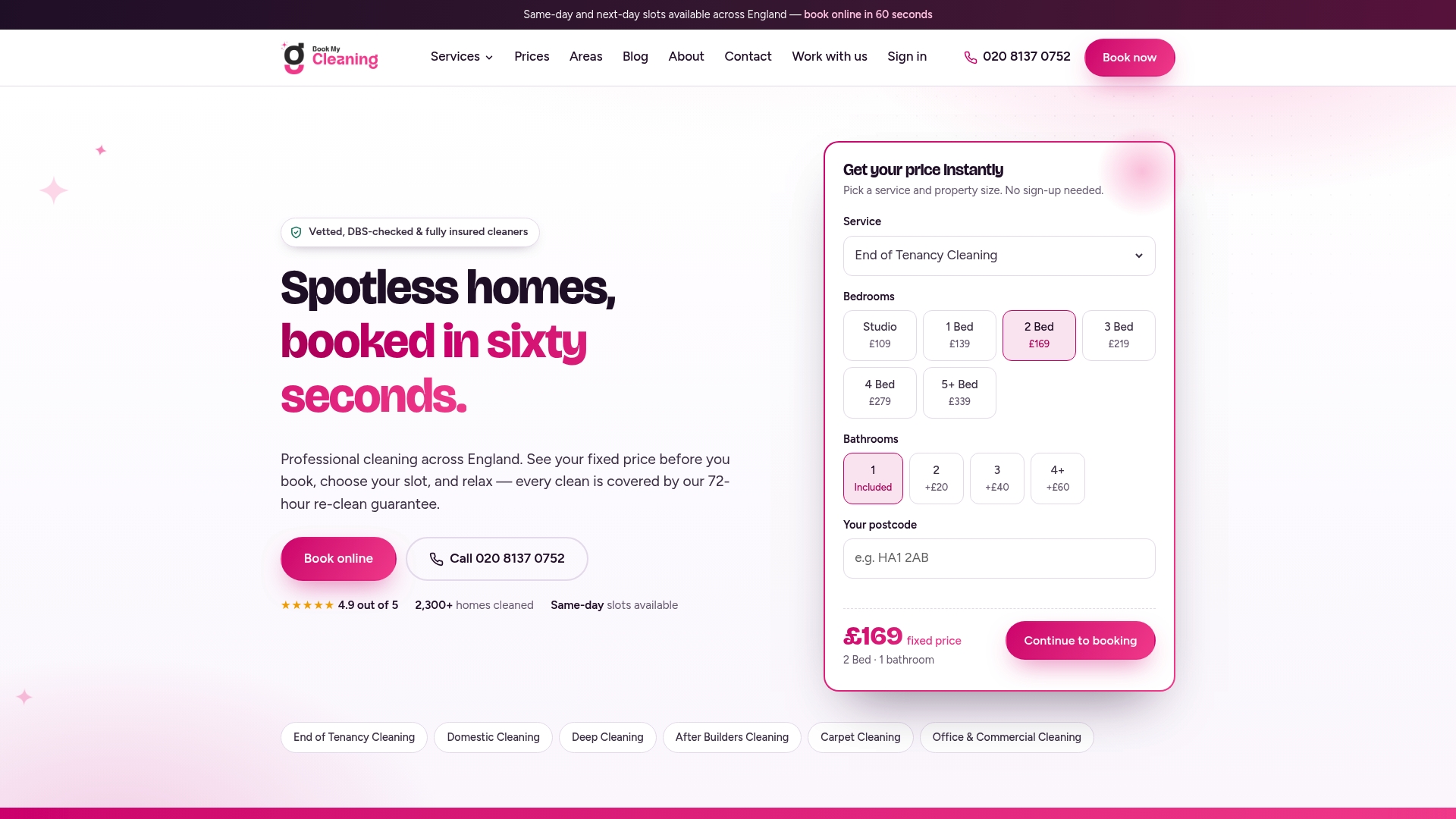
End of tenancy cleans are priced from £109 up to £339 one-off depending on the property, and the price is shown online before you book. Booking takes under a minute and needs no card or deposit. If the standard is not met, our 72-hour re-clean guarantee applies, which is a useful safeguard when the deposit is at stake. The timing matters too: leave a gap between the clean finishing and the check-out so there is time to fix anything.
The key rule for tenants: do not hand a cleaner a key that you still need, and do not leave the property unlocked after the clean. Keep a record of the time the cleaner arrived and left.
If you are a landlord or letting agent
If the property is let, you cannot simply send a cleaner in when you like. In England, a landlord generally needs to give a tenant at least 24 hours' written notice before entering, except in an emergency, as summarised in a landlord guide dated October 2026. Arrange cleaning access only between tenancies, or with the tenant's agreement and in writing.
Between tenancies, the simplest pattern is a key safe at the property that the agent re-codes after each visit, and a booking that names the date and time. A thorough end-of-tenancy clean before the next move-in gives you a clean starting point and a reference for the next inspection.

If you manage an office
Office cleaning is often out of hours, so access is rarely a matter of someone being present. Agree in writing who holds the fob or code, which doors and floors are included, how the alarm is set at the end of the shift, and who the cleaner calls if a door fails. Keep a log of access and remove codes promptly when a person leaves your team. We have a guide to vetted after-hours office cleaning with the 72-hour guarantee. Office and commercial cleaning has no published price, so you request a quote.

What to do if the cleaner cannot get in
Plan for it before it happens. The usual causes are a changed code, a flat battery in a smart lock, a key that does not fit, a building entry-phone that nobody answers, or an alarm that was not disarmed.
- Give the cleaner a number to ring and answer it. Most lockouts are solved in two minutes if you can talk the cleaner through the problem.
- Have a fallback. A neighbour, a family member or an agent with a second key, named in advance.
- Test the code from outside the door the day before, particularly after changing it.
- Check your booking terms for what happens if access fails. Wait times and charges for a missed visit vary between companies, so read the terms before the first clean.
If a key is lost: tell the cleaning company straight away, change the code if a key safe was involved, and replace the cylinder if the lost key could be linked to your address. A lost key labelled only with a first name is far less risky than one with your address on it, which is why the labelling advice above matters.
How to tell a cleaner you can trust with access
Trust is built by process, not by a feeling. Before you give anyone access, look for:
- Vetting: DBS checks on every cleaner who will enter your home.
- Identification: a uniform or ID so you can recognise the person who turns up.
- Insurance: cover for damage and for lost keys or locksmith costs, in writing.
- A guarantee: a clear promise to return and fix problems, with a time limit.
- Written scope: a checklist of what is included, so there is no argument afterwards.
- Fixed pricing: no surprise charges for time on site.
Our cleaners are vetted and DBS-checked and arrive in uniform. Prices are fixed and shown online before you book, with no hidden fees, and our 4.9-star rating comes from over 2,300 cleaned homes.
Our view on giving access
We think the best access arrangement is the one where you never have to wonder who can get in. That means choosing a method you can switch off, giving the cleaner only what they need for the day, and booking people who have been vetted and who turn up in uniform.
We built our service around that idea. Cleaners are DBS-checked, the price is fixed and visible before you book, and a written checklist sets out what will be cleaned. If standards are not met, our 72-hour re-clean guarantee means we come back. You can book online in under a minute, without a card or deposit, and same-day slots are available when plans change.
For access itself, our advice is simple: use a re-codable key safe or be at home for the first clean, keep valuables put away, and write down the details. Then you can leave and get on with your day.
Book
Booking a clean with access sorted
If you would like the access question handled alongside the clean itself, you can see our fixed prices and book online. Domestic cleaning starts from £17.50 an hour, deep cleaning from £119 and end of tenancy cleaning from £109, all with the 72-hour re-clean guarantee. Our domestic cleaning in Kensington page shows how a regular booking works, and our areas page lists where we cover across England.
When you are ready, book your clean at Book My Cleaning. If you are moving out, our end of tenancy cleaning in Ealing page has the fixed price and guarantee details, and if you have just moved in, the move-in cleaning checklist is a handy companion.
FAQ
Is it safe to leave a key with a cleaner?
It can be, if you choose a vetted cleaner and keep control of the key. Use a re-codable key safe where you can, label any key without your address, and note who holds access. Check how your contents insurance treats theft with a genuine key before you decide.
Do I need to be at home when the cleaner arrives?
Not for regular cleans once access is arranged, but we suggest being there for the first visit. It lets you show the cleaner around, agree the details on pets and alarms, and see that the person who arrives matches your booking.
How often should I change a key safe code?
Change it whenever a cleaner changes, a tenancy ends or you think someone may have seen it. Good key safes let you re-code at any time, and many have no master override code, so the code you set is the only one that works.
What if I am moving out and the keys are with my letting agent?
Ask the agent whether they will release the keys to someone else, then give them the cleaner's name. We offer a key pick-up from the agency for £15 one-off, so the clean can be done before the check-out without you travelling back.
Do cleaners bring their own supplies?
With our service, yes. All products and equipment are provided, so you do not need to leave anything out except what you want cleaned or protected.
Sources
- Spify: who has access to your home after hiring cleaners
- 1Control: safer ways to let people into your home
- Secured by Design: what to look for when buying a key safe
- Careline: guide to the Supra C500 KeySafe
- TechnoActive: Ajax alarm system guide for UK homeowners
- John Barone: can I trust a house cleaner with my keys
- Tenancy Pilot: landlord notice to enter a property in England