

The fastest way to book a cleaner is to pick a vetted managed service or a well-reviewed independent cleaner, confirm the job scope in writing, and get a fixed price before anyone sets foot in your home. Before you commit, check three things: DBS clearance, public liability insurance, and a price that will not move once the cleaner arrives.
TL;DR:
- Managed cleaning services offer more reliable same-day or next-day bookings with backup staff and insurance, suitable for urgent or large jobs.
- Short visits of around two hours focus on basic maintenance tasks, excluding deeper cleaning of appliances or upholstery, which require extra charges.
- Flat fees for end-of-tenancy cleans range from £150 to £350, while hourly rates for regular cleans typically fall between £15 and £25.
- Confirm scope, price, and insurance details in writing before booking, and avoid cleaners without reviews, fixed quotes, or proof of insurance.
- Providing clear, written instructions and photos before the visit significantly improves cleaning outcomes and helps avoid misunderstandings.
Table of Contents
- Quick 5-step checklist to book a cleaner
- How to choose between an agency, an independent cleaner or a platform
- What a cleaner will actually do in one to three hours
- Pricing expectations: common rates and how to get a fair quote
- Questions to ask before you book and red flags to watch for
- Timeline expectations and same-day booking options
- How to prepare your home before the cleaner arrives
- How to communicate your cleaning preferences clearly
- When you want a guaranteed, quick booking
- A practical insider tip on getting the result you want
- Sources
- FAQ
Quick 5-step checklist to book a cleaner
Booking a cleaner is not complicated once you know the order of operations. Follow these steps and you will avoid the two most common problems: unclear scope and surprise charges.
- Decide the job type. Work out whether you need a regular maintenance clean, a one-off deep clean, or a specialist job like an end-of-tenancy clean or carpet treatment.
- Choose your booking route. Weigh speed, cost, and guarantees: a managed service suits urgency, an independent cleaner suits a tight budget.
- Confirm scope in writing. List the rooms, tasks, and any add-ons (oven, fridge, windows) before the visit, not during it.
- Agree the price and payment method. Get a written quote or invoice that states the total, not just an hourly estimate.
- Confirm arrival details. Settle on a time window, entry method (key, code, or you letting them in), and a contact number for the day.
Skip any of these and you risk a mismatch between what you expected and what turns up.
How to choose between an agency, an independent cleaner or a platform
Each booking route trades off cost, reliability, and peace of mind differently, and the right one depends on what you are actually worried about.
- Managed service or agency: usually the most expensive per hour, but you get backup cover if a cleaner cancels, and most agencies run DBS checks and carry insurance as standard, which suits end-of-tenancy work or recurring bookings where reliability matters.
- Independent cleaner: typically cheaper and more flexible on timing, but you carry the responsibility for checking references, insurance, and whether they bring their own equipment.
- Online platform or marketplace: results vary by provider, so read reviews carefully, check what protection the platform offers if something goes wrong, and confirm the cancellation terms before paying anything.
Pro Tip: If you need someone the same week with no risk of a no-show, a managed service with backup staff is the safer bet over a single independent cleaner.
Pick a managed provider when you need a guarantee or same-day cover, and pick an independent cleaner when you are after the lowest hourly rate for a recurring arrangement and can vet them yourself.
What a cleaner will actually do in one to three hours
A short booking covers the basics well but will not stretch to specialist jobs unless you pay for them separately. According to Checkatrade's hiring guide, a typical two-hour session focuses on core maintenance rather than deep restoration work.
- High-dusting surfaces, skirting boards and shelves.
- Vacuuming carpets and mopping hard floors throughout.
- Wiping down kitchen counters, hobs and sinks.
- Sanitising bathroom fixtures, tiles and mirrors.
Tasks like the inside of an oven, fridge, or freezer, heavy limescale removal, upholstery cleaning, or a full carpet deep clean are usually excluded from a standard short visit and priced as add-ons instead. For an accurate estimate on a larger or messier property, Checkatrade recommends sending photos or arranging a short viewing so the cleaner can quote the actual condition rather than guessing from a phone call, particularly for deep cleans or end-of-tenancy jobs where the standard has to meet an inspection.
Pricing expectations: common rates and how to get a fair quote
Cleaning prices vary by job type and region, but published pricing guides give a useful benchmark before you accept a quote.
Maintenance cleans typically run £15 to £25 per hour, deep cleans £20 to £30 per hour or £120 to £300 as a flat fee, and end-of-tenancy cleans commonly fall between £150 and £350 depending on property size, according to Hey Jodie's UK pricing guide. Those bands give you a sense check against whatever figure lands in your inbox.

Hourly pricing suits unpredictable jobs where you are not sure how long the work will take. A flat fee suits standardised jobs like end-of-tenancy cleans, where both sides know exactly what "done" looks like in advance. When you compare quotes from different providers, make sure you are comparing the same scope: ask whether cleaning products and equipment are supplied or whether you need to provide them, check for any travel charges or minimum call-out fees, and always get the final figure in writing before the appointment. Hey Jodie's guidance also notes that providers who reply quickly and confirm scope clearly tend to win the booking over ones offering a marginally lower price but slower communication.
Questions to ask before you book and red flags to watch for
A short conversation before booking saves most of the problems that show up afterwards. Ask these five questions and note how confidently they are answered.
- Are you DBS or CRB checked, and can you show proof?
- Do you carry public liability insurance?
- Will you bring your own equipment and cleaning products, and what chemicals do you use?
- What is your cancellation and refund policy if either side needs to reschedule?
- Will I get a written receipt or invoice after the job?
Walk away if a cleaner has no reviews or references, refuses to confirm insurance details, insists on cash with no invoice, or gives you a price that keeps shifting between the call and the visit. Checkatrade's checklist recommends asking for a copy of the insurance certificate and a reference you can actually contact, not just a verbal assurance.
Pro Tip: Ask for confirmation by text or e-mail after the call. A provider who will not put the price and scope in writing is telling you something.
Timeline expectations and same-day booking options
Most independent cleaners need several days' notice, particularly for a first booking, because they are fitting you around an existing round of regular clients. A managed service is usually better placed to offer same-day or next-day slots, since it can draw on a wider pool of staff rather than relying on one person's diary.
If you need a cleaner urgently, whether for a last-minute viewing, a pre-moving deadline, or an unexpected mess, say so at the point of enquiry rather than after you have already picked a time. Being upfront about urgency lets the provider tell you honestly whether they can help or whether you need to look elsewhere. For end-of-tenancy cleans tied to a checkout date, book at least a few days ahead if you can, since these jobs run longer and often need a specific time slot to coincide with a final inspection or key handover.
Recurring bookings are a different timeline problem: once you have a cleaner who knows your property, rescheduling around holidays or one-off changes becomes far easier than booking cold each time. If a same-day slot is not available, ask what the next realistic date is rather than assuming you have to keep calling around.
How to prepare your home before the cleaner arrives
A few minutes of preparation makes the difference between a cleaner spending their time cleaning and spending it tidying around your belongings first. Clear surfaces of paperwork, toys, and personal items so the cleaner can actually reach the counters, floors, and shelves you are paying them to clean.
Deal with perishable food and anything in the fridge or cupboards that needs sorting before a deep clean, particularly if the booking includes the inside of the fridge or oven. If you are clearing out a kitchen before a bigger clean, a use-it-up kitchen approach is a practical way to work through what is left before the cleaner gets to the cupboards and shelves.
Secure pets somewhere they will not be under the cleaner's feet, and leave a note if there is anything fragile, valuable, or off-limits, such as a locked room or a delicate ornament. Make sure the cleaner has a clear way in, whether that is someone home to let them in, a key left with a neighbour, or agreed access instructions sent in advance, and check the same point applies for your own household contents insurance: some policies have conditions around who has access to your property, so it is worth checking exclusions before relying on cover for accidental damage during a clean.

How to communicate your cleaning preferences clearly
Vague instructions produce vague results. Instead of saying "focus on the kitchen", specify what that means: inside the microwave, under the toaster, or just wiping the counters and hob. The more specific the instruction, the closer the outcome will match what you had in mind.
Put preferences in writing before the visit rather than explaining them verbally on the day, since a message or e-mail gives the cleaner something to refer back to and gives you a record if something gets missed. If you have particular products you want used or avoided, perhaps because of allergies, pets, or a sensitive surface like natural stone, say so explicitly rather than assuming the cleaner will ask.
For recurring bookings, keep a running note of any changes, such as a new rug that needs extra care or a room that has been added to the rotation, and share it at the start of each visit rather than relying on memory. Photos are particularly useful for anything unusual: a stain you want tackled, a delicate item you want left alone, or the state of a room before a deep clean so the cleaner can gauge the scale of the job accurately.
When you want a guaranteed, quick booking
If you would rather skip the vetting process altogether, a reputable managed cleaning service handles it for you. Cleaners are typically DBS-checked and may arrive in uniform, pricing is usually fixed and shown on the site before you book, and no hidden charges should be added afterwards.
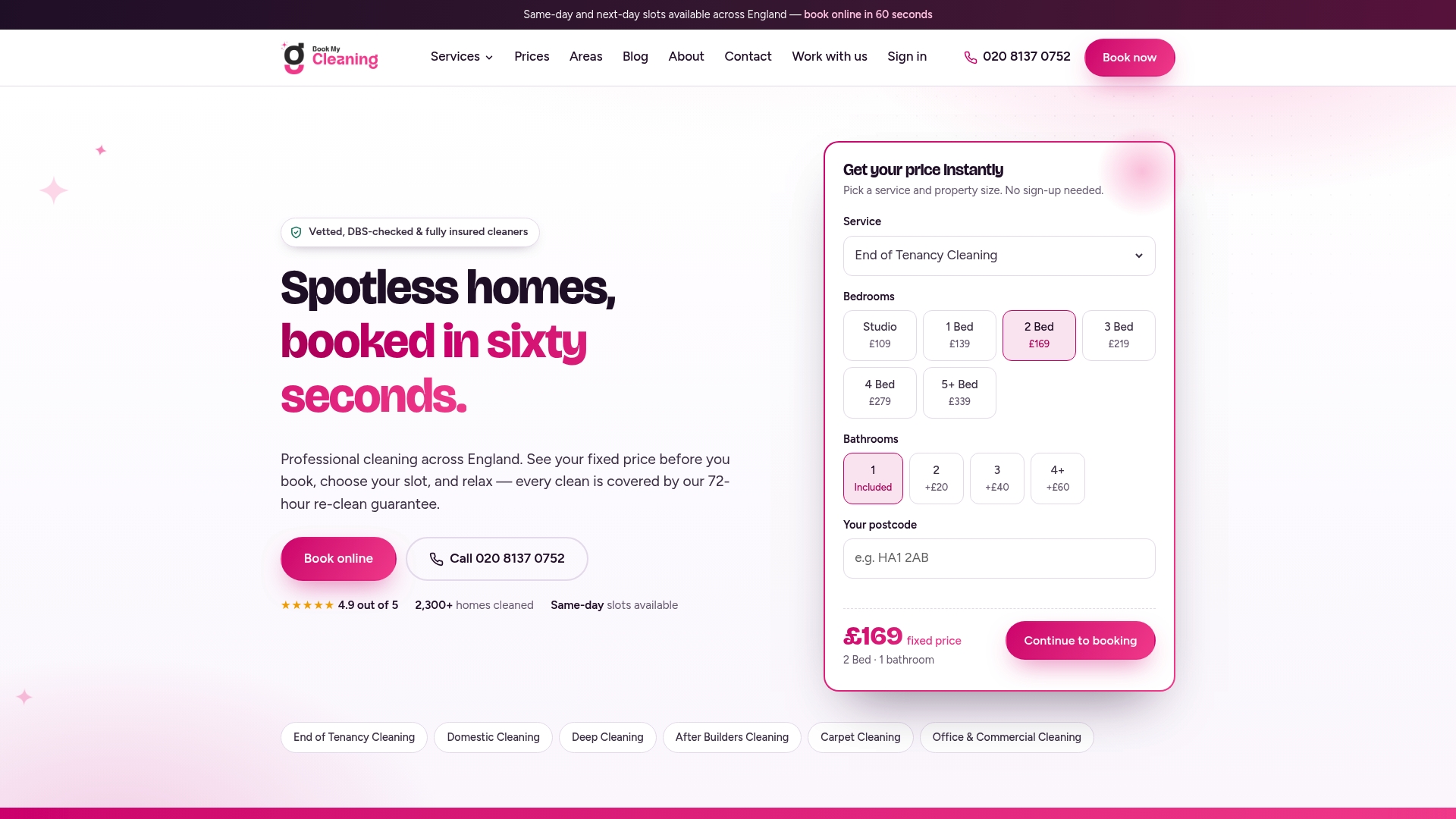
- Fixed prices for domestic cleaning, deep cleans, and end-of-tenancy cleaning are shown upfront on the site.
- Some managed services offer a re-clean guarantee if the standard does not meet expectations.
- Some providers offer same-day booking slots for customers who need a cleaner quickly.
- Some managed services offer a re-clean guarantee if the standard does not meet expectations.
- Some providers offer same-day booking slots for customers who need a cleaner quickly.
To find the right category and price, check the full pricing list for your job type, whether that is a one-off deep clean, a recurring domestic visit, or a checkout clean tied to a tenancy deadline. Once you pick a service, booking takes under a minute online, with no deposit required before a cleaner is confirmed.
A practical insider tip on getting the result you want
We care about two things above all: speed and doing exactly what we said we would, at the price we quoted. The one habit that consistently produces the best results is sending photos of the property and a short written checklist before the visit, so there is no ambiguity when the cleaner arrives.
— Book
Sources
- The 2026 guide to hiring a house cleaner | Checkatrade
- How much to charge for cleaning: UK pricing guide | Hey Jodie
- Household contents insurance - Citizens Advice
FAQ
How much does a cleaner cost for 3 hours?
A three-hour maintenance clean typically falls within the standard hourly band of £15 to £25 per hour, according to Hey Jodie's pricing guide, putting a three-hour visit roughly in that range multiplied by three. The exact figure depends on your location and property size, so confirm the total cost in writing before booking.
How much is a 1 hour clean?
A single hour of cleaning generally sits at the lower end of the standard maintenance band, around £15 to £25, based on Hey Jodie's UK pricing bands. Many providers also set a minimum call-out time, so check whether a one-hour booking is actually available before assuming the hourly rate applies as quoted.
What will a cleaner do in 2 hours?
In two hours, a cleaner typically covers core maintenance tasks such as vacuuming, mopping, dusting, and sanitising kitchen and bathroom surfaces, as outlined in Checkatrade's hiring guide. Specialist jobs like inside the oven or a full carpet clean are usually add-ons rather than part of a standard two-hour visit.
Is £20 an hour a lot for a cleaner?
£20 an hour sits within the standard maintenance cleaning band of £15 to £25 per hour reported by Hey Jodie, so it is a typical rate rather than an unusually high one. Where a quote lands within that band often depends on region, property size, and whether the cleaner supplies their own equipment.