
Run a four-tier schedule (daily, weekly, monthly, quarterly) and log every visit against a checklist that captures date, zone, cleaner and inspector. Daily rotation must cover washrooms, kitchens and high-touch points such as door handles and shared keyboards. Start today by building or downloading a template with those audit fields; without them, you're guessing whether the programme actually works.
TL;DR:
- Cleaning frequency should match foot traffic levels, with high-traffic offices needing daily cleaning, while low-traffic spaces may only require a few weekly visits.
- Daily checklists focus on high-touch zones like washrooms, kitchens, and shared surfaces, with specific tasks such as disinfecting fixtures and wiping high-touch points.
- Weekly tasks address soil and grime buildup, including vacuuming carpets, dusting surfaces, and cleaning interior glass and fridges, ideally on fixed days.
- Monthly work includes high dusting, HVAC filter inspections, and upholstery cleaning, with schedule reviews to adjust for changing staff or visitor patterns.
- Deep cleaning tasks like carpet extraction, floor recoats, window cleaning, and upholstery sanitation should be scheduled quarterly or annually, depending on traffic and wear.
Table of Contents
- Why scheduling and frequency matter for an office cleaning checklist
- Daily checklist: zone-by-zone non-negotiables
- Weekly tasks that stop soil accumulation
- Monthly tasks and preservation checks
- Quarterly and periodic deep cleans: when to bring in specialists
- Zone-specific checklist templates and required audit fields
- Assigning ownership: split between staff and professional cleaners
- Scope and definitions for each cleaning task to avoid ambiguity
- Inspection criteria and acceptable standards for each task to guide audit consistency
- Common pitfalls and expert fixes from facility managers
- How Bookmycleaning delivers a checklist-driven office programme
- Sources
- FAQ
Why scheduling and frequency matter for an office cleaning checklist
Frequency should follow foot traffic, not floor area. A 100-person client-facing office needs daily attention throughout, while a quiet ten-person back office might get by on two or three visits a week, provided washrooms and kitchens stay on the daily list regardless of headcount. Task drift creeps in when nobody owns a slot on the calendar: the weekly fridge clean gets pushed, then forgotten, then becomes a complaint.
Fixing frequency to traffic tiers stops that slide:
- Low traffic (under 20 staff, no visitors): a few cleans weekly, with daily washroom checks.
- Medium traffic (20 to 75 staff, occasional visitors): daily cleaning on most weekdays.
- High traffic (client-facing, 75+ staff, or shared/multi-tenant floors): daily cleaning, with possible extra visits for busy entrances and washrooms.
Restrooms and kitchens are the most common source of staff complaints in any tier, which is why they anchor the daily list rather than floating with general frequency.
Daily checklist: zone-by-zone non-negotiables
Daily tasks exist to control hygiene and first impressions before either becomes a problem. Break the list by zone so nothing gets assumed as "someone else's job."
- Reception and entry: vacuum the main traffic line, clean entry glass and door handles, wipe the reception desk, empty visitor-area bins.
- Workstations: empty desk bins, wipe high-touch surfaces (desk edges, phone handsets, monitor stands), spot-vacuum under desks where crumbs and dust collect.
- Meeting rooms: wipe tables, disinfect shared remotes and keyboards, reset chairs to a standard layout after every booking.
- Kitchen and break room: wipe all counters, sanitise the sink, empty food waste bins, wipe down appliance fronts (microwave, fridge, coffee machine).
- Washrooms: disinfect all fixtures, mop floors, restock soap, paper and sanitiser, and run an odour check before signing off.
- High-touch points across the floor: door handles, light switches, shared printers, lift buttons and badge readers all need a daily wipe regardless of which zone they sit in.
Facilities teams often assume vacuuming is the failure point when a programme goes wrong. It usually isn't. The recurring complaint is a missed high-touch surface or an odour nobody caught, not a strip of unvacuumed carpet. Build the daily list around zones and touchpoints, not just floor coverage, and most complaints disappear before they're raised.
Weekly tasks that stop soil accumulation
Weekly work catches what daily wiping misses: the dust that settles on surfaces nobody touches, the grime that builds on glass, the mess that quietly grows in a shared fridge. Skip a week and none of it looks urgent. Skip a month and you've got a deep-clean job instead of a five-minute task.
- Full vacuum of all carpeted areas, including under desks, along skirting and into corners; damp-mop hard floors throughout.
- Detailed dusting of horizontal surfaces (shelves, cabinet tops) and reachable vertical surfaces (partitions, picture frames).
- Interior glass and partition cleaning, plus a polish pass on brightwork (door handles, taps, metal trim).
- Full fridge purge, including expired items and a wipe-down of shelves and drawers.
- Disinfect bins inside and out, and treat any visible upholstery spots before they set.
Pro Tip: Assign the fridge purge to a fixed day, like "Fridge Friday." A task with no fixed day is the first thing dropped in a busy week.
Monthly tasks and preservation checks
Monthly work protects the building's assets and the air people are breathing, which is why it needs its own slot rather than getting folded into a busy weekly round.
- High dusting: air vents, light fittings and the tops of cabinets and partitions that daily and weekly rounds never reach.
- HVAC filter inspection, with replacement triggered by visible dust load or a fixed interval set by the manufacturer.
- Upholstery vacuuming and spot treatment, plus a machine scrub of hard floors in areas showing wear.
- Wash and disinfect all bins (not just wipe them), and check consumable stock levels against reorder points.
Monthly is also the right point to review whether your daily and weekly tiers are still matched to actual traffic. Headcount and visitor patterns shift; the schedule should shift with them.
Quarterly and periodic deep cleans: when to bring in specialists
Some jobs need equipment and skill that sit outside a standard cleaning contract, and trying to squeeze them into a weekly round wastes both money and results.
- Carpet hot-water extraction: quarterly for heavy-traffic lanes, every 6 to 12 months for general office areas.
- Hard-floor strip and recoat: typically twice yearly, more often where footfall is heavy or spills are frequent.
- External and hard-to-reach window cleaning: quarterly for ground-floor and entrance glass, twice yearly for upper floors.
- Upholstery deep cleans: annually, or sooner if fabric shows visible staining or odour.
Pro Tip: Write each of these as a separate line item in your tender document, with the frequency stated, so every bidder quotes against identical scope rather than guessing what "carpet care" includes.
Zone-specific checklist templates and required audit fields
A checklist only works as an audit tool if it captures who did what, when, and to what standard. The minimum header needs date, site or zone, cleaner name and inspector name, plus frequency and time taken. Each task line then needs a Pass, Fail or N/A column and a short notes field for anything an inspector flags.
Hand this same structure to every vendor you're tendering to. When each bidder prices against identical line items, comparing quotes stops being a guessing game about what's actually included.
Assigning ownership: split between staff and professional cleaners
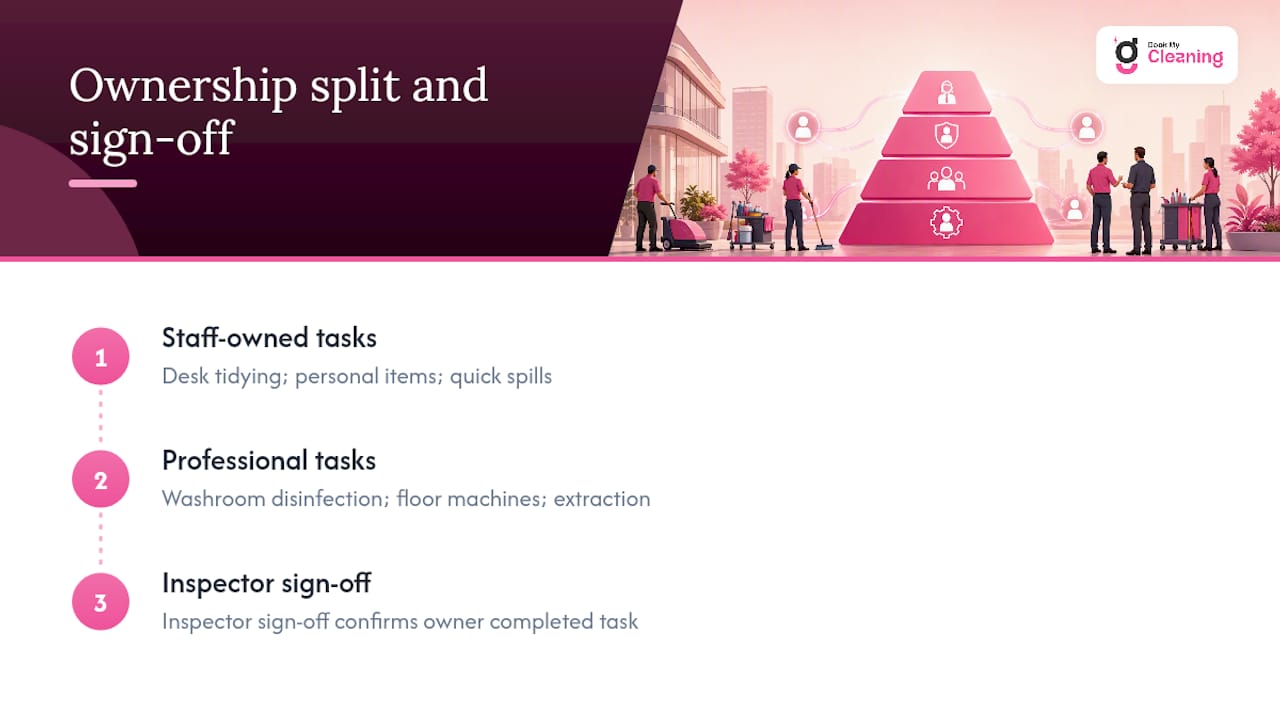
Sanitation-critical and equipment-dependent work belongs with professionals: washroom disinfection, floor machine work and deep extraction all need training and kit that in-house staff rarely have. Staff can reasonably own desk tidying, personal item management and quick spill wipe-ups, but restroom disinfection should never sit on a staff rota.
Write the split directly into your checklist rather than leaving it as an unwritten assumption. Put the owner's role against each line item, then use inspector sign-off to confirm the right party actually did the work. That single habit closes most of the disputes that come up when something gets missed and nobody's sure whose job it was.
Scope and definitions for each cleaning task to avoid ambiguity
"Clean the kitchen" means five different things to five different cleaners unless you define it. Ambiguity is where checklists quietly fail, because everyone assumes their interpretation is the standard one.
Define each task with a start point and an end point. "Wipe surfaces" should specify which surfaces (counters, appliance fronts, table tops) and with what (disinfectant wipe, not just a damp cloth). "Vacuum" should state whether it includes under furniture and along skirting, or just open floor space. "Empty bins" should specify liner replacement, not just tipping contents into a larger bag.
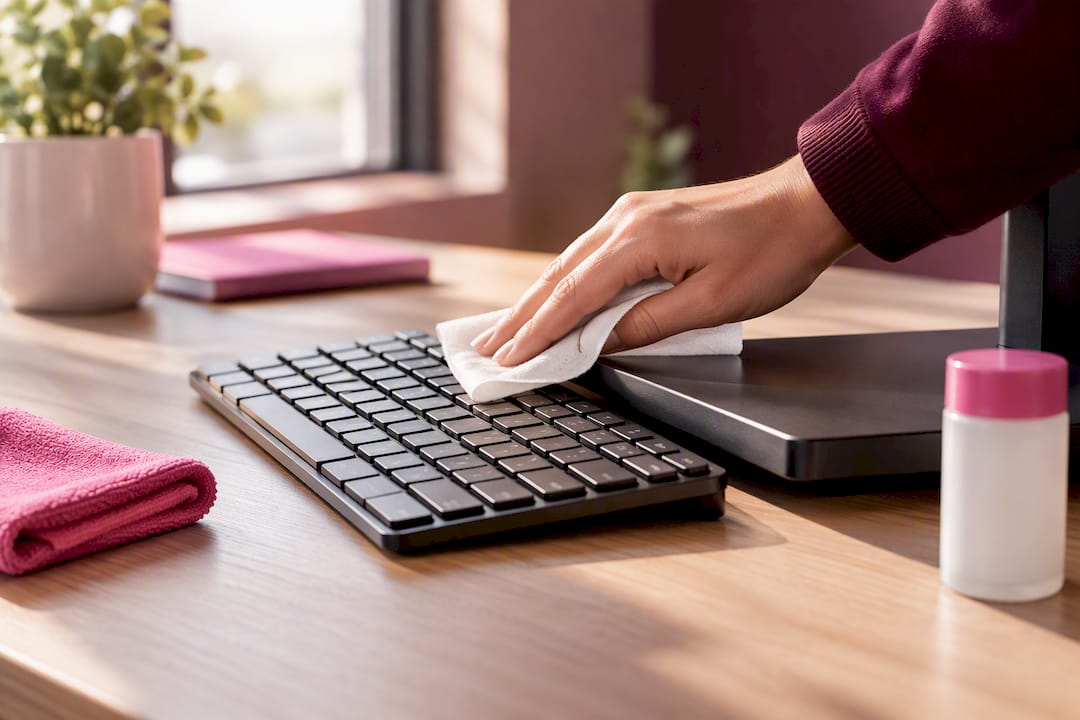
Some definitions matter more than others because getting them wrong causes damage. Monitors and keyboards need anti-static, isopropyl alcohol-safe wipes rather than a wet cloth or an all-purpose aqueous disinfectant, which can damage electronics over repeated use. That distinction belongs in the checklist itself, not in a separate training document nobody reads before their first shift.
Washroom disinfection needs its own scope note too: which fixtures, using which product, and for how long the product sits before wiping. That last point, dwell time, is what separates surface tidying from actual disinfection, and it's worth its own line in the checklist rather than an assumed step.
Write scope notes directly under each checklist item, even briefly. A one-line definition ("wipe includes desk surface, phone, and monitor stand; excludes personal items") removes almost all of the ambiguity that causes disputes between managers, staff and vendors.
Inspection criteria and acceptable standards for each task to guide audit consistency
A Pass or Fail column is only as good as the standard behind it. "Clean" is not a standard; "no visible dust, no residue on touch, no odour on approach" is. Every task on the checklist needs a plain description of what passing actually looks like, written so two different inspectors would reach the same verdict on the same day.
For washrooms, the standard is straightforward: no visible soil on fixtures, no odour on entry, consumables stocked to at least half capacity. For workstations, it's an empty bin, a wiped surface with no visible marks, and no crumbs or debris under the desk. For floors, it's an even vacuum pattern with no visible debris in corners or under furniture, and no streaking on hard floors after mopping.
Consistency comes from training inspectors against the same written standard, not from trusting instinct. A new inspector and a five-year veteran should be able to walk the same floor and produce matching results, and that only happens when the acceptable standard is written down rather than assumed. Where a task allows some subjectivity, such as "high dusting," add a simple test: run a finger along the surface and check for visible residue.
Build in a notes field for borderline cases. A washroom that passes on fixtures but fails on odour still needs documenting, because a pattern of near-misses on the same criterion usually signals a scheduling problem rather than a one-off lapse.
Common pitfalls and expert fixes from facility managers
Task drift is the single biggest failure mode in office cleaning programmes, and it's almost always fixable with a fixed day rather than a stricter policy. Give the weekly fridge clean a name and a slot, "Fridge Friday" works fine, and it survives busy weeks that would otherwise bump it.
Dwell time gets skipped more often than people admit. Cleaning first and disinfecting second, in that order, matters more than the product used. Colour-coded microfibre and dedicated mop heads by zone prevent cross-contamination between washrooms and kitchens, and cost almost nothing to implement. Build a standing audit prompt, "check under desks for crumbs", into every inspection round. It catches the miss that vacuuming alone won't.
— Book
How Bookmycleaning delivers a checklist-driven office programme
If you'd rather hand this whole schedule to a vendor than manage it in-house, Bookmycleaning's office and commercial cleaning service is built around exactly this structure: daily, weekly, monthly and quarterly tiers mapped to a written checklist rather than a vague "we'll keep it tidy" arrangement.
Every job is carried out by vetted, DBS-checked cleaners who arrive in uniform, and every visit is backed by a 72-hour re-clean guarantee if the standard on the checklist isn't met. Pricing is shown upfront with no hidden fees, in keeping with the transparent fixed pricing shown across Bookmycleaning's services, and a same-day booking model and high customer satisfaction applies to office scheduling too. If you're weighing up whether to keep cleaning in-house or contract it out, Bookmycleaning's cost guide is a useful starting point. Request a checklist-scoped quote or a free site assessment and get a programme built against your own zones and traffic levels, not a generic template.
Sources
Build your checklist directly from source templates rather than starting from a blank page.
FAQ
What is the 20/10 rule for cleaning?
The 20/10 rule is a time-management habit, not an office-specific standard: clean for 20 minutes, then rest or switch tasks for a short break, repeating until a space is done. It's more commonly applied to personal decluttering than commercial cleaning schedules, though some teams use it to break up long deep-clean sessions.
What are the 7 stages of cleaning?
Definitions vary by industry, but a common version runs: dry clean (dust and debris removal), pre-clean, main clean, rinse, disinfect, dry, and inspect. Commercial cleaning programmes rarely name all seven explicitly, but the sequence, clean before disinfect, then verify, matches the dwell time principle that underpins proper washroom and kitchen sanitation.
What is included in office cleaning?
A full office cleaning programme spans four tiers: daily tasks (bins, high-touch points, washrooms, kitchens), weekly tasks (full vacuuming, dusting, glass), monthly tasks (high dusting, HVAC checks, upholstery), and quarterly deep cleans (carpet extraction, floor strip and recoat, window cycles). Bookmycleaning's office service covers this full range, scoped to your site's actual traffic and zones.
What is the 6 to 10 cleaning list?
There's no widely recognised numbered cleaning framework in commercial or facilities cleaning standards. If you've seen this referenced, it's likely a variation of a numbered daily task list, similar in spirit to the zone-by-zone daily checklist covered above, rather than an established industry term.
How often should an office cleaning checklist be reviewed?
Review the checklist monthly alongside your HVAC and consumable checks, since staffing and visitor traffic shift over time and frequency should track that traffic. A checklist set for 20 staff stops working once headcount doubles, even if nobody's changed the schedule to reflect it.