
A professional office deep clean delivers the thorough sanitation and detail standard cleaning misses. If your workspace hasn't had one in a while, or you're heading into a post-renovation or return-to-office reset, hire a vetted team now rather than stretch your usual cleaner further. Request a site survey or check a fixed-price deep-clean page to see what's covered before you commit.
TL;DR:
- Professional deep cleaning targets all zones, including vents, appliances, and high-touch surfaces, which routine cleaning often overlooks or skips entirely.
- The process takes two to four hours for a medium-sized office and can include additional charges for carpet extraction, appliance cleaning, or window washing.
- Choosing a provider requires verifying insurance, DBS checks, scope clarity, equipment, and guarantees to ensure a complete and reliable service.
- Scheduling during non-work hours and expecting fixed upfront pricing with a re-clean guarantee can prevent common issues with incomplete or unexpectedly expensive jobs.
- Deep cleaning is recommended every three to six months, especially after renovations or a return to office, to improve air quality and reduce maintenance problems.
Table of Contents
- What does an office deep clean include?
- How long does it take and what does it cost?
- How do you choose a professional office deep cleaning provider?
- A practical office deep-clean checklist by zone
- What proof points actually matter when hiring?
- What are the payment and contract terms?
- When should you actually book a deep clean?
- Ready to book your office deep clean?
- Sources
- FAQ
What does an office deep clean include?
Forget task lists organised by job title (dusting, vacuuming, wiping). The better way to scope a deep clean is by zone, because it maps directly onto how a survey team will walk your building and how you'll be quoted. A zone-based checklist removes the guesswork about what's actually covered and stops providers quietly narrowing the scope after you've signed off.
Here's how the zones typically break down:
- Reception and communal areas: glass partitions, seating upholstery, high-touch surfaces like door handles and lift buttons, high dusting of light fittings.
- Open-plan desks and workstations: keyboard and monitor wipe-downs, under-desk vacuuming, cable management areas, shared equipment.
- Meeting rooms: table and chair sanitisation, screen and AV control cleaning, whiteboard degreasing.
- Kitchens and break rooms: interior appliance cleaning (microwaves, fridges), degreasing surfaces, sink and drain treatment.
- Washrooms: descaling, grout and tile work, touchpoint disinfection.
- Floors and carpets: hot water extraction, spot treatment, edge and corner vacuuming.
- Vents, blinds and HVAC-accessible components: often skipped by routine cleans, yet critical for indoor air quality.
The sequence matters as much as the task list. Cleaning removes visible soil and organic matter first; disinfecting then targets the pathogens left behind, and it only works if the product stays wet on the surface for its stated contact time. Skip the cleaning step and you're just pushing grime around with a disinfectant that never gets the chance to work as intended, a point Workbox's guidance on office disinfection makes clearly.
How long does it take and what does it cost?
A medium-sized office typically takes between two and four hours for a professional team to deep clean properly, according to Banner UK's breakdown of the process. That window shifts depending on furniture density, how much carpet needs hot-water extraction, and whether high-dusting or vent access is part of the job.
Pro Tip: Ask for the time estimate in writing before booking, not as a verbal aside. A provider who won't commit to a duration usually hasn't scoped the job properly.
Pricing tends to follow one of a few models: hourly rates, flat fees per room or zone, or per square metre for larger footprints. Add-ons push the price up predictably:
- Carpet extraction, usually priced per room
- Oven and fridge interiors
- Grout and tile deep treatment
- Window cleaning, inside and out
For context, Bookmycleaning's own deep cleaning service starts at £119 for domestic-scale jobs, which gives you a useful anchor point when comparing office quotes of a similar size. Scheduling around these figures matters too: most providers recommend working out of hours or across a phased weekend visit, both to avoid disrupting staff and to allow carpets and disinfected surfaces time to dry before Monday morning.
How do you choose a professional office deep cleaning provider?
Getting quotes from three companies and picking the cheapest is how businesses end up with a rushed, incomplete job. Run every provider through the same checklist instead.
- Insurance: ask for proof of public liability cover, not just a verbal assurance.
- Vetting: confirm staff are DBS-checked, especially if the clean happens after hours with nobody else on site.
- Written scope: a proper site survey should produce a document, not a quote scribbled on the back of an email.
- COSHH compliance: chemical handling and storage should follow documented controls, not ad hoc practice.
- Equipment: hot-water extraction machines and commercial-grade vacuums do a different job to a domestic Hoover and a spray bottle.
- References: a provider confident in their work will point you to other commercial clients.
- Guarantees: what happens if a zone isn't up to standard after the crew leaves?
When you're on the phone or walking the site with a quote in hand, ask directly: what's excluded from this price? Which products are you using, and what are their dwell times? Can your team access restricted areas outside office hours? What's your re-clean policy if I'm not satisfied?
Red flags are usually obvious once you're looking for them: no written scope, vague answers about timelines, staff who can't name the chemicals they're using, or a quote that arrived without anyone visiting the site first.
A practical office deep-clean checklist by zone
Use this during your site survey and again once the job's finished, to check the work against what was agreed.
Reception and meeting rooms: strip and wipe all surfaces including glass and shared tech, high-dust light fittings and picture rails, deep clean seating fabric.
Workstations: keyboards and mice need proper disassembly-level cleaning, not a wipe over the top, since these are among the highest-touch surfaces in any office. Under-desk areas get vacuumed, and upholstered chairs get spot-treated for stains.
Kitchens and break rooms: interior appliance cleaning for microwaves and fridges, degreasing around hobs and worktops, sink and drain hygiene treatment to shift lingering odours.
Washrooms: descaling taps and fittings, grout and tile cleaning that goes beyond a quick mop, touchpoint disinfection on handles, taps, and flush mechanisms.
Floors and carpets: standard vacuuming first, then spot treatment for stains, then hot-water extraction for a genuine deep clean. Factor in drying time, and use floor signage so nobody slips before carpets are ready to walk on.
HVAC, vents and blinds: high-dusting covers what's reachable; anything inside ductwork needs a specialist duct-cleaning service rather than a general cleaning crew. If air quality is a priority for your building, insist vents are named explicitly in the site-survey scope, not left as an assumption.
What proof points actually matter when hiring?
Claims are easy. What you want are specifics you can check before the crew turns up.
- DBS-checked, uniformed staff: reduces the risk of letting unvetted people into your building, particularly for after-hours work.
- Fixed pricing shown before booking: no surprise invoice once the job's done, and no renegotiation halfway through.
- A re-clean guarantee: Some cleaning providers back their work with a 72-hour re-clean guarantee, so if a zone falls short, it gets fixed rather than argued over.
- Clear service coverage: knowing a provider actually operates where you're based avoids wasted time on quotes that never convert.
Each of these does a specific job in procurement. Fixed pricing removes the hidden-fee risk that makes finance teams nervous about signing off. A re-clean guarantee shifts the risk of a substandard job back onto the provider, where it belongs. You can see how these apply in practice on Bookmycleaning's deep cleaning page and the full pricing list.
What are the payment and contract terms?
Most professional cleaning contracts, deep clean or otherwise, follow a fairly standard structure, and it's worth checking each point before you sign anything.
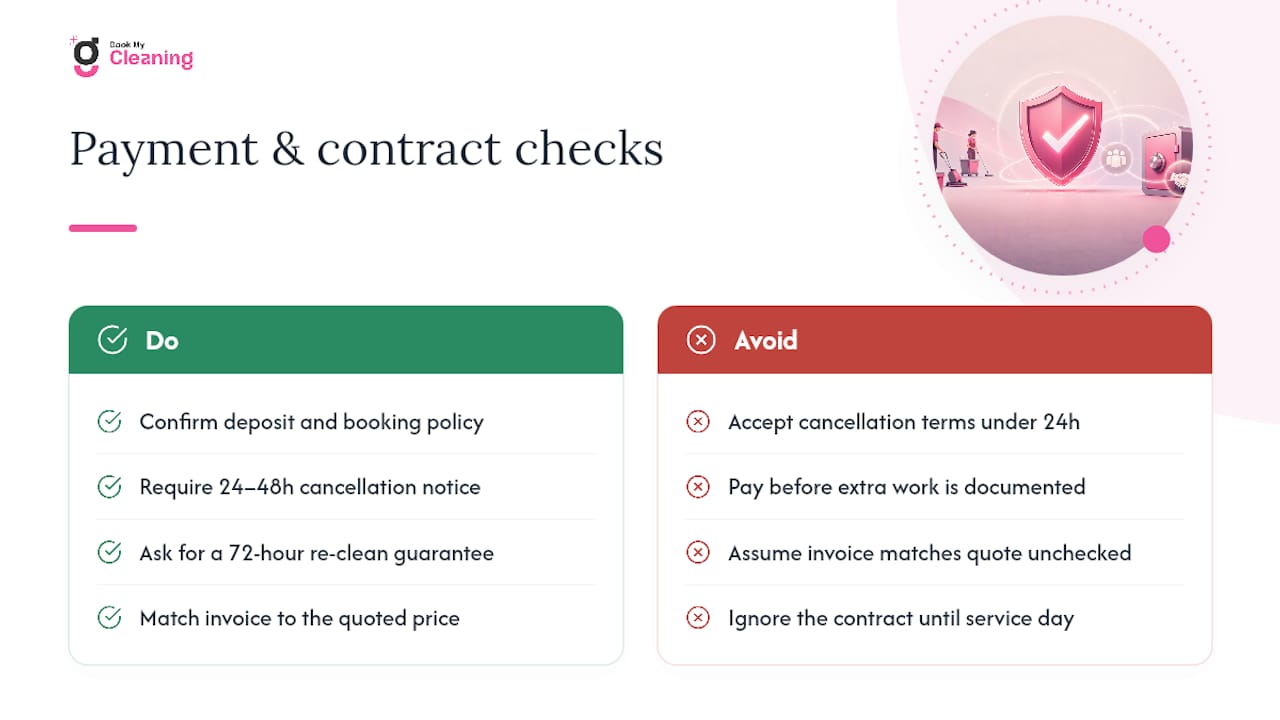
Deposits: some providers ask for a deposit to secure a booking slot, particularly for larger commercial jobs booked weeks in advance. Some providers let you book without needing a card upfront, which removes friction if you're still comparing options.
Cancellation policy: check how much notice you need to give to cancel or reschedule without a fee. A reasonable policy allows 24 to 48 hours' notice; anything stricter than that is worth querying.
Satisfaction guarantees: this is where the 72-hour re-clean guarantee earns its keep. If a zone hasn't met the agreed standard, you should be able to flag it within that window and have it addressed at no extra cost, rather than being told the job's already closed.
Invoicing: fixed-price quotes should convert directly into a matching invoice. If numbers shift between quote and invoice without a documented reason (an added zone, extra hours agreed on-site), that's a conversation worth having before you pay, not after.
Read the terms before the crew arrives, not while you're standing in reception wondering why the invoice doesn't match what you were told on the phone.
When should you actually book a deep clean?
Quarterly makes sense for high-footfall offices; twice a year is usually enough for smaller, lower-traffic spaces, in line with the 3 to 6 month window most cleaning specialists recommend. Beyond the calendar, watch for triggers: post-renovation dust, a return-to-office push after a quiet period, or a big client visit on the calendar. Better air quality and fewer maintenance complaints follow naturally. Book it for a weekend or overnight slot when occupancy is lowest, and phase larger buildings over two visits if one session would mean shutting the whole floor down.
— Book
Ready to book your office deep clean?
Bookmycleaning is the alternative to chasing multiple contractors for quotes that never quite match what turns up on the day. You get fixed pricing shown online before you book, DBS-checked and uniformed teams, and a 72-hour re-clean guarantee if any zone falls short, without a deposit or a card needed to secure your slot.
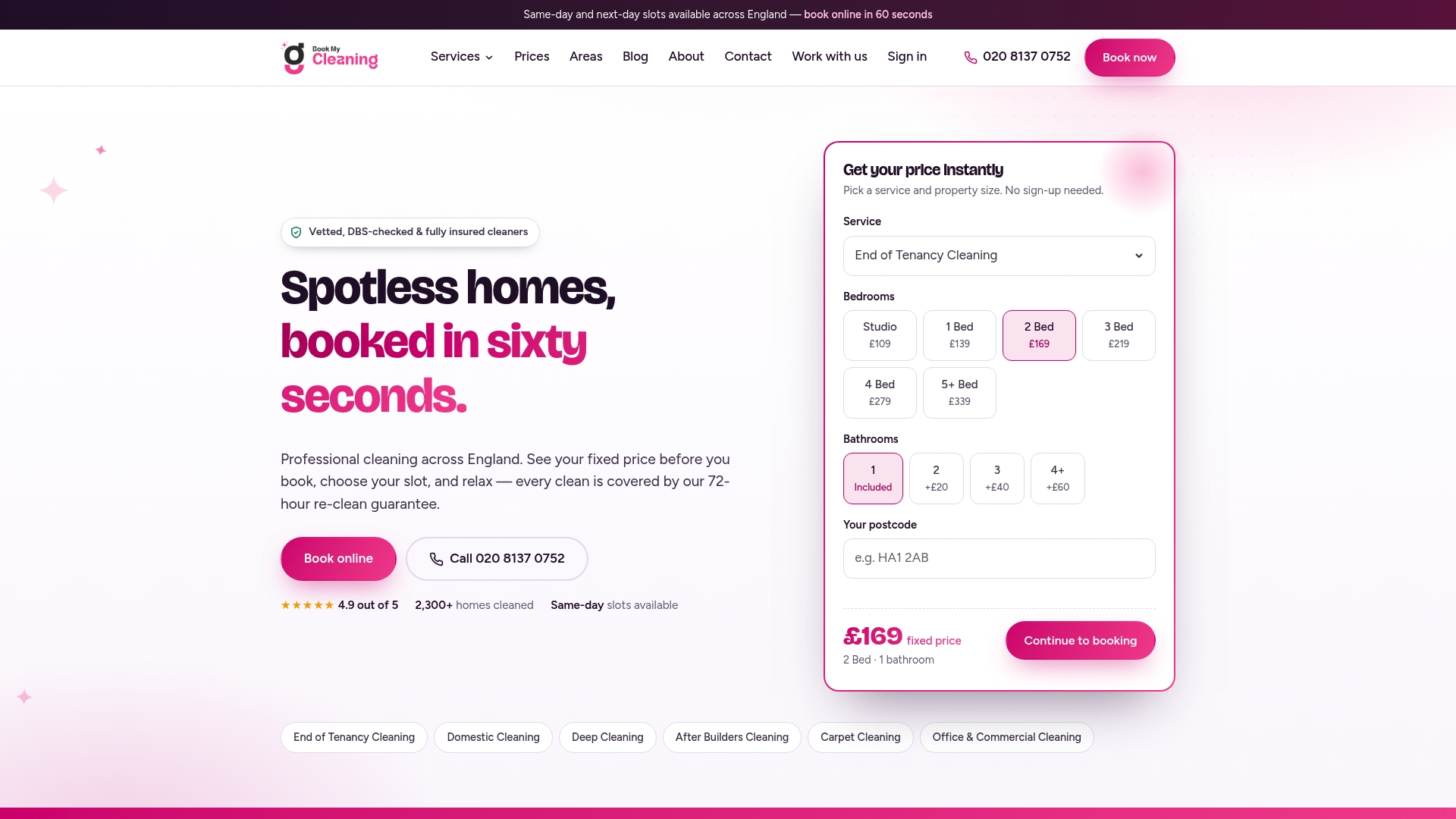
If you manage an office and want to see exactly what a professional reset involves, start with the deep cleaning service page to check pricing for your space, or look at the full price list to compare against add-ons like carpet extraction or appliance interiors. Booking takes under a minute online, and you'll know the exact cost before anyone sets foot in your building.
Sources
For deeper detail beyond this guide: Neathive's full deep-cleaning checklist covers task-level detail by zone; Workbox's disinfection guide explains the cleaning-versus-disinfecting distinction properly; MT Cleaners' checklist breaks down UK-specific frequency recommendations by space type.
- How to deep clean an office | Banner UK
- Office deep cleaning checklist: A complete workplace guide | Neathive Cleaning
- Deep clean office checklist: what needs cleaning (and how often) — MT Cleaners
- How to disinfect office space for a productive team | Workbox
FAQ
What is included in an office deep clean?
A full deep clean covers every zone from reception to washrooms: high-dusting, carpet extraction, appliance interiors, grout and tile work, vents, blinds, and disinfection of high-touch surfaces like door handles and keyboards.
How much does an office cleaner cost?
Pricing varies by provider and job size, typically charged hourly, per room, or per square metre; check Bookmycleaning's pricing page for current fixed rates on comparable domestic-scale services.
What does "deep office cleaning" mean?
It means a thorough, zone-by-zone clean that goes beyond routine tidying, including tasks like hot-water carpet extraction, appliance interiors and high-dusting that a standard weekly clean skips.
Is it worth paying for a deep clean?
Yes, particularly every 3 to 6 months or after events like renovations or a return-to-office push, since it improves air quality, first impressions, and reduces ongoing maintenance issues that build up between routine cleans.