
The single most effective way to manage office kitchen cleaning is a short daily routine, a weekly appliance check and a clearly named owner for each task. Food Standards Agency guidance points to a sanitisation interval for food-contact surfaces in continuous use at regular intervals, and Scoped briefs indicate that appliance interiors often get missed when no person is assigned responsibility. Get those three things right and most hygiene complaints disappear.
TL;DR:
- Assign responsibility for food labelling, daily checks, and scheduled deep cleaning to specific staff and contractors to prevent ownership gaps.
- Replace sponges with disposable paper towels and keep all cleaning tools food-safe and dedicated to avoid cross-contamination.
- Maintain fridge temperature at or below 5°C, label all food with dates, and conduct weekly resets to prevent spoilage and infestations.
- Clean appliances such as microwaves, kettles, and coffee machines regularly, with descale routines tailored to water hardness levels.
- Implement strict routines for bins, drains, and spills to control odors and pests, with daily waste bin empties and weekly drain inspections.
Table of Contents
- What you need: tools, food-safe products and basic safety
- Daily, weekly and monthly checklist you can print and use
- Fridge and food-storage protocol: label, temperature and discard day
- Appliance-specific steps: microwave, coffee machine, kettle and dishwasher
- Bins, drains and floors: spill response and pest prevention
- Roles, rosters and etiquette: how to prevent ownership gaps
- Cleaning vs sanitising and food-contact guidance
- When to hire a professional and how Bookmycleaning helps
- Why clarity and routine win
- Book Bookmycleaning for office kitchen cleaning
- Sources
- FAQ
What you need: tools, food-safe products and basic safety
You don't need a cupboard full of specialist chemicals. You need the right basics, used consistently, on the right surfaces.
- Microfibre cloths (colour-coded if possible, laundered after each use, never reused sponges)
- Disposable paper towels for spills and raw food areas
- A mop and dedicated bucket for the kitchen floor only
- A food-safe sanitiser labelled for food-contact use
- Disposable gloves and an appliance descaler
- Bin liners sized to your bins, plus spare rolls stored nearby
Use food-safe products on anything that touches food, benches, sinks, fridge shelves, and always follow the manufacturer's stated contact time before wiping or rinsing. Keep a basic COSHH note on the cupboard door: what each product is for, how long it needs to sit, and where gloves are kept. Store chemicals away from food items, ideally in a labelled, closed cabinet.
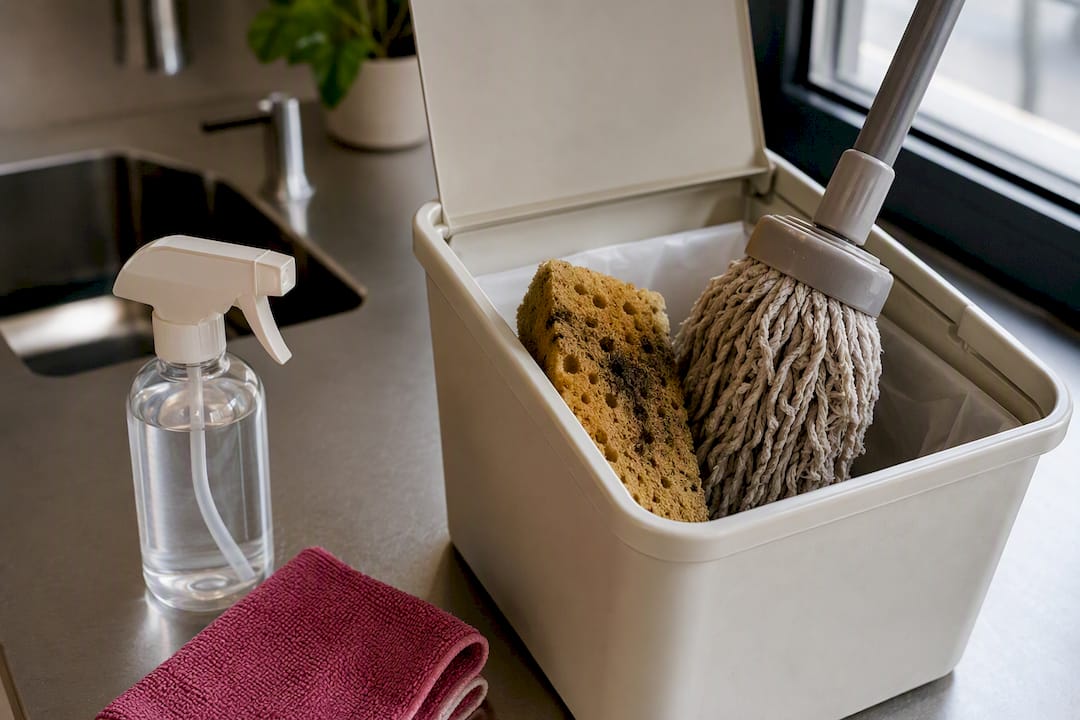
Pro Tip: Bin the sponges entirely. ISSA's guidance on commercial kitchen hygiene flags dirty sponges and worn mop heads as one of the most common causes of cross-contamination in shared kitchens.
Daily, weekly and monthly checklist you can print and use
Frequency is what turns good intentions into a working system. Break tasks into three tiers and assign each one to a person or role, not just a day.
Daily tasks (end of each day or between peak uses):
- Wipe all worktops and benches with sanitiser
- Disinfect high-touch points: fridge handles, kettle switches, taps, cupboard pulls
- Empty and wipe out bins
- Clean sinks and draining boards
- Spot-clean visible floor spills
- Restock hand soap, paper towels and bin liners
High-touch surfaces need daily attention because ordinary use transfers grease and bacteria onto handles and switches faster than almost anywhere else in the room, and normal cleaning has to happen before disinfectant can work properly.
Weekly tasks:
- Clean the microwave interior, including the roof and door seal
- Check fridge contents and temperature
- Wipe cabinet fronts and drawer handles
- Descale the kettle if limescale is visible
Monthly or quarterly tasks:
- Deep-sanitise the fridge, shelves, drawers and gasket
- Clean behind and underneath large appliances
- Deep-clean floors, including grout lines and skirting
Fridge and food-storage protocol: label, temperature and discard day
A communal fridge is the single riskiest object in most office kitchens, mainly because nobody owns it. Fix that with a simple protocol rather than a vague reminder email.
- Keep the fridge at or below 5°C, checked weekly with a simple fridge thermometer, not guesswork
- Label all food with name and date; anything unlabelled or unclaimed gets binned on reset day
- Run a weekly reset day, often a Friday, where everything unclaimed is cleared out before the weekend
- Wipe shelves and drawers weekly; deep-sanitise, including door seals and gaskets, monthly
Seals and gaskets trap crumbs and moisture and are usually the first place mould appears, so they deserve more attention than the shelves people actually look at.
Appliance-specific steps: microwave, coffee machine, kettle and dishwasher
Each shared appliance has its own failure point, and assigning a cadence to each one closes the gaps a generic "clean the kitchen" instruction always leaves.
- Microwave: wipe the interior after any spill; do a full deep clean weekly, including removable trays soaked in warm soapy water
- Coffee machine: wipe the exterior and drip tray daily; descale monthly following the manufacturer's instructions
- Kettle: empty and wipe daily; descale every few weeks depending on local water hardness
- Toaster: empty crumb trays daily; wipe the exterior with a damp cloth
- Dishwasher: run at the manufacturer's recommended cycle; clean the filter and door seals monthly
Pro Tip: Descaling frequency depends entirely on your local water hardness. Offices in hard-water regions may need to descale kettles and coffee machines twice as often as the manufacturer's default guidance suggests.
Bins, drains and floors: spill response and pest prevention
Odour and pests almost always trace back to one of three things: an overdue bin, a neglected drain, or a spill left to dry.
- Empty and wipe bins daily; use sealed food-waste bins where the kitchen generates much food waste
- Contain a spill immediately, clean with detergent first, then sanitise if it touched food, and dry the floor to stop slips
- Inspect drains weekly for organic buildup and schedule a proper drain clean before smells or fruit flies appear
- Keep fruit bowls covered or refrigerated. Uncovered fruit is the single biggest driver of fruit fly infestations in office kitchens
Ants and fruit flies rarely appear from nowhere. They follow food residue and standing moisture, so tightening bin and spill routines usually solves the pest problem faster than any spray.
Roles, rosters and etiquette: how to prevent ownership gaps
Most office kitchen failures aren't down to laziness. They come down to nobody actually owning the task. A clear split of responsibility, and visible signage reinforcing it, reduces repeat offences far more reliably than an occasional reminder email.
Split ownership three ways: staff clean up their own mess and label their own food; an in-house coordinator runs the daily checks; a cleaning contractor covers the scheduled daily and weekly tasks in the agreed scope. Ambiguous ownership, not lack of effort, is usually the actual cause of a messy shared kitchen. Mapping the room and naming a person against every task closes that gap.
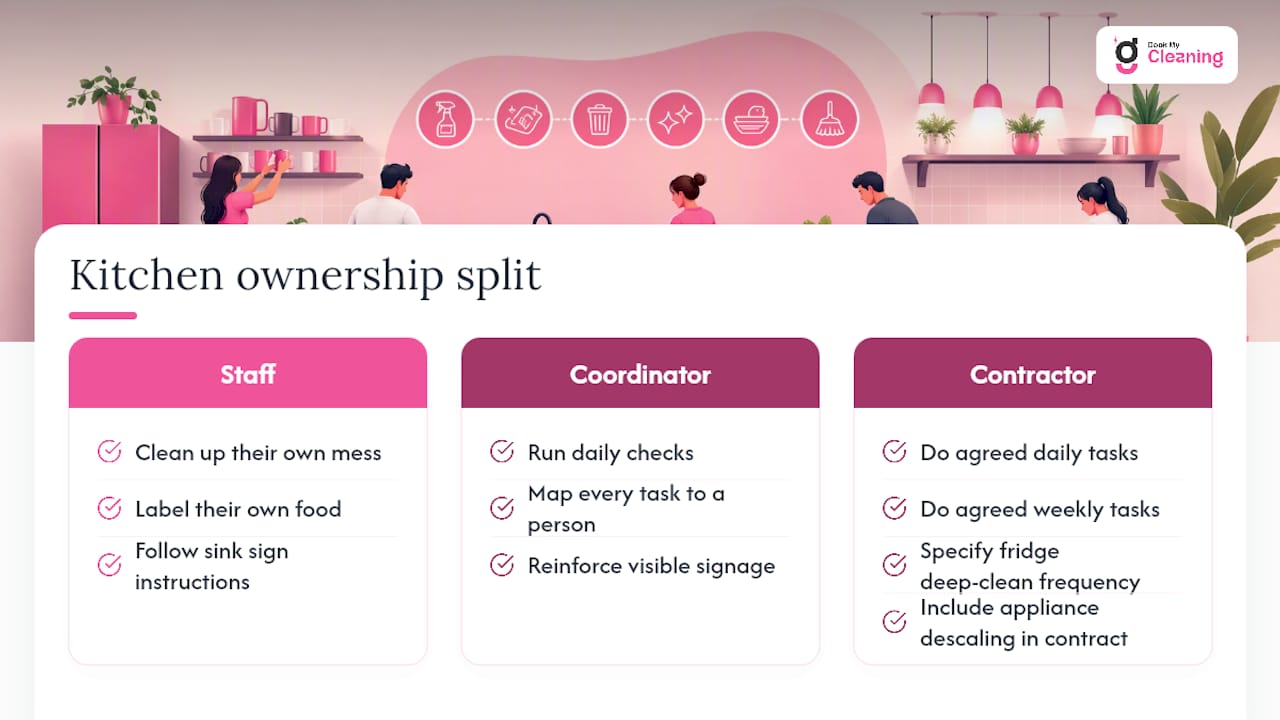
A short sign above the sink ("Wash it, dry it, put it away, today") does more than a policy document nobody reads. If you outsource, write fridge deep-clean frequency and appliance descaling directly into the cleaning brief or contract, not left as an assumption.
Cleaning vs sanitising and food-contact guidance
Cleaning and sanitising are two different jobs, and skipping the first one wastes the second. Cleaning removes grease, crumbs and visible soil that would otherwise stop a sanitiser from working. Sanitising only kills bacteria effectively once the surface underneath is actually clean, which is why the sequence matters more than the product.
Food contact surfaces in continuous use should be cleaned and sanitised at regular intervals, with Food Standards Agency guidance pointing to a 4-hour interval to prevent bacterial growth on surfaces used throughout the working day.
Apply this by wiping down worktops and prep surfaces regularly during heavy use, not just at the end of the day. NSF's clean-then-sanitise framework is worth following closely on dilution and contact time. If a sanitiser needs a stated dwell time before wiping or rinsing, respect it. Cutting that time short is the most common reason sanitising products underperform.
When to hire a professional and how Bookmycleaning helps
Some offices genuinely can't sustain a rota. High footfall, shared shift patterns, or a kitchen that always seems to smell no matter who's on duty are the clearest signs it's time to bring in a contractor rather than another memo.
An Office & Commercial Cleaning service is built around exactly this gap. Fixed pricing shown upfront, DBS-checked cleaners who arrive in uniform, and same-day booking availability all remove the guesswork from outsourcing kitchen hygiene. If standards slip, a 72-hour re-clean guarantee means it gets sorted, not argued over.
When briefing any cleaning provider, specify:
- Fridge deep-clean frequency, weekly or monthly
- Which appliances need interior work and how often
- Proof of DBS checks and insurance before staff arrive on site
Why clarity and routine win
The evidence here keeps pointing at the same conclusion: office kitchens don't fail because people are careless, they fail because nobody was told the fridge was theirs to check. Print the checklist, set a weekly reset day, and put appliance tasks into the brief in writing. That's the whole system.
— Book
Book Bookmycleaning for office kitchen cleaning
Most offices try to solve kitchen hygiene with a rota nobody follows or an ad hoc arrangement that falls apart the first time someone's on leave. This service takes that uncertainty out of the equation with fixed pricing shown before you book, so you know what a weekly or monthly visit costs before committing to anything.
The Office & Commercial Cleaning service covers the daily and weekly tasks this guide sets out, benches, sinks, bins, high-touch points, with appliance interiors and fridge deep-cleans added to the brief as extras rather than left to chance. Cleaners have DBS checks and uniform, and if a visit doesn't meet standard, a 72-hour re-clean guarantee means the issue is fixed at no extra cost. Full current prices are listed online, so there's no quote-chasing involved.
Before booking, ask about fridge deep-clean frequency, whether appliance descaling is included, and request evidence of DBS checks for anyone attending your site. Get a quote through the office cleaning page and get the rota problem off your desk for good.
Sources
FAQ
What is the 5-5-5 rule for cleaning?
There's no single agreed definition of a "5-5-5 rule" in food hygiene guidance, and it isn't part of Food Standards Agency or NSF standards. If you've seen it referenced elsewhere, treat it as informal shorthand rather than an official rule, and follow the 4-hour sanitisation interval and clean-then-sanitise sequence set out above instead.
How much should I charge to clean a commercial kitchen?
Pricing for commercial kitchen cleaning varies by size, frequency and scope, so there's no single market rate to quote. For office kitchens specifically, Bookmycleaning lists current office and commercial cleaning prices on request rather than a flat published rate, since scope varies so much between sites.
What is the 20 minute rule of cleaning?
This isn't an established food-hygiene standard either. The reliable benchmark for office kitchens is the 4-hour sanitisation interval for food-contact surfaces during continuous use, not a fixed 20-minute figure.
How do professional kitchens clean?
Professional and commercial kitchens follow a strict clean-then-sanitise sequence: soil and grease are removed first, then a food-safe sanitiser is applied and left for its full contact time before any rinsing. Tools are laundered or replaced regularly, since worn mop heads and dirty sponges are a recognised source of cross-contamination in shared kitchens.
Who should be responsible for office kitchen cleaning?
Responsibility works best split three ways: staff manage their own dishes and food labelling, an in-house coordinator runs daily spot-checks, and a cleaning contractor handles the scheduled deep tasks written into the brief. Ambiguous ownership, not lack of effort, is the most common reason office kitchens fall into disrepair.