
Yes, cleaners should wear uniforms. No UK law makes them do it, but a uniform does three jobs that matter to you: it shows who is in your home or workplace, it protects the cleaner's own clothes and skin, and it signals a business that stands behind its people. At Book My Cleaning our cleaners are vetted, DBS-checked and arrive in uniform, so you can tell who they are before they step through the door.
TL;DR
- There is no specific work uniform law in the UK. If an employer sets one, it must be reasonable and not discriminate on any of the nine protected characteristics.
- Where protective equipment is required for a risk, the employer must provide it free. A plain branded uniform is a different matter, and who pays depends on the contract.
- For you as a customer, a uniform means easy identification, consistency and a business willing to be recognised.
- Tabards suit domestic and heavy-duty work, polos suit offices, and non-slip footwear matters more than either.
- A uniform worn on arrival is only one trust signal. Pair it with vetting, a written checklist and a re-clean guarantee.
Table of Contents
- What the law says about cleaning uniforms in the UK
- Why a uniform helps you as the customer
- Why a uniform helps the cleaner
- Tabard, polo or tunic: which suits which job
- Who pays for the uniform, and who washes it
- How often should a cleaner's uniform be washed
- Does a uniform mean the cleaner is trustworthy?
- Uniforms in offices and shared buildings
- Our view
- Book a uniformed, vetted cleaner
- FAQ
- Sources
What the law says about cleaning uniforms in the UK
The short answer is that no statute says "cleaners must wear a uniform". According to a UK employment law explainer, there is no specific work uniform or dress code law. What the law does is set limits on what an employer can require. Any uniform or dress code must be reasonable and must not discriminate against staff on the nine protected characteristics in the Equality Act 2010: race, sex, sexual orientation, age, pregnancy and maternity, disability, marriage or civil partnership, religion or belief, and gender reassignment.
In practice that means a sensible cleaning company offers uniform options that work for different bodies, faiths and needs: trousers and skirts, long sleeves, head coverings, maternity fits. A uniform is a business decision, not a legal duty, and a well-run firm treats it with care.
Protective clothing is a different category
The picture changes when clothing is protective equipment. Under the Personal Protective Equipment at Work Regulations 1992, every employer must ensure suitable PPE is provided to employees who may be exposed to a risk to their health or safety, unless the risk is adequately controlled by other equally or more effective means. The same HSE page explains that section 9 of the Health and Safety at Work etc Act 1974 means employees cannot be charged for it.
For cleaners that usually covers gloves, and sometimes aprons or eye protection when working with stronger chemicals. In healthcare settings the standard is stricter: NHS England's 2025 cleanliness standards say disposable plastic aprons should be worn for cleaning tasks where clothing is likely to be splashed, or where the risk assessment says so.
Employers must also keep protective clothing in working order. Regulation 7(1) of the 1992 PPE regulations requires it to be maintained, including replaced or cleaned as appropriate. The TUC adds that where special clothing is required, Regulation 24 of the Workplace (Health, Safety and Welfare) Regulations 1992 calls for suitable and sufficient facilities for changing.
Why a uniform helps you as the customer
Let an unknown person into your home and you want to know quickly that they are who they say they are. A uniform answers that before anyone speaks. It is also why contracts for shared buildings spell it out: one housing association's communal cleaning specification requires operatives to wear identity badges and/or labelled uniform clothing that residents and staff can clearly identify, and to keep uniforms properly laundered and replaced as necessary.
Four benefits are worth naming.
- Recognition. In a block of flats, a school or an office, neighbours, security and reception staff can see at a glance that the person is working there.
- Consistency. The same look every visit tells you the firm has a standard and expects its staff to meet it.
- Accountability. A branded top ties the individual to a company you can contact, which matters if something goes wrong.
- Professional presentation. In offices and client-facing sites, a neat uniform reflects on your own business, too.
A uniform is not a guarantee of quality on its own. That is why the sensible approach is to treat it as one signal among several. Our hire a cleaner checklist covers the others: vetting, insurance, pricing, what is included and what happens if the job falls short.
Why a uniform helps the cleaner
Cleaning is physical, wet and sometimes messy. A work top keeps the cleaner's own clothes out of the splash zone. One UK uniform guide notes that tabards protect clothes from splashes but look less formal, so some corporate clients prefer polo shirts.
The same guide describes the usual kit: a branded tabard or polo, dark comfortable work trousers and non-slip shoes, with a fleece or softshell in winter. It says tabards suit domestic and heavy-duty work, polos suit office and client-facing cleaning, and tunics suit housekeeping and care-home domestic staff.

Footwear matters more than the top
The biggest injury risk for a cleaner is not a splash, it is a fall. Industry reporting notes that slips and trips are still among the top causes of injury or death at work in the UK, and the biggest risk when cleaning open spaces such as offices, schools or universities. The same article reports HSE advice that a softer sole with a close-packed tread works well on fluid contaminants and indoors, while a more open pattern suits outdoor work or solid contaminants.

So when you ask whether cleaners should wear uniforms, the better question is whether the whole outfit is fit for the job: sleeves that will not catch, trousers that allow kneeling and reaching, and shoes that grip a wet kitchen floor.
Tabard, polo or tunic: which suits which job
| Garment | Best for | Why |
|---|---|---|
| Tabard | Domestic, deep cleans, heavy-duty work | Covers everyday clothes from splashes and is quick to wash |
| Polo shirt | Offices and client-facing sites | Looks smarter and less like overalls |
| Tunic | Housekeeping, care-home domestic work | Easy to move in and common in care settings |
| Fleece or softshell | Winter, travelling between jobs | Keeps the cleaner warm and keeps the brand visible |
A domestic job such as a deep clean or an after-builders clean is hard on clothing, so a wipe-clean top is practical. An office manager booking an evening clean may reasonably prefer something smarter. Either way, the uniform should look the same visit after visit.
Who pays for the uniform, and who washes it
This is the question most cleaners ask, and it is where firms differ. UNISON states that if an employer requires a uniform, they should pay for it and for its upkeep, but this is not a legal requirement. An employer can only make staff pay if the contract has a specific clause. And if paying would take someone's average pay below the minimum wage, the employer paying around the National Living Wage must refund the cost.
Washing is a similar split. For genuine PPE the TUC is clear that responsibility for maintenance lies with the employer, and it also warns workers not to take hazards home in the form of dust, chemicals or oils. For ordinary branded uniforms the arrangement depends on the employer.
Tax relief for cleaners who wash their own
Where a cleaner is required to wear a recognisable uniform and washes it themselves, they may be able to claim tax relief. UNISON notes that this applies if the uniform shows you have a certain job and your employer requires it, that claims can go back up to four years, and that a basic-rate taxpayer normally gets 20% of the cost. The Low Incomes Tax Reform Group adds that if you claim only the flat rate expense you need no supporting evidence. A uniform guide puts the standard amount for jobs not on HMRC's list at £60 a year, worth £12 to a basic-rate taxpayer; check the current rates on GOV.UK before claiming.
How often should a cleaner's uniform be washed
A clean uniform on every visit is the baseline you should expect. There is no single rule for domestic cleaners, but healthcare guidance gives a useful benchmark. Local infection prevention guidance for care settings says uniforms should withstand a 60°C wash, that staff should change into normal clothing at the end of the day, and that the employer should provide enough uniforms for a clean one to be worn every day.
The science supports that. A UK Parliament deposited paper reports that a ten-minute wash at 60°C removes most micro-organisms from uniforms, and that with detergent many organisms come out at lower temperatures, with MRSA completely removed at 30°C.
For a cleaner working across several homes in a day, the practical routine is simple:
- Wear a fresh uniform each working day.
- Wash used uniforms separately from everyday laundry.
- Change out of the uniform before going home or into public spaces where practical.
- Replace worn or stained tops, since a faded, grubby uniform defeats the point.
Does a uniform mean the cleaner is trustworthy?
It helps you recognise them, nothing more. Trust comes from what sits behind the uniform. Before a cleaner arrives, ask:
- Has the cleaner been vetted, and is there a DBS check?
- Will they bring products and equipment, or do you need to supply them? Our guide on whether cleaners bring their own supplies explains what to expect in UK homes.
- Is the price fixed and shown before you book, with no hidden fees?
- Is there a written checklist of what will be done? See what cleaners actually do in UK homes.
- What happens if the standard is not met?
If you are a tenant booking an end-of-tenancy clean to protect your deposit, the last two questions matter most. A checklist gives you something to hold the clean against, and a guarantee gives you a remedy.
It also helps to be ready on the day. Clearing floors and putting valuables away makes the visit smoother, as our guide to how to prepare for cleaners in a UK home sets out.
Uniforms in offices and shared buildings
In a workplace the case is stronger still. Out-of-hours cleaners move through spaces holding other people's data, equipment and belongings. Reception staff, security and tenants need to know who belongs there. A uniform, plus a name or badge, makes that quick and reduces awkward challenges at 7pm.
Some clients also prefer a smarter look. If your site is client-facing, say so when you book, and ask for a polo-style top instead of a tabard. Office managers can request a free quote through our office and commercial cleaning page.
Our view
We think cleaners should wear uniforms, and ours do. Every Book My Cleaning cleaner is vetted, DBS-checked and arrives in uniform, because someone letting a stranger into their home should be able to recognise the person at the door as the one they booked.
A uniform is one part of the same promise. You see a fixed price online before you book, with no hidden fees. Cleaners follow a written checklist, and we provide all products and equipment. If the standard is not met, our 72-hour re-clean guarantee applies.
More than 2,300 homes have been cleaned this way, and we hold a 4.9-star rating. We would rather you could see exactly what you are getting than ask you to take it on trust.
Book
Book a uniformed, vetted cleaner
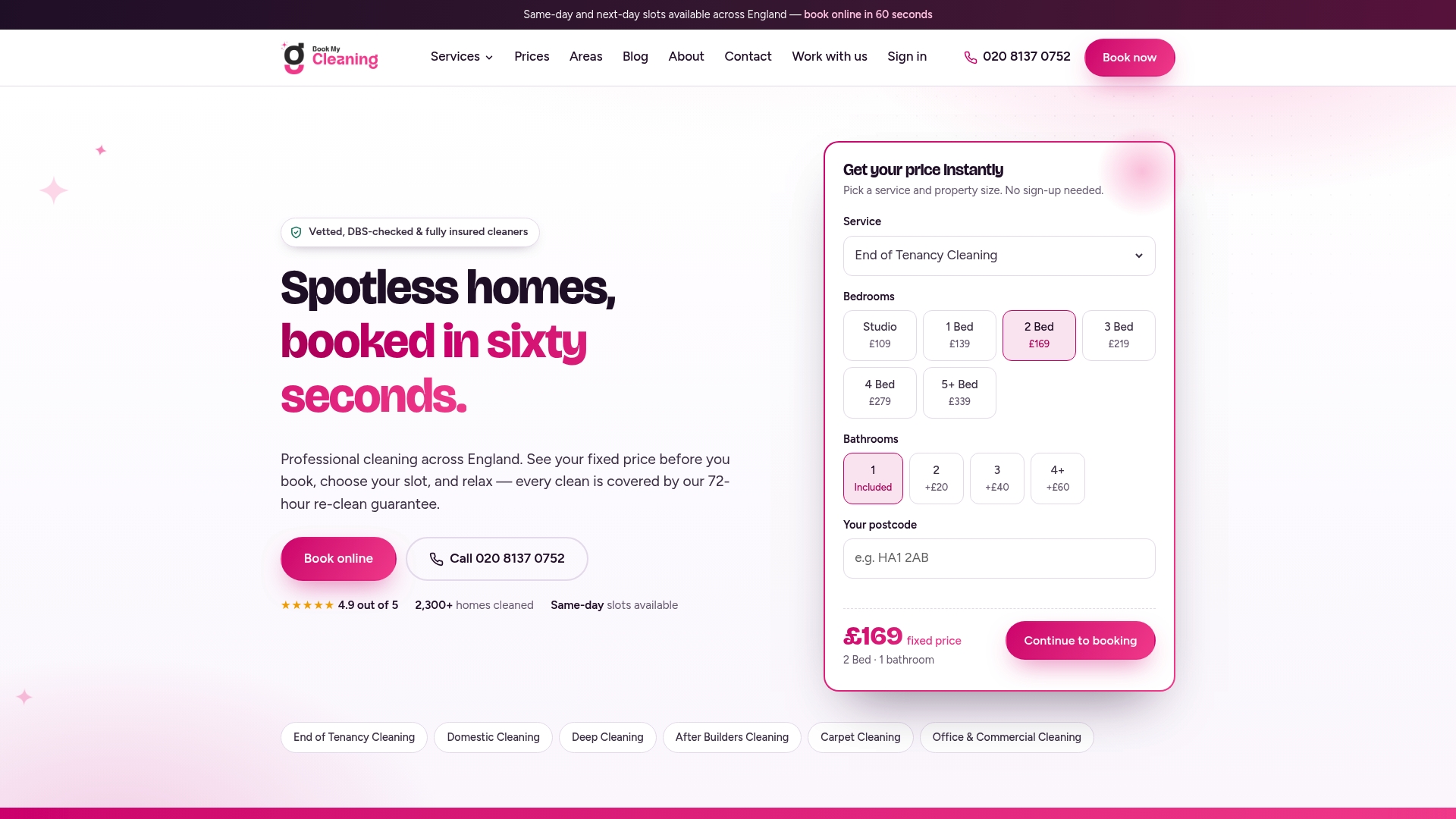
If you want a cleaner who arrives identifiable, checked and working to a written checklist, you can book online in under a minute without a card or deposit. Prices are fixed and shown upfront: domestic cleaning is from £17.50 an hour, deep cleaning from £119, and end-of-tenancy cleaning from £109, with all products and equipment provided. Full details are on Book My Cleaning, and for a regular clean in south-west London you can start with domestic cleaning in Richmond. We also cover areas across England.
If you want to understand what you are paying for first, our breakdown of what a cleaner costs in England explains the pricing.
FAQ
Is it a legal requirement for cleaners to wear a uniform in the UK?
No. There is no specific UK law requiring a work uniform. If an employer does set one, it must be reasonable and must not discriminate on the protected characteristics in the Equality Act 2010. Protective equipment is separate: where a risk requires it, the employer must provide it free of charge.
Who pays for a cleaner's uniform?
It depends on the employer and the contract. UNISON says an employer who requires a uniform should pay for it and its upkeep, though that is not a legal requirement. A deduction or charge cannot take pay below the National Minimum Wage. Cleaners who wash their own uniform may be able to claim tax relief from HMRC.
How often should a cleaner wash their uniform?
A clean uniform each working day is the sensible standard. Care-setting guidance says uniforms should survive a 60°C wash and that employers should supply enough to wear a clean one daily. A ten-minute 60°C wash removes most micro-organisms, and detergent helps at lower temperatures.
What is the best uniform for a house cleaner?
A branded tabard or polo with dark, comfortable trousers and non-slip shoes is the usual combination in UK cleaning. Tabards protect everyday clothes in domestic and heavy-duty work, while polos look smarter for offices. Footwear grip matters most, because slips are a leading cause of workplace injury.
What are the benefits of cleaners wearing uniforms?
You can identify the person at your door, see a consistent standard from visit to visit, and know which company is accountable. The cleaner's own clothes are protected from splashes. In offices and shared buildings, a uniform also helps security and neighbours recognise who should be there.
Sources
- The Law on Dress Codes, LegalVision UK
- Do employers have to provide PPE?, HSE
- National Standards of Healthcare Cleanliness 2025, NHS England
- My employer provides protective clothing, TUC
- Communal Cleaning Specification, Clarion Housing
- Cleaning Uniform Guide UK
- Cleaning operatives clothing and safety, Cleaning Magazine
- Uniform requirements, UNISON
- Tax relief for employment expenses, Low Incomes Tax Reform Group
- Infection Prevention and Control Guidance, Kirklees and Wakefield Council
- UK Parliament deposited paper DEP2009-0656