
Blot spills straight away with a clean white cloth, working inward from the edge, and never rub. Vacuum weekly with a soft or suction-only head, stick to WoolSafe-approved, low-alkalinity products, and keep domestic steam cleaners away from wool entirely. If a stain has set, a pet has been involved, or you've already tried a household spotter, stop and book a WoolSafe-aware professional rather than risk the fibre.
TL;DR:
- Regular vacuuming with a soft head and minimal soil buildup extends the life of wool carpets and prevents long-term damage from grit and soil particles.
- Immediate blotting of spills with a white cloth and gentle blotting are crucial, but avoid scrubbing or applying household spotters on set-in stains or pet urine.
- Professional cleaning using controlled water temperature, low-alkalinity products, and proper sequence is necessary for deep, embedded soil and grease removal without risking fibre damage.
- Avoid high heat and aggressive agitation during cleaning to prevent wool felting, shrinking, or uneven drying, and always ensure good airflow to speed up drying time.
- For odour issues, airing and sodium bicarbonate work well; masking smells with sprays may worsen the problem, especially in organic odours like pet urine.
Table of Contents
- Immediate spill and stain steps you can follow now
- Routine maintenance: vacuuming, prevention and interim cleaning
- Cleaning methods explained: interim, restorative, and the safety rules wool demands
- When to call a professional and what to check before you book
- Preventing shrinkage and distortion during cleaning
- Getting rid of odours without harming the fibre
- Keeping your wool carpet looking its best between cleans
- How professionals actually perform restorative cleaning
- Author perspective: why wool needs a specialist approach
- Book My Cleaning: a direct, bookable option for wool carpet cleaning
- Sources
- FAQ
Immediate spill and stain steps you can follow now
Wool reacts fast to the wrong response. Scrubbing pushes a spill deeper into the pile and roughs up the fibre's natural cuticle, which is part of what gives wool its stain resistance in the first place. Get to it within minutes and you'll usually stop a spill becoming a permanent mark.
Here's the sequence IWTO's wool carpet care guidance recommends:
- Blot immediately with a clean white cloth or paper towel, working from the outer edge of the spill toward the centre. This stops it spreading outward.
- Scoop off any solids with a spoon rather than wiping them across the pile.
- Leave mud to dry completely before vacuuming it away. Cleaning it wet just smears it into the yarn.
- Dampen your cloth with cold or lukewarm water first. Never spray a cleaning product straight onto the pile; apply it to the cloth instead.
- Work in gentle, repeated blots rather than one hard scrub, and always test any product on a hidden corner first, such as inside a cupboard or under furniture.
Stop there and call a professional if the patch is already discoloured, if it's pet urine, or if you've already tried a shop-bought carpet spotter on it. Layering more chemistry onto an already-treated stain is one of the fastest ways to turn a fixable mark into a permanent one.
Pro Tip: Keep a small offcut of your carpet, or test on a scrap under a sofa, before trying any new product. Wool dyes can bleed with the wrong pH, and you want to find that out on an inch of carpet nobody sees, not the middle of the lounge.
Routine maintenance: vacuuming, prevention and interim cleaning
Most of what damages wool carpet over the years isn't a single dramatic spill. It's grit. Sharp, dry soil particles work down into the pile and act like sandpaper every time someone walks across the room, and the fix is almost embarrassingly simple.
- Vacuum at least once a week across the whole home, and more often in hallways, under dining tables, and anywhere with heavy footfall, since dry soil that isn't lifted regularly gets ground into the base of the pile according to the WoolSafe Organisation.
- Use a suction-only or soft-bristle head rather than an aggressive rotating brush bar, and run it with the direction of the pile rather than against it.
- Doormats at every entrance and a "shoes off" habit indoors cut down dramatically on the coarse grit that causes most long-term wear.
- Between professional cleans, low-moisture interim methods, mist-and-extract, encapsulation, or absorbent compound cleaning, refresh the surface appearance without saturating the backing.
Interim methods have real limits, though. They lift surface dust and light soiling, but they don't touch grease, ground-in traffic soil, or anything that's worked down to the base of the pile. That's a job for restorative cleaning, and it always works best after a thorough pre-vacuum has already cleared the loose grit out of the way.
Cleaning methods explained: interim, restorative, and the safety rules wool demands
Interim and restorative cleaning solve different problems, and mixing them up is where most DIY attempts go wrong.
- Interim cleaning is quick, low-moisture, and dries within an hour or two. It's designed for surface refresh between deeper cleans, not for embedded or sticky soil.
- Restorative (wet) cleaning follows a fixed sequence: pre-vacuum, pre-spray, a dwell time for the chemistry to break down soil, extraction, grooming the pile back into shape, then a controlled dry. This is what actually shifts the greasy, embedded soil that interim methods can't touch, as WoolSafe's own cleaning guidance sets out.
The chemistry matters just as much as the method. Products used on wool should sit in a pH range of roughly 5.5 to 7.5, low alkalinity, with no bleach, no added dyes, and no sticky residue left behind once it dries. Anything more alkaline risks stripping the fibre's natural protective coating and can trigger colour bleed.
Heat and agitation are the other danger zone. Domestic steam cleaners frequently run hot enough to felt wool fibres, matting and shrinking them in a way that can't be reversed, British Wool's care guide warns. Professional hot-water extraction can be used safely, but only because the equipment controls temperature precisely and extracts moisture efficiently, rather than dumping heat and water into the pile and hoping for the best.
When to call a professional and what to check before you book
Some situations are simply beyond a cloth and cold water, and knowing where that line sits saves you from making a stain worse; this is why understanding professional carpet-cleaning pricing and what alters cost is essential before you book.
- Call a professional for old or set-in stains, pet urine, any sign of colour change, or a carpet that's already had a household spotter applied to it, since continued home treatment at that point raises the risk of permanent damage rather than fixing it.
- Check credentials before booking: ask whether the cleaner has WoolSafe experience or works with WoolSafe-approved products, how they control water temperature, and what their drying strategy looks like.
- Book on a schedule, not just when things look dirty. Aim for professional cleaning every 12 to 18 months in an average home, and every 6 to 12 months where there's heavy traffic or pets.
- Expect a full sequence on the day: pre-vacuum, pre-spray, dwell, extraction, and grooming, with drying times that vary by carpet weight and ventilation but typically run several hours.
Preventing shrinkage and distortion during cleaning
Shrinkage isn't really about water. It's about heat combined with agitation. Wool fibres have a natural crimp, and when they get hot and wet while being scrubbed or brushed hard, that crimp locks into a shorter, tighter shape that never fully relaxes back out. That's felting, and it's why the temperature and mechanical action matter more than how much liquid touches the carpet.
A few habits keep the risk low. Avoid rented carpet-cleaning machines built for synthetic fibres; most run far hotter and more aggressively than wool tolerates. Never grind a stain with a stiff brush, no matter how tempting it is when a mark won't lift; work it gently with a cloth instead. If a carpet has been recently fitted, give the backing time to settle before its first deep clean, since a fresh fit combined with heavy wetting is a common cause of visible rippling.
Drying speed matters just as much as the cleaning itself. Good airflow, open windows, a dehumidifier, or fans pointed across the surface all shorten drying time and stop the backing sitting damp for hours. A carpet left wet too long is more prone to shrinking unevenly as it finally dries, and it's also an open invitation for mould in the underlay. If a rug or carpet does come out of a clean looking rippled or uneven, don't try to stretch or flatten it yourself; a professional with proper carpet stretchers can usually correct it, but forcing it by hand risks tearing the backing.
Getting rid of odours without harming the fibre
Wool actually resists odours better than most synthetic fibres, thanks to its natural structure, but pet accidents, damp, and years of general use can still leave a smell behind. The instinct is to reach for a heavily scented spray, and that's usually the wrong move.
Start with a proper airing: open windows, run fans, and let the room breathe before assuming the carpet itself is the problem. If the smell persists, a light dusting of plain bicarbonate of soda left on the pile for a few hours, then vacuumed off thoroughly, absorbs odour without introducing moisture or altering pH. Avoid heavily perfumed carpet powders and aerosol deodorisers; many mask a smell rather than neutralise it, and some leave a residue that attracts more dirt over time.
For anything set into the fibre, pet urine especially, surface treatment rarely solves it. Urine can penetrate through the pile into the backing and underlay, and a genuine fix usually means a professional extraction that reaches that layer, sometimes paired with an enzyme-based treatment designed specifically for organic odours. Trying to mask it from the top with home products tends to just delay the point at which you call someone in, while giving the smell longer to settle in.
Keeping your wool carpet looking its best between cleans
A well-cared-for wool carpet can last 20 to 30 years; one that's neglected can start looking tired within about five, according to British Wool's care guidance. The gap between those two outcomes usually comes down to small, boring habits repeated consistently, not occasional heroic effort.
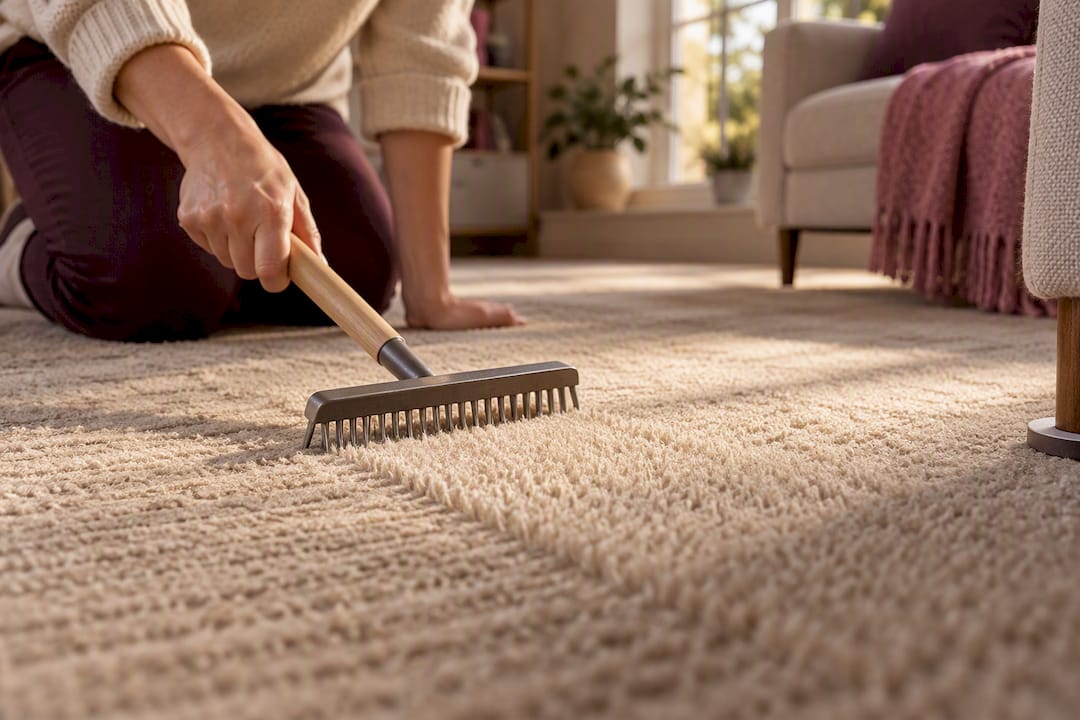
Rotate furniture occasionally so the same patches of pile aren't permanently crushed under the same chair legs. Use furniture coasters or wide-footed protectors under heavy pieces to spread the weight. Brush or groom high-traffic areas lightly with a carpet rake now and then; it lifts flattened pile fibres back upright and keeps the surface looking even rather than worn in tracks.
Direct sunlight fades wool over time just as it fades most natural fibres, so curtains, blinds, or UV-filtering film on south-facing windows genuinely extend how long colours stay rich. And keep grit management as a daily habit, not an occasional one: doormats, a shoes-off policy, and that weekly vacuum aren't glamorous advice, but they're doing more for the carpet's long-term appearance than any product you could buy.
How professionals actually perform restorative cleaning
A proper restorative clean follows a set order, and skipping steps is usually where amateur attempts and cheap operators go wrong. It starts with a thorough pre-vacuum to strip out as much dry soil as possible before any liquid touches the carpet, since wetting dry grit first just turns it into abrasive mud within the pile.
Next comes a pre-spray of a wool-safe, low-alkalinity solution, applied evenly and left to dwell for a set period so the chemistry has time to break down grease and ground-in soil without needing aggressive scrubbing to do the work instead. Extraction follows, using equipment that controls both water temperature and suction strength, pulling out the dissolved soil along with most of the moisture rather than leaving it to sit in the backing.
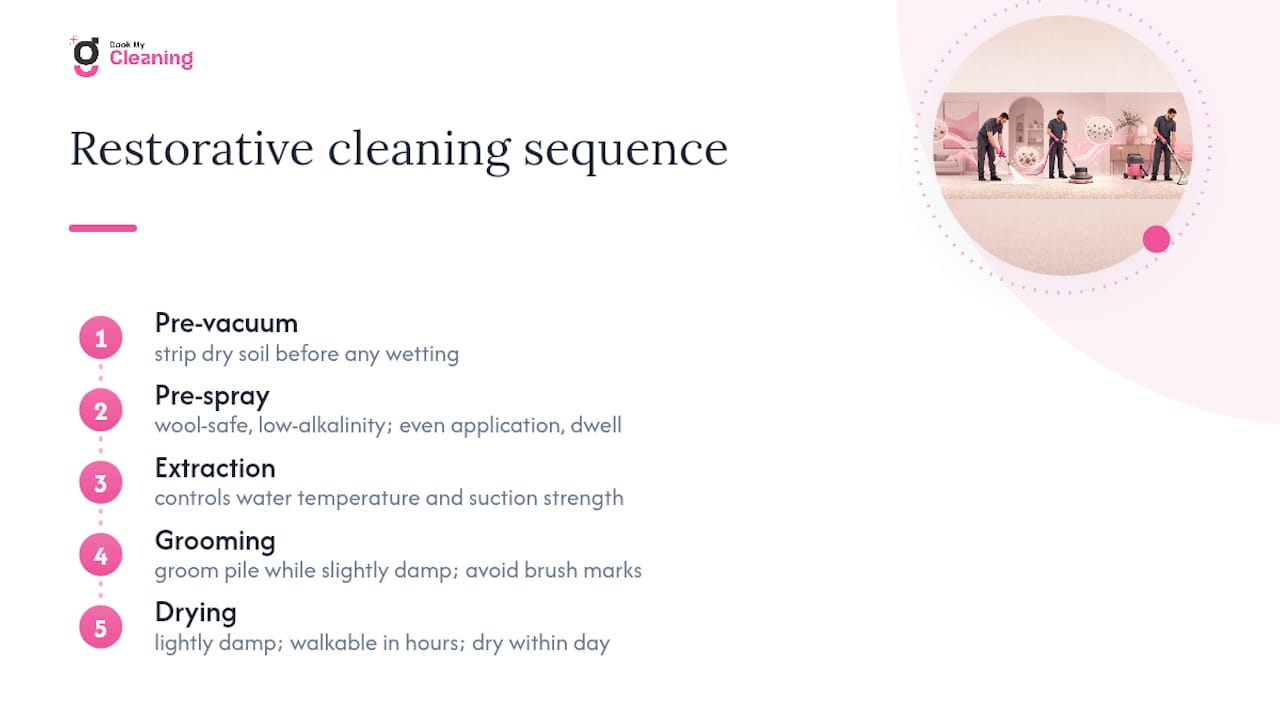
Grooming the pile back into its natural direction while it's still slightly damp is what stops a professionally cleaned carpet drying with visible brush marks or a flattened texture. Drying time depends on ventilation, carpet weight, and the room's humidity, but a well-executed job leaves the carpet only lightly damp to the touch, dry enough to walk on carefully within a few hours, and fully dry within a day given reasonable airflow.
Author perspective: why wool needs a specialist approach
Wool is a protein fibre, not a plastic one, and that single fact should shape every decision you make about cleaning it. Chemistry built for nylon or polyester can be too harsh, too hot, or too alkaline for wool without ever showing obvious damage at first. Treating it with proper respect, gentler products, controlled heat, is what protects both its look and its resale value for decades, not just years.
— Book
Book My Cleaning: a direct, bookable option for wool carpet cleaning
Wool needs a cleaner who actually understands the fibre, not one running the same hot machine they use on every synthetic carpet in town. That's the gap Bookmycleaning's carpet cleaning service fills: fixed pricing from £32 a room and a re-clean guarantee.

The service covers everything from a single stubborn stain through to a full restorative extraction across a whole property, and every job is priced upfront so there's no surprise invoice waiting at the end. Before you book, it's worth simply asking whether wool-safe, low-alkalinity products will be used on your carpet, particularly if it's an older or higher-value weave. Full pricing for carpet cleaning and every other service sits on the prices page, and booking a slot takes under a minute online.
Sources
For deeper reference: The WoolSafe Organisation for approved products and service providers, and British Wool's care guide for fibre-specific maintenance advice.
- How to clean a wool carpet guide - British Wool Shop (2026)
- Wool carpet care and maintenance guide — IWTO (2024)
FAQ
How do you clean a 100% wool carpet?
Blot spills immediately with a clean cloth, vacuum weekly with a soft or suction-only head, and use only WoolSafe-approved or low-alkalinity products for spot treatment. For anything beyond light surface soiling, a professional restorative clean using controlled temperature and extraction is the safer route.
Can you professionally clean a wool carpet?
Yes, and for anything beyond routine maintenance it's the recommended approach. Professionals follow a set sequence of pre-vacuum, pre-spray, dwell, extraction, and grooming, using equipment that controls both temperature and moisture, which is exactly what Bookmycleaning's carpet cleaning service offers from £32 a room.
What is the best carpet cleaning solution for wool carpets?
Look for products that are WoolSafe-approved and sit within a low-alkalinity pH range of roughly 5.5 to 7.5, with no bleach or added dyes, as WoolSafe's own guidance specifies. Avoid anything marketed for general or synthetic carpets unless it's specifically confirmed as wool-safe.
Do wool carpets need to be cleaned?
Yes. Even with weekly vacuuming, wool carpet benefits from a professional restorative clean roughly every 12 to 18 months in an average home, or every 6 to 12 months with heavy traffic or pets, since vacuuming alone can't remove deep, embedded soil.