
A hidden cleaning fee is any charge you were not clearly told about before you booked. It usually turns up as an add-on for the oven, parking, heavy dirt, key collection or a minimum booking. The simplest way to avoid it is to book a cleaner who shows a fixed price online before you commit, with every extra listed and priced. That is how we work at Book My Cleaning, and the rest of this guide shows you what to look for in any quote.
TL;DR
- A hidden fee is a mandatory or likely charge missing from the headline price. A clearly listed, optional extra is not.
- Since 6 April 2025, UK businesses must show the total price up front, including compulsory charges.
- The usual culprits are ovens, carpets, balconies, parking, key collection, heavy soiling, short-notice booking and VAT.
- Before you pay, check what the price includes, what it excludes, who supplies products and equipment, and what happens if the result falls short.
- If an unagreed charge appears, keep the quote and messages, and complain in writing.
Table of Contents
- What counts as a hidden fee in a cleaning quote
- The extras that most often appear
- What UK law says about prices
- How to read a cleaning quote before you book
- Where hidden fees appear in each type of clean
- What it looks like when each extra has a price
- If a charge appears that you did not agree
- Our view: a price you can plan around
- Book a fixed price clean
- FAQ
- Sources
What counts as a hidden fee in a cleaning quote
Not every extra charge is hidden. A cleaner can charge more for an oven, a balcony or a very dirty kitchen. The problem starts when you only learn about the charge after you have booked, or when the first price you saw could never really be booked.
A UK legal guide for cleaning businesses makes the same point: the issue is not charging extra but hiding it. It also notes that advertising something like 'from £15 per hour' when that rate cannot be booked in ordinary circumstances may mislead customers.
In practice, a charge is hidden when it meets one of these tests:
- It is compulsory but not in the headline price. Parking, travel, a call-out or admin fee you cannot avoid.
- It is likely but described as 'possible'. 'Heavy soiling may cost extra' on a flat everyone knows is heavily soiled.
- It appears after you have committed. On the doorstep, in an invoice, or on a confirmation page for the first time.
- It was added without your say-so. A ticked box or a quiet upgrade you never asked for.
- The price is a rate that does not match the job. A low hourly figure with a minimum number of hours that makes the real cost much higher.
The extras that most often appear
The same handful of items causes most disputes. The table shows where each tends to show up and the question that settles it.
| Extra | Where it appears | The question to ask |
|---|---|---|
| Oven, fridge or freezer interiors | End of tenancy, deep clean | Is the inside of the oven in the price? |
| Inside windows, external windows | Tenancy, deep clean | Are windows included, inside and out? |
| Carpets and upholstery | Tenancy, after builders | Is carpet cleaning separate, and priced per room? |
| Balcony or patio | Flats and houses | Is outdoor space covered? |
| Parking or congestion costs | Central London and other cities | Is any travel or parking cost added? |
| Key collection from an agency | Tenancy cleans | Is collecting keys charged? |
| Heavy soiling, limescale, paint splashes | Deep clean, after builders | What counts as heavy, and what does it cost? |
| Minimum hours or minimum spend | Domestic and office | What is the smallest booking? |
| Cleaning products and equipment | Any | Who supplies them, and is it free? |
| VAT | Commercial work especially | Is the quoted price with or without VAT? |
| Short-notice or same-day surcharge | Any | Does a quick slot cost more? |
The legal guide above lists very similar items: ovens, carpets, balconies, pet hair, parking, key collection, heavy soiling and short-notice bookings are the areas where a low entry price can hide extra cost.
What UK law says about prices
You do not need to know the statute to book a cleaner, but a few rules are worth knowing because they back up what a fair quote looks like.
Total price up front
From 6 April 2025, the Digital Markets, Competition and Consumers Act (DMCC Act) requires businesses to give the total price upfront, including mandatory charges, when they invite you to buy. Genuinely optional charges are excluded. Mandatory charges include unavoidable fees you must pay to receive the service, such as administration or compulsory cleaning charges. This practice of revealing costs in stages is known as drip pricing.
So a price that excludes a charge you cannot avoid is, in principle, the wrong way round. A price that leaves out an optional extra, such as an oven clean you can choose to add, is fine.

What you were told becomes part of the contract
Under the Consumer Rights Act 2015, section 50 treats information about a service that you took into account as a term of the contract. If the price or inclusions were stated before you booked, they count. Where no price was fixed at all, section 51 says you pay a reasonable price for the service and no more.
Extras need your consent
The government's own report on the Consumer Contracts Regulations explains that traders must obtain express consent for any extra paid services, and that pre-ticked boxes for additional charges were effectively banned. You are not liable for payments that arise from them.
How to read a cleaning quote before you book
A good quote lets you answer every question below without a phone call. If you cannot, the gaps are where extra costs live.
1. Find the headline price and what it is for
Is it a fixed fee for the whole job, or an hourly rate? A fixed fee for a one-bedroom flat tells you the cost. An hourly rate tells you the cost only if you know how many hours the job takes. If it is hourly, ask how the number of hours was estimated for your property.
2. Read the inclusions and exclusions
Look for a written checklist of tasks. A phrase like 'full clean' means different things to different people, and a tenancy inventory or landlord's list can be much more specific. Our guide to what is standard and what is extra in a professional clean sets out the typical split for tenants.
3. Check who supplies products and equipment
A surprising number of low prices assume you provide the vacuum, the ladder or the descaler. Confirm that products and equipment are included.
4. Ask about the add-ons you are likely to need
Oven, fridge, windows, balcony, carpets, limescale. If you know you need them, get them priced at the start, so the total you see is the total you pay.
5. Check minimums, surcharges and VAT
Is there a minimum number of hours? Is there a charge for short notice, evenings or weekends? Is VAT included? For business customers especially, a price quoted without VAT is 20% lower than the price you will actually pay if VAT applies.
6. Look at what happens if the result is not right
A fixed price means little if you pay again to fix problems. Look for a clear re-clean promise with a time limit, and a way to report problems in writing.
7. Get it in writing
A screenshot of the price page, a confirmation email and the checklist are all you need. Because what you were told before booking can count as a term of your contract, keeping that record is the sensible habit.
Where hidden fees appear in each type of clean
End of tenancy cleaning
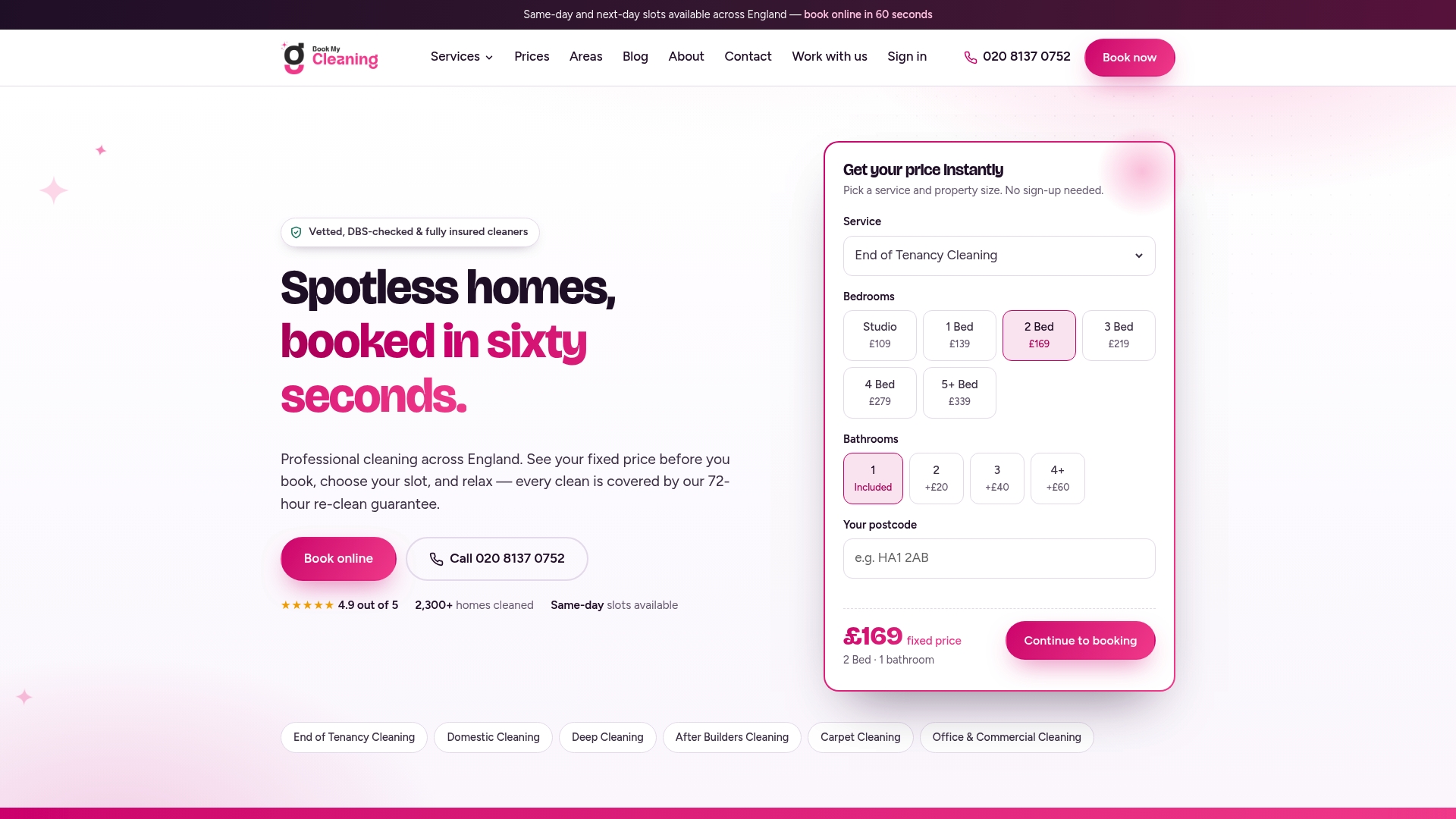
Tenants have the most to lose here, because the deposit depends on the clean and the deadline is fixed. The common traps are separate charges for the oven, carpets, inside windows and key collection from the agency. Prices also scale with property size, so check that the quote matches your number of bedrooms and bathrooms. Our end of tenancy cleaning starts from £109 and goes up to £339 depending on the property, with the figure shown online before you book.
Landlords arranging a clean between tenants should check the same list, plus access: who has the keys and when.
Regular domestic cleaning
For busy professionals, the trap is the hourly rate. A low per-hour price is only useful if the cleaner can do what you need in the hours you book, and if there is no minimum that inflates it. Our domestic cleaning is priced from £17.50 to £20.95 per hour. For a fuller picture of rates in England, see what a cleaner really costs in 2026.
Deep cleaning and after builders cleaning
Homeowners finishing a renovation often get the biggest surprises: dust on every surface, paint splashes, cement residue and limescale. A quote that says 'subject to condition on arrival' leaves the door open to extra charges on the day. Ask for a fixed price for your property size, and a list of the heavy-duty tasks included. Our deep clean runs from £119 to £329 and our after builders cleaning from £159 to £419, both fixed one-off prices by property size.
Office and commercial cleaning
Commercial pricing works differently. Office cleaning in 2026 generally falls in the £18 to £25 per hour band, and contracts are often quoted as a fixed monthly fee after a site survey. Office managers should confirm hours, frequency, consumables such as paper and soap, VAT and notice periods in the contract. Where a site visit sets the price, it should be free and the resulting quote should be written. We offer a free site visit, for example for office cleaning in Sutton. We do not publish a standard price for office work, because it depends on the premises.

What it looks like when each extra has a price
The cleanest way to avoid a hidden fee is to see every optional extra priced before you book. These are the add-ons on our price page:
| Add-on | Price |
|---|---|
| Inside oven | £25 |
| Inside fridge / freezer | £15 |
| Inside windows | £15 |
| External window cleaning | £25 |
| Balcony / patio cleaning | £15 |
| Key pick-up from agency | £15 |
| Heavy limescale treatment | £20 |
| Paint splash removal (heavy) | £30 |
| Wall spot cleaning | £20 |
| Carpet cleaning (per room) | £32 |
| Upholstery / sofa cleaning (per item) | £25 |
| Mattress deep clean (per mattress) | £30 |
| Laundry (wash and fold) | £12 |
| Ironing (per hour) | £17.50 |
A worked example: a tenant adds the oven (£25), the fridge (£15) and carpets in two rooms (£64) to a tenancy clean. The extras come to £104, and the tenant can add that to the base price on screen before paying. Nothing is added later, and you choose which items to include.
If a charge appears that you did not agree
Do not simply pay and hope. Here is what to do:
- Gather the evidence. The original quote, the booking confirmation, the invoice and any messages.
- Compare them. Was the extra charge mentioned before you booked? Did you consent to it?
- Complain in writing. State the amount you dispute and refer to the Consumer Rights Act 2015. A trader cannot normally raise the price unilaterally unless the contract fairly and clearly allows it, according to a UK consumer guide.
- Ask for a refund or a price reduction of the unauthorised amount.
- Escalate if needed. If the trader belongs to an alternative dispute resolution scheme, you can use it. Citizens Advice can help you with next steps.
Cancelling is a separate matter. After a contract is formed, a business could charge a cancellation fee or keep part of a deposit to cover its loss, so read the cancellation terms before you book too. If you asked for the work to begin inside the cooling-off period, you pay proportionately for what was supplied, as the DMCC guidance notes.
Our view: a price you can plan around
Most arguments about cleaning bills start the same way: the customer expected one number and received another. We think the fix is simple. Show the price before the customer commits, and list every extra with its own price.
That is why our prices are fixed and visible online before booking, with no hidden fees. Domestic, deep, end of tenancy and after builders cleans are priced by service and property size, and the add-ons sit on the same price page.
The rest of the experience follows from the same idea. Our cleaners are vetted, DBS-checked and arrive in uniform. We provide all products and equipment. Each job has a written checklist, and our 72-hour re-clean guarantee means that if standards are not met, we come back. You can book online in under a minute without a card or deposit.
Tenants, landlords, homeowners and office managers all need the same thing: to know what they are paying for. We have cleaned more than 2,300 homes and hold a 4.9-star rating, because clear pricing and a clear checklist leave little room for disagreement.
Book
Book a fixed price clean
If you want the total in front of you before you commit, start on our prices page. Choose your service, enter your property size, add the extras you need and see the price. End of tenancy cleans start from £109, deep cleans from £119, after builders cleans from £159 and domestic cleaning from £17.50 per hour. Same-day slots are available.
If you are a tenant in west London, our pages for end of tenancy cleaning in Kensington and in Chelsea show the fixed price from £109. For a step by step walk through, see our five step booking checklist.
FAQ
What is a hidden fee in cleaning?
It is any charge you were not clearly told about before booking, such as parking, access, heavy dirt, a minimum spend or an add-on. Optional extras that are clearly priced in advance are not hidden. Compulsory charges missing from the headline price are the ones to watch.
Is VAT usually included in cleaning quotes?
It depends on the provider and the customer. Always confirm whether the figure you see includes VAT, especially for office and commercial work where prices are often quoted without it. A written quote should say which applies.
Can a cleaner charge extra on the day?
Only if you agreed to it. Information you were given before booking can form part of the contract, and extra paid services need your express consent. If a charge appears that you did not agree, keep your quote and messages and complain in writing.
How do I know what a clean includes?
Ask for a written checklist and compare it with your tenancy agreement, landlord's list or your own priorities. Check ovens, windows, carpets and balconies in particular, as these are the items most often priced separately.
Sources
- Drip pricing: CMA clarifies obligations
- Consumer Rights Act 2015, Part 1, Chapter 4
- Statutory Report on the Implementation of the Consumer Contracts Regulations
- Advertising Rules for Cleaning Companies in the UK
- Office and Commercial Cleaning Prices UK (2026)
- How to Claim a Refund for Overcharged Services
- Cancelling a service you've arranged, Citizens Advice