
The standard is simple to state: you return the property in the same state of cleanliness it was in when you moved in, allowing for fair wear and tear. It is not "spotless", and in England your landlord or letting agent cannot make you hire a professional cleaner. What decides a dispute is the evidence: your check-in inventory, your check-out report and your tenancy agreement. This guide explains how that works in practice, room by room, so you know what to do before you hand back the keys.
TL;DR
- The benchmark is the property's condition at check-in, less fair wear and tear, not a showroom finish.
- A landlord cannot require you to pay for professional cleaning, but you can use a company of your choice if you prefer.
- Deductions must be reasonable, relate to a real loss and be backed by evidence such as check-in and check-out reports.
- Kitchens (oven, hob, appliances) and bathrooms are where most cleaning claims start, so give them the most attention.
- Photograph everything on your last day and keep any invoice or checklist.
Table of Contents
- What standard do tenants actually have to meet?
- Can a landlord or letting agent require a professional clean?
- What cleaning is commonly expected, room by room
- Fair wear and tear versus cleaning
- When can a landlord deduct cleaning costs?
- What letting agents and landlords can fairly check
- Perspective: why a written checklist beats guesswork
- A practical plan for your last week
- Doing it yourself or booking a clean
- Book an end of tenancy clean with a fixed price
- FAQ
- Sources
What standard do tenants actually have to meet?
Tenants are expected to return the property in a similar condition to the start of the tenancy, with allowance for fair wear and tear, and cleaning claims are treated separately from wear and tear in the Tenancy Deposit Scheme's (TDS) guidance on inventories. In other words, you are not obliged to leave the home cleaner than you found it. Shelter's advice for England says the same: deductions must be reasonable and relate to money the landlord has lost, and a tenant does not have to improve the property.
That is the legal and practical principle. In everyday language, "end of tenancy standard" usually means the level a good cleaner would reach in a rented home: every surface wiped, appliances cleaned inside, bathrooms descaled, floors clean, and no rubbish left behind. Your tenancy agreement may describe this in its own words, often with a line such as "leave the property clean and tidy" or "in the same condition as at the start". Read that clause before you plan anything.
Why the check-in inventory matters most
The check-in report records the cleanliness and condition of the property at the start. Comparing it with the check-out report shows what has changed, and that change is what a deposit claim has to be about.
There is a catch that works in your favour. Under TDS's approach to cleaning disputes, landlords cannot assume a property was clean at the start unless the inventory says so explicitly or other evidence, such as a professional cleaning invoice, supports it. If your inventory says nothing about cleanliness, or describes the oven as "used", the baseline is weaker than a landlord might hope.
So the first job is to find your inventory and the photos you took when you moved in. If you never checked it, our guide to a move-in cleaning checklist shows what to record on day one, and it is worth keeping for your next tenancy.
Can a landlord or letting agent require a professional clean?
No, not in England. Shelter's guidance is that a landlord cannot require you to pay for professional cleaning. A clause demanding a professional standard of cleanliness is only fair if the property was cleaned to that standard before you moved in.
The legal reason is the Tenant Fees Act 2019. A recent official decision on a prohibited payment treated a requirement to clean professionally and provide receipts as a third-party service contract barred under section 1(3) of the Act in England. That is why letting agent emails demanding "a professional clean with a receipt" are often not enforceable as written.
What does that mean for you?
- You can clean the property yourself, or use a cleaning company of your own choice.
- If a letting agent insists on a named firm or a receipt, you can challenge it. Ask them in writing which part of your agreement or the law requires it.
- You are still responsible for leaving the home in the condition the standard above describes. Not being forced to hire a professional does not remove the duty to clean.
This guide covers England. If you rent in Wales, Scotland or Northern Ireland, check the guidance for your own nation, as the tenancy rules and deposit schemes differ.
What cleaning is commonly expected, room by room
No statute lists the tasks. Guidance from student housing advisers gives a realistic picture of what is commonly expected: kitchens including ovens, hobs and appliances, bathrooms including tiling, showers and toilets, plus woodwork, windows, furniture and outside areas left clean and free of rubbish. Here is how that turns into a working list.
Kitchen
This is the most common source of deductions, because grease builds up slowly and is easy to spot.
- Oven, grill and racks cleaned inside, plus the hob and extractor filter.
- Fridge and freezer emptied, defrosted and wiped, with the door seals clean.
- Cupboards emptied and wiped inside and out, worktops and splashbacks degreased.
- Sink and taps descaled, bins emptied and cleaned.
If the oven is beyond a quick scrub, a dedicated clean is the practical choice. On our price list an inside oven clean is £25 and an inside fridge or freezer clean is £15, and both can be added to any booking.
Bathroom and toilet
- Limescale removed from taps, shower screen, tiles and the toilet bowl.
- Grout and sealant wiped free of mould where it is surface mould, not damage.
- Mirrors, cabinets and extractor fans wiped, plughole cleared.
Heavy limescale is a common reason a bathroom fails inspection. We offer a heavy limescale treatment at £20 for the tougher cases.
Living areas and bedrooms
- Floors vacuumed and mopped, skirting boards, door frames and light switches wiped.
- Windowsills and the inside of windows cleaned. Inside windows are £15 on our list; external window cleaning is £25.
- Wardrobes and drawers emptied and wiped.
- Marks on walls cleaned where they will come off. Our wall spot cleaning is £20.
Carpets, upholstery and mattresses
Carpets are a grey area. If the inventory recorded them as clean and stain-free, a visible new stain is a legitimate cleaning issue. If they were already worn or marked at check-in, that is not your cost. Professional carpet cleaning is £32 per room with us, upholstery is £25 per item and a mattress deep clean is £30. These matter mainly if you had pets, spills or furnished lets with sofas and beds included in the inventory.

Outside areas and communal spaces
Balconies, patios and any garden you have use of should be tidy and free of rubbish. Balcony or patio cleaning is £15 on our list. Communal hallways are normally the landlord's responsibility unless your agreement says otherwise.
Smells
Odour is part of cleanliness, though it is rarely listed. If you or a previous occupant smoked, or you had pets, fresh air and wiping surfaces help, and guidance on smoke smell removal room by room explains what works on fabrics, hard surfaces and the air itself.
Fair wear and tear versus cleaning
Fair wear and tear means changes caused by normal everyday living. According to Shelter, a landlord cannot keep deposit money for it. A lightly worn carpet in a walkway, faded paint or a loose door handle all fall into this group.
How it is judged varies. Adjudicators look at the length of the tenancy, the type of occupants such as families with children, and the quality of the contents. A five-year tenancy will naturally show more wear than a six-month one.
Cleaning is different. Dirt, grease, limescale and rubbish are not wear and tear: they are things you can reasonably be expected to remove. That is why cleaning disputes are so common. TDS reports that cleaning disputes account for over 60% of the cases it handles, which is why clear documentation at both ends matters to tenants and landlords alike.
When can a landlord deduct cleaning costs?
A landlord may claim cleaning costs when evidence shows the property was less clean at the end than at the start. The check-in and check-out reports are the key documents, and detailed invoices or quotes support the amount.
Two limits protect you:
- The claim must be proportionate. Adjudicators do not simply accept an invoice for a full professional clean if the work went beyond what was needed to restore the original pre-tenancy state.
- The landlord needs evidence of a loss. Deductions have to be reasonable, and a landlord cannot use the deposit to upgrade the property.
If you disagree with a deduction, you can ask the deposit protection scheme holding your money to resolve the dispute. Gather your inventory, dated photos, any cleaning invoice and the correspondence, and respond to the landlord's itemised claim point by point.
What letting agents and landlords can fairly check
If you are the landlord, the same logic applies in reverse. Your claim is strongest when your inventory is detailed, describes cleanliness honestly and is signed or acknowledged by the tenant at the start. Regular inspections help you spot problems early: the DPS advises that landlords inspect properties regularly, and that seasonal inspections are enough.
For a fair check-out, walk the property with the check-in report in hand, compare room by room, photograph differences and give the tenant a chance to put them right. A professional-standard clause only stands up if you can show the property was professionally cleaned before the tenancy began, for example with an invoice.

Housing associations in Northern Ireland follow a related approach: sample guidance says a recoverable charge may be raised if a vacated dwelling is not left clean and the association has to pay a contractor to clean it. The principle is the same across the UK: you pay for a real cleaning cost, not for ordinary use.
Perspective: why a written checklist beats guesswork
We see the same pattern on most end of tenancy jobs. Tenants are rarely refused a deposit because they did not try hard enough. They lose money because nobody agreed in advance what "clean" meant, and nobody has the evidence to say what the standard was.
That is why we work from a written checklist covering kitchen, bathrooms, floors, windows and the details agents tend to inspect: oven interiors, limescale, skirting boards and cupboards. Our cleaners are vetted, DBS-checked and arrive in uniform with all products and equipment, so there is nothing for you to supply.
Our prices are fixed and shown before you book, with no hidden fees. End of tenancy cleaning runs from £109 to £339 depending on the property. If the standard is not met, our 72-hour re-clean guarantee means we come back to put it right.
The best protection is still a mix of evidence and a proper clean: your inventory, dated photos at check-out, and a checklist you can point to.
Book
A practical plan for your last week
- Find your paperwork. Locate the tenancy agreement, check-in inventory and any move-in photos. Note what they say about cleanliness.
- Read the cleaning clause. If it demands a professional clean with a receipt, remember it may not be enforceable in England, but decide whether hiring help is worth it for your own peace of mind.
- Work from a room-by-room list. Our move out cleaning checklist with photo evidence breaks the job down, and our end of tenancy checklist covers the points that most often cost deposits.
- Clean after your belongings are out. Empty rooms are easier to clean and show no dust or marks from furniture.
- Photograph and date everything. Take wide and close-up shots of the oven, fridge, bathroom, floors and windows. Keep any receipts or quotes.
- Attend the check-out. If you can, be present with your inventory and discuss differences on the spot.
- Keep a record of the keys handover. Note the date and time, and keep any emails confirming it.
For a clearer view of what is routine and what is an extra, our standard versus extra cleaning checklist is a useful companion, and our guide on guarding your deposit with the inventory first goes deeper on evidence.
Doing it yourself or booking a clean
Cleaning the property yourself is perfectly acceptable, and many tenants do it. It is mostly a question of time, tools and the condition of the oven and bathroom. If you are moving the same week, juggling work or leaving a long-lived-in property, booking a clean can take the pressure off.
Here is how our options compare for a tenant leaving a home:
| Need | What we offer | Published price |
|---|---|---|
| Full clean before handing back keys | End of Tenancy Cleaning | £109 to £339 one-off |
| Heavily used oven | Inside oven | £25 |
| Fridge or freezer | Inside fridge / freezer | £15 |
| Carpets with marks | Carpet cleaning | £32 per room |
| Limescale build-up | Heavy limescale treatment | £20 |
| Agent holds the keys | Key pick-up from agency | £15 |
The price depends on property size, and you see it before you book. If you want more detail on how a professional clean works with your deposit, read our guide to checkout cleaning for UK tenants and the page on our 72-hour re-clean guarantee.
Book an end of tenancy clean with a fixed price
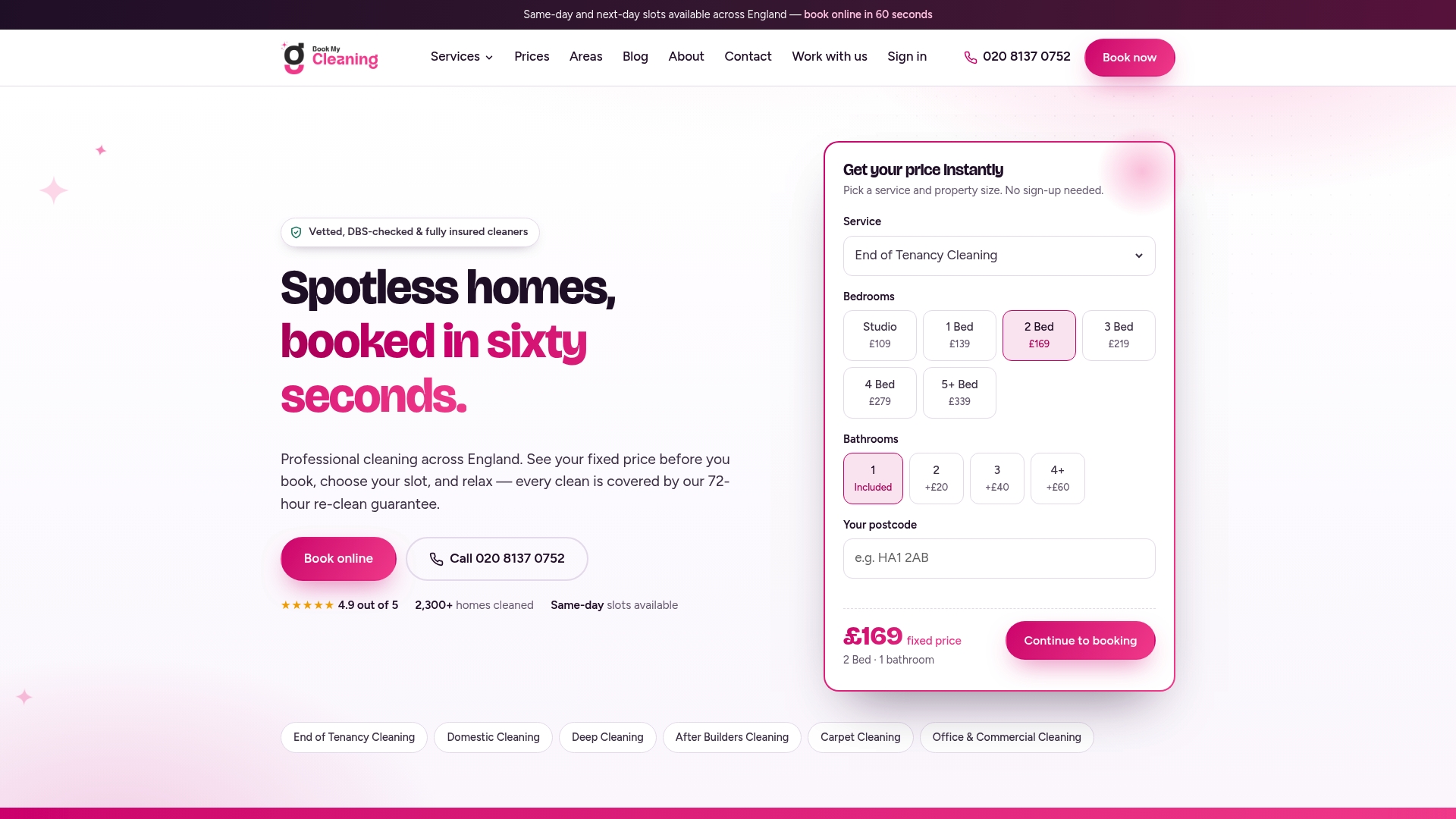
If you would rather hand the job to someone else, we can do it. You choose your service online, see the fixed price straight away and book in under a minute, with no card or deposit needed to reserve. Same-day slots are available, and every clean is backed by our 72-hour re-clean guarantee.
We cover England, including London areas such as Kensington, Ealing and Acton. You can also start from our main site to see all services and prices.
FAQ
Is end of tenancy cleaning mandatory in England?
No. A landlord cannot require you to pay for professional cleaning, and the Tenant Fees Act 2019 is the reason. You still have to return the property in a similar state of cleanliness to the start, allowing for fair wear and tear, whether you clean it yourself or use a company.
What are the landlord's cleaning requirements at check-out?
There is no fixed national list. The benchmark is the condition recorded in the check-in inventory, plus anything reasonable in your tenancy agreement. Landlords and agents typically inspect the kitchen, appliances, bathrooms, floors, windows and any outside areas.
Can a letting agent make me use a particular cleaning firm?
Not in England if it amounts to requiring a third-party service. You can clean the property yourself or choose your own company. If an agent insists, ask for the clause and the legal basis in writing, and contact your deposit scheme or Shelter if you are unsure.
What happens if the landlord says it wasn't clean enough?
They must show the property was less clean at the end than at the start, using the inventory, photos and invoices. You can dispute the claim through your deposit protection scheme. Adjudicators look at whether the amount is proportionate and evidenced.
Sources
- TDS guide to inventories, check-in and check-out reports
- How TDS approaches disputes involving cleaning
- Shelter England: what can a landlord keep from your deposit
- Shelter England: can landlords charge for cleaning and gardening
- Tenant Fees Act prohibited payment decision, February 2026
- Newcastle University Students' Union: cleaning at the end of a tenancy
- DPS: common dispute questions
- Department for Communities: recoverable charges
- Smoke smell removal, room by room