
Inventory check cleaning is the cleaning you do before your check-out inspection so the property matches the cleanliness recorded in your check-in inventory. The inspector compares the two reports. If the property is less clean at the end than it was at the start, the landlord can claim the cost of putting that right from your deposit. This guide explains what the standard is, what to clean room by room, and how to leave evidence that holds up.
TL;DR
- Your check-in inventory sets the benchmark. The check-out inspection measures your clean against it, not against a hotel standard.
- Cleaning is a tenant obligation. Fair wear and tear covers condition, such as faded paint, not dirt, grease or limescale.
- Your landlord or agent cannot force you to hire a particular cleaning company, but they can ask for a professional standard and claim against your deposit if you fall short.
- Oven, fridge, carpets, windows and limescale are the items most often questioned. Photograph them dated, once you have finished.
- A fixed-price end of tenancy clean from us starts at £109, and our 72-hour re-clean guarantee covers you if standards are not met.
Table of Contents
- What inventory check cleaning actually means
- What standard do you have to reach?
- Can your landlord make you hire a professional cleaner?
- Room-by-room checklist for the inspection
- How to prepare before the inspection
- Where tenants lose money, and what it costs to fix
- How it differs from domestic, deep and commercial cleaning
- Perspective
- Booking a professional end of tenancy clean
- If a deduction is disputed
- FAQ
- Sources
What inventory check cleaning actually means
The phrase mixes two things that are often confused: the inventory and the cleaning.
The inventory is a document. The Tenancy Deposit Scheme (TDS) describes it as a record of the cleanliness and condition of the property immediately before the tenancy starts. The check-in is where you agree that record. The check-out is where the condition at the end is recorded so that any changes can be identified.
The cleaning is your job. It is the work needed to bring the property back to the cleanliness the inventory describes, before the check-out happens. So "inventory check cleaning" is not a separate trade or a special technique. It is a tenancy-end clean, done with the inventory in your hand.
MyDeposits explains that an inventory check records the property's contents, condition and cleanliness, usually with photographs or video, creating a record that can be compared over time. It also notes that an inventory is not a legal requirement in the UK but is strongly recommended, because without one it is hard to prove who caused damage or cleaning issues.
Inventory, check-in, check-out and cleaning: who does what
| Stage | What happens | Whose job |
|---|---|---|
| Inventory | The property's contents, condition and cleanliness are written up, usually with photos | Landlord or agent, often an independent inventory clerk |
| Check-in | You read the report, note disagreements and agree it | You, ideally in the first days of the tenancy |
| Your clean | You return the property to the recorded cleanliness | You |
| Check-out | The property is inspected and compared with the inventory | Landlord, agent or inventory clerk, with you invited |
What standard do you have to reach?
The short answer is: the standard in your check-in report. The longer answer has three parts.
Professional standard is the usual expectation. The TDS guide says property and contents should be cleaned to a professional standard for the check-out unless other arrangements have been agreed with the agent or landlord. The same guide notes that over 60% of the deposit disputes TDS deals with involve cleaning, so this is where most arguments start.
Check-in cleanliness matters. A law firm's guidance puts it plainly: if the property was professionally cleaned at the start, a landlord can reasonably expect something similar at the end, but if it was not, they cannot demand more at the end. TDS takes the same approach in cleaning disputes: it looks for evidence that the property was less clean at the end than at the start, and it will not decide a case solely on a clause in the tenancy agreement.
Fair wear and tear does not excuse dirt. TDS defines fair wear and tear as the deterioration a landlord might reasonably expect from everyday use over the tenancy. That covers things like a worn carpet pathway or lightly faded paint. TDS does not treat it as relevant to cleaning claims, so grease on the hob or limescale on the taps is yours to clear. For Scotland, Shelter Scotland gives a useful example: if you leave a stain on a carpet, the landlord can only charge for cleaning it, not a whole new carpet.
Can your landlord make you hire a professional cleaner?
Not as a condition of the tenancy. The Tenant Fees Act guidance for England says landlords cannot require a tenant to use a particular company, but they may ask for the property to be cleaned to a professional standard and can claim against the deposit if it is not left in a fit condition. The Property Ombudsman's code for letting agents in England repeats the point: an agent cannot require you to pay for a professional clean at check-out, but may ask for that standard.
The same code says that when notice is given, the agent must give you written guidance on preparing for the check-out and flag any clauses about cleaning standards or deposit deductions. Ask for it if it has not arrived.
In practice, you choose how to reach the standard. Many tenants do it themselves. Others book a professional because the oven, carpets and limescale take longer than expected, or because they are moving the same day. Both routes are legitimate. What matters is the result on the day of the inspection.
Room-by-room checklist for the inspection
Use your own inventory first, then work through these. The tasks below draw on checklists published by a letting agent, a student housing charity and a landlord guide.
Kitchen
The kitchen draws most of the scrutiny.
- Empty and clean every cupboard and drawer, including under the sink, and wipe the fronts and handles.
- Clean worktops, sink, taps and tiles, and wipe walls, switches and sockets of fingerprints and food splashes.
- Clean the oven inside, plus the hob, grill pan and knobs. Read the manufacturer's instructions first, and keep oven cleaner off the outside of the cooker.
- Clean the microwave inside and out. Heating a mug of water on full power for two minutes loosens the residue.
- Defrost and clean the fridge and freezer, then wedge the doors open to stop mould.
- Clean the floor, including under the cooker and fridge if you can move them safely.
Bathroom
- Descale and clean the shower, screen, bath, taps and tiles.
- Clean the toilet, including behind the pan and around the base.
- Wipe mirrors, cupboards and the floor, and clear the extractor grille if it is accessible.
Bedrooms, living areas and hallways
- Remove all belongings and rubbish, plus posters, blue tack and tape.
- Dust surfaces, skirting boards, light fittings and picture rails, and clear cobwebs.
- Vacuum carpets, including under beds and behind wardrobes.
- Clean wardrobes and drawers inside and out, and put back any furniture that was in the room at the start.
- Wipe paintwork, door handles and windowsills, and clean windows and mirrors.
- Rehang curtains properly.
The things that are not cleaning
Shelter England advises tenants to replace missing or broken items, fix damage they caused if they can, and clean so the property is the same as when they moved in. Make sure the garden matches its check-in state and that rubbish too big for your bins is removed. For a longer version with photo prompts, see our room-by-room move-out checklist and our guide to what is standard and what is extra.
How to prepare before the inspection
Good preparation is mostly paperwork and order of operations.
- Read your check-in inventory and tenancy agreement. Note the cleanliness wording for each room, and any items listed that you must return.
- Confirm the end date and key return in writing. Flatfair advises tenants to confirm these arrangements in writing and to record meter readings.
- Empty the property first. Cleaning around boxes means cleaning twice. Remove belongings and rubbish before you start.
- Clean from top to bottom. Dust and wipe high surfaces first, do floors last.
- Clean appliances early. Ovens and fridges need time to soak or defrost.
- Attend the check-out. Shelter England advises tenants to be there if they can, make sure disagreements are recorded, show proof of damage that was there before, and sign and date the check-out report only if they are happy with it, keeping a copy.
Agents in England are expected to offer you the chance to be present, and the check-out report should refer back to the original inventory, according to the letting agents' code.
Evidence worth keeping
Once the property is empty and clean, Flatfair suggests taking dated photographs of every room, close-ups of anything that could be questioned, a continuous video, final meter readings and the returned keys, plus written confirmation of how and when keys were returned.
Be realistic about what photographs prove. TDS's cleaning guidance says photos and video are generally of little value in cleaning claims except for individual items such as ovens. That is why the oven, hob and fridge deserve close-ups, and why a receipt or written checklist from a professional clean is a useful addition. TDS also says invoices or quotes help support a claim, which works in your favour too if you can show a detailed record of what was cleaned.

Where tenants lose money, and what it costs to fix
Disputes cluster around a handful of items. The table shows the add-ons we publish for them, so you can see what a gap in your own clean might cost to close. These are our published prices at the time of writing.
| Item | Our price |
|---|---|
| Inside oven | £25 |
| Inside fridge / freezer | £15 |
| Inside windows | £15 |
| External window cleaning | £25 |
| Heavy limescale treatment | £20 |
| Wall spot cleaning | £20 |
| Professional carpet cleaning | £32 per room |
| Upholstery / sofa cleaning | £25 per item |
| Mattress deep clean | £30 per mattress |
| Key pick-up from agency | £15 |
Carpets deserve a note. If your inventory describes them as professionally cleaned at check-in, expect the inspector to look for the same. A carpet with several stains may need more than cleaning, a point where condition and cleanliness overlap, according to Total Landlord Insurance. Tackle stains early and report anything that was already there at check-in.
How it differs from domestic, deep and commercial cleaning
Inventory check cleaning has one reference point: a written report. Other types of cleaning have different goals.
- Routine domestic cleaning keeps a lived-in home tidy week to week. Surfaces get wiped, floors vacuumed and bathrooms refreshed, but cupboards, oven interiors and skirting boards usually are not touched every visit. Our domestic cleaning runs from £17.50 to £20.95 an hour.
- Deep cleaning resets a home that has built up grime. It is a thorough one-off that is useful before moving in or after a long gap. Ours runs from £119 to £329 depending on the property.
- After builders cleaning deals with fine plaster dust, paint splashes and debris once renovation work finishes. Ours runs from £159 to £419.
- Office and commercial cleaning is scoped around a workplace: desks, kitchens, toilets, floors and agreed schedules. It has no inventory comparison. We do not publish a price for it, because it depends on the site and the frequency.
- End of tenancy cleaning is a deep clean with a defined finish line: the inventory standard and the inspection.
For homeowners planning a deep clean after renovation, or office managers planning a commercial clean, the questions are different: how many rooms, how much dust, what access is available, and how often the work repeats. None of that depends on an inventory, so the tenancy checklist above only applies if you are leaving a rental.
Perspective
We clean a lot of homes at the end of tenancies, and the same pattern comes up: tenants who read their inventory before they start finish faster and argue less.
The inventory is the rulebook. If a room was recorded as clean at check-in, then the oven, the skirting boards and the bathroom grout are all in scope. Our job is to make that list simple. Our cleaners arrive vetted, DBS-checked and in uniform, bring all products and equipment, and work from a written checklist, so you can see what is being done.
We price openly. You see the fixed price online before you book, with no hidden fees. If the standard is not met, our 72-hour re-clean guarantee means we come back and put it right. That matters when the alternative is a deduction you did not expect.
Book
Booking a professional end of tenancy clean
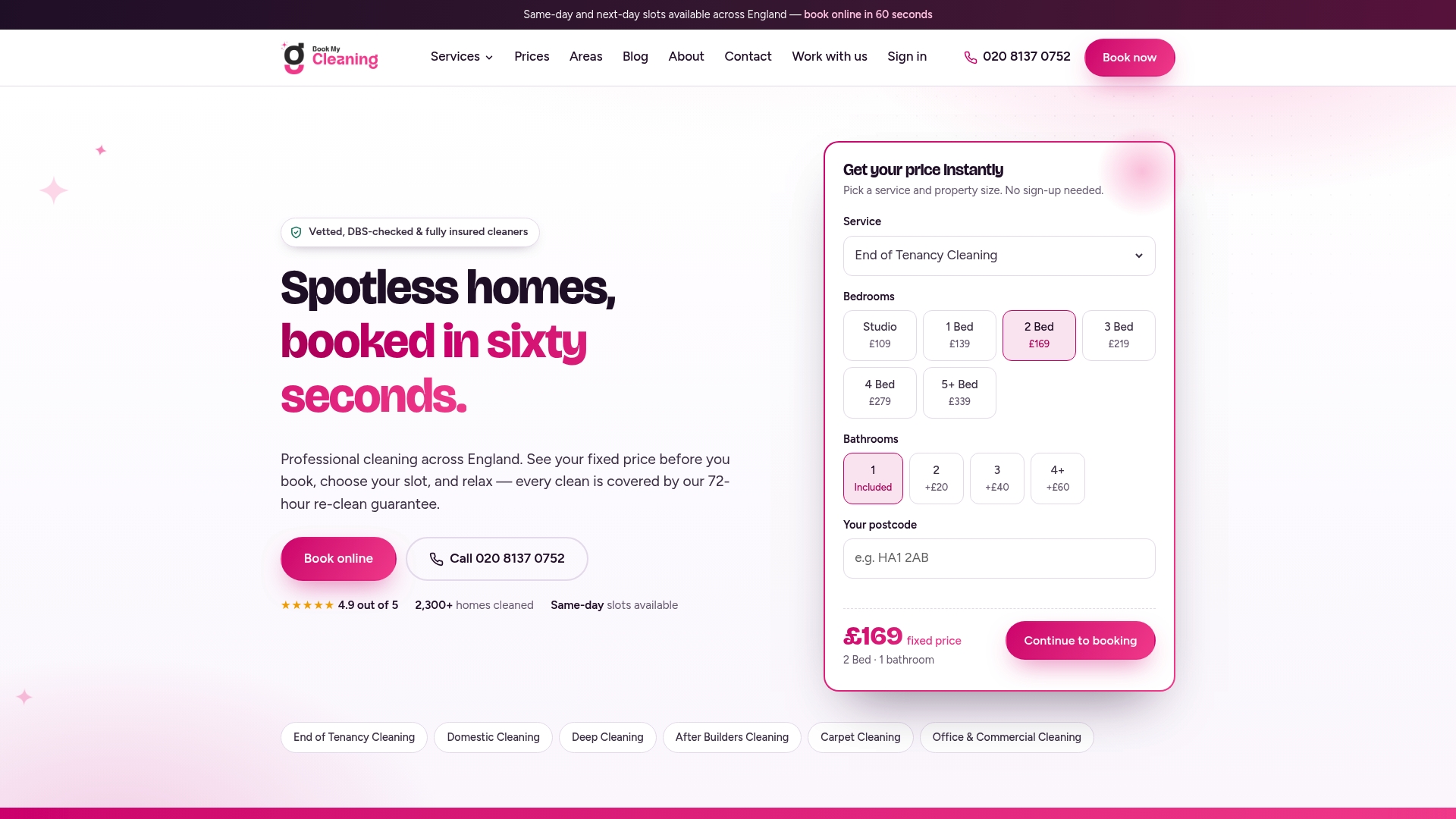
If you would rather hand the clean over, our end of tenancy cleaning service is priced from £109 and goes up to £339 for larger properties. You see the price online before you book, and you can book in under a minute without a card or deposit. Same-day slots are available, which helps if your inspection is close.
To plan the day, our guide to how long end of tenancy cleaning takes shows what to expect. We also publish a fuller end of tenancy cleaning checklist and a guide to inventory-first tenancy cleaning. Our cleaners work across England, and the areas page lists where. If you want to see how a clean protects your deposit, read our checkout cleaning guide.
If a deduction is disputed
If your landlord proposes to take money for cleaning, ask what they are comparing against. The National Residential Landlords Association says a landlord should consider the most economical solution, show the damage goes beyond fair wear and tear, and show in the check-in documents that it was not there at the start. If there is no check-in report, TDS says it will look at other evidence, such as a detailed invoice for cleaning at the start, and may reduce awards where the work claimed was more than necessary.
Keep the check-out report, your photographs, your cleaning receipt or checklist, and any messages with the agent. If the deposit is in a protection scheme, use its dispute service. Your deposit should come back within ten days if you and the landlord agree the amount, according to Citizens Advice guidance for England and Wales. For advice on your own case, speak to Shelter or Citizens Advice.
FAQ
Is inventory check cleaning the same as end of tenancy cleaning?
In practice, yes. Both mean cleaning the property to the standard recorded at check-in before the check-out inspection. The inventory is the document that sets the standard, and the clean is the work that meets it.
Does fair wear and tear cover a dirty oven?
No. Fair wear and tear covers deterioration from ordinary use, such as gentle wear on a carpet. TDS does not treat it as relevant in cleaning claims, so grease, limescale and food residue are expected to be cleaned.
Do I have to use a professional cleaner?
No, your landlord or agent cannot require you to use a professional or a specific company. They can ask for a professional standard, though, and claim against your deposit if the property is not clean enough. How you reach that standard is your choice.
What if I had no check-in inventory?
Then the landlord has less to compare against. TDS says it considers other evidence in that situation, and a landlord generally cannot expect more than the property's starting condition. Keep your own photographs and a record of what you cleaned.
Sources
- TDS: Inventories, check-in and check-out reports
- TDS: How TDS approaches disputes involving cleaning
- MyDeposits: Inventories and inventory check guide
- TSABI Law: Wear and tear and cleaning
- Shelter Scotland: Getting your deposit back
- Shelter England: Check out inspections
- Shelter England: How to check and agree an inventory
- MHCLG: Tenant Fees Act guidance
- TPO Code of Practice for Residential Letting Agents
- CA Properties: Room-by-room cleaning checklists
- Unipol: Deposit Inspection Checklist
- August App: End of tenancy inventory checks and cleaning
- Flatfair: Preparing for check-out
- Total Landlord Insurance: End of tenancy cleaning checklist
- NRLA: How to prevent cleaning disputes
- Citizens Advice: Tenancy deposits