
A cleaning clause can ask you to leave the property as clean as you found it. In England it cannot make you pay for a professional cleaner. The Tenant Fees Act 2019 bans that, so the wording of the clause matters less than the standard it sets and the evidence behind it. Below we cover how to read the clause, what you owe at check-out, how deposit deductions work across the UK, and when hiring a cleaner is simply the easy route.
TL;DR
- In England, a landlord cannot require you to pay for professional cleaning, but you must return the property to the cleanliness recorded at the start of the tenancy (Shelter).
- "Professional standard" describes a result you can reach yourself. "Must be cleaned professionally" names a service you cannot be forced to buy.
- Fair wear and tear is not a cleaning matter and cannot be taken from your deposit.
- Your best protection is the check-in inventory, dated photographs and receipts, kept until the deposit is back.
- Rules differ in Wales, Scotland and Northern Ireland, so check the version for where the property is.
Table of Contents
- What a landlord cleaning clause usually says
- Can a landlord make you pay for professional cleaning?
- The standard you actually have to meet
- How cleaning deductions from your deposit work
- England, Wales, Scotland and Northern Ireland compared
- What to do before you sign a clause you disagree with
- Our view: a clause is only as good as the evidence behind it
- When it makes sense to hire a cleaner anyway
- Book a fixed-price end of tenancy clean
- For landlords: writing a clause that stands up
- FAQ
- Sources
What a landlord cleaning clause usually says
Most tenancy agreements contain a clause on the condition of the property when you leave. The wording varies, but it tends to take one of three forms:
- Same condition as at the start. You return the property in the same state of cleanliness as at check-in, allowing for fair wear and tear.
- A professional standard. The property must be left "to a professional standard of cleanliness".
- A professional service. You must have the property "professionally cleaned", sometimes with receipts, or a fixed cleaning fee is taken from the deposit.
The first is normal. The second is common and lawful, because it describes an outcome. The third is the one that causes disputes, and in England it is the one that has been prohibited since the Tenant Fees Act took effect.
Can a landlord make you pay for professional cleaning?
In England, no. Shelter's guidance says a landlord cannot require you to pay for professional cleaning, though you do need to meet the starting cleanliness standard (Shelter England). The Tenant Fees Act 2019 applies to assured shorthold tenancies in England, and since 1 June 2019 landlords and agents have not been able to make professional end-of-tenancy cleaning a condition of the tenancy, as GOV.UK landlord guidance is summarised by industry commentary.
So a clause that says you must hire a cleaner, or that a set cleaning fee will be deducted whatever the state of the property, is a prohibited payment in England. You can raise this with the landlord or agent in writing, and the prohibited payment can be recovered.

"Professionally" versus "professional standard"
The distinction is a fine one but it has been tested. A First-tier Tribunal decision on a recovery of a prohibited payment looked at exactly this: the word "professionally" in a clause can be read as requiring a particular service, which is not allowed, while "professional standard" describes a result that can be achieved by any means (First-tier Tribunal decision, 8 June 2020). TDS Northern Ireland makes the same point in practice: a professional standard refers to the quality of the result, not to compulsory use of contractors (TDS NI).
A quick way to read your own clause:
| Wording in the clause | What it means in practice |
|---|---|
| "Return in the same condition of cleanliness as at the start" | Normal. Match your check-in report. |
| "Leave to a professional standard" | An outcome. You can clean yourself or hire help. |
| "Must be professionally cleaned and receipt provided" | Risky for the landlord in England: a service you cannot be made to buy. |
| "Cleaning fee of £X deducted from deposit" | A flat fee regardless of condition is a prohibited payment in England. |
The standard you actually have to meet
The benchmark is the start of the tenancy, not a hotel room. Shelter says you need only clean to the same standard as when you moved in, as noted on the inventory or check-in report, and that a landlord cannot keep deposit money for fair wear and tear (Shelter England).
In practice:
- Fair wear and tear covers the ordinary effects of living in a home: light marks on walls, gently faded curtains, slightly worn carpet in a hallway.
- Cleaning covers what you can reasonably remove: grease in the oven, limescale on taps, dust, marks on surfaces, rubbish left behind.
- Damage is a separate matter again, and is judged against the record and the cost of the loss.
This is why the check-in report matters so much. If it says the oven was "clean" and you leave it baked with grease, that is a gap a landlord can reasonably claim for. If it says "fair" or has no cleaning note at all, a landlord has a weaker case. Our guide on starting with the inventory to guard your deposit goes through how to read yours.
What condition should the property be in on day one?
The law does not set a precise cleanliness specification for a property at the start of a let. What protects both sides is a written record. An inventory is not a legal requirement in England or Wales, but adjudicators decide disputes on evidence, so a signed and accurate record of cleanliness is what carries weight. When you move in, note anything that is not clean, photograph it with the date visible, and send your comments to the landlord or agent promptly. That record becomes your benchmark when you leave.

Damp and mould are a different category from housekeeping. If a problem comes from the building rather than from how the home is used, it is for the landlord to deal with, and Awaab's Law for landlords explains what that means for property managers. Do not let a cleaning clause be used to push that onto you; report it in writing.
How cleaning deductions from your deposit work
A landlord cannot simply keep part of your deposit. Deductions go through the protection scheme holding the money, and the claim needs evidence. TDS says over half of deposit disputes involve cleaning claims, and stresses that the cleanliness standard should be recorded in the check-in report (TDS NI).
The evidence an adjudicator tends to weigh is:
- the check-in inventory and any comments you made on it
- the check-out report
- dated photographs from both ends of the tenancy
- receipts for cleaning, repairs or replacements
Flatfair advises tenants to take clear, dated photographs and to keep the check-in inventory, check-out report and any cleaning, repair or replacement receipts (Flatfair help centre). Our room-by-room move-out checklist with photo evidence turns that into a routine you can follow on the last day.
England, Wales, Scotland and Northern Ireland compared
The cleaning principle is similar across the UK, but the rules and the bodies involved differ. The Tenant Fees Act ban described above is an English one.
| Nation | What to know |
|---|---|
| England | Landlords cannot require you to pay for professional cleaning. You clean to the starting standard recorded at check-in. |
| Wales | The Rent Smart Wales code says deductions must not be made without actual losses, evidence must support claims in a dispute, and fair wear and tear cannot be deducted (Code of Practice). |
| Scotland | Landlords must lodge deposits with an approved scheme within 30 working days of receipt, and an independent adjudicator can weigh photographs and receipts in a dispute (Scottish Government). |
| Northern Ireland | A cleaning deduction depends on the recorded cleanliness at the start and end, the tenancy agreement and other factors (TDS NI). |
Two extra points from the Welsh code are worth knowing wherever you live. It recommends inspecting a vacated property within 24 hours or on the next working day, and it says landlords and agents should give tenants written guidance on notice that draws attention to specific clauses and any specified cleaning standards (Code of Practice). In Scotland, Shelter notes that landlords cannot charge for fair wear and tear, and for a stained carpet they can charge only for cleaning, not a new carpet (Shelter Scotland).
What to do before you sign a clause you disagree with
If the draft agreement contains a professional cleaning requirement, act before you sign, not at check-out.
- Read the exact words. Is it "professionally", "professional standard", or a flat fee?
- Ask in writing for the wording to be changed to "the same standard of cleanliness as recorded in the inventory".
- Keep the reply. An email that the clause will not be enforced is worth having on file.
- Insist on a detailed inventory with cleanliness described room by room.
- Photograph everything on day one with dates visible.
If you have already signed, a clause that conflicts with the Tenant Fees Act does not bind you in England. Shelter's housing advice pages and your local Citizens Advice are the places to go if the landlord pushes back.
Our view: a clause is only as good as the evidence behind it
We clean thousands of rented homes, and the pattern is plain: disputes are rarely about whether a tenant hired a professional. They are about what the property looked like on the day the tenancy began and what can be shown on the day it ended.
That is why we write our service around evidence. Every end of tenancy booking works from a written checklist, so you can see what is being cleaned before anyone arrives. Our cleaners are vetted, DBS-checked and arrive in uniform with all products and equipment, and the price is fixed and shown online before you book.
We also stand behind the result. If standards are not met, our 72-hour re-clean guarantee means we return to put it right, which gives you time to respond to any check-out comments. You are never obliged to use us, and we would never say you were. But if you would rather spend your last weekend packing than scrubbing an oven, a fixed-price clean to a clear checklist is a sensible way to meet the standard your clause sets.
Book
When it makes sense to hire a cleaner anyway
You cannot be forced to hire one, but plenty of tenants choose to. Common reasons:
- Time. Moving is already a full week. A clean to a written checklist takes one task off the list.
- Heavy items. Ovens, limescale and carpets are what most often turn into deposit claims.
- A recorded high standard. If the check-in report describes the flat as professionally cleaned, matching it takes effort.
- Peace of mind. Our 72-hour re-clean guarantee is designed to reduce the risk of a cleaning dispute.
If you do hire help, keep the receipt even though the law does not require you to produce one. It is useful evidence of the effort made. Our guide on what is standard and what is extra in a professional clean shows what to expect, and our end of tenancy checklist covers the tasks that matter most to a check-out inspection.
Book a fixed-price end of tenancy clean
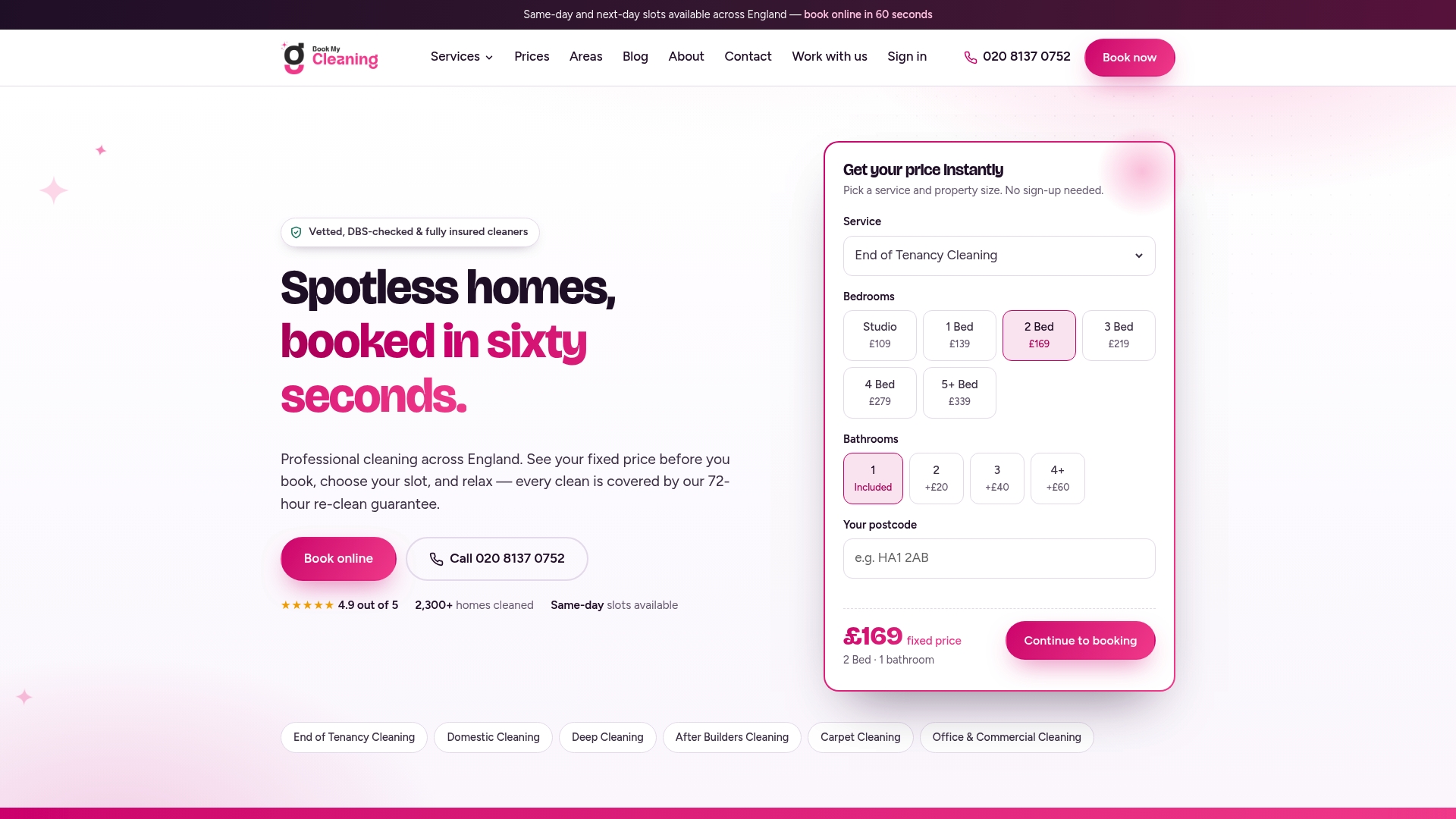
Our end of tenancy cleaning is priced from £109 up to £339 depending on property size, with the price shown online before you book. You can book in under a minute without a card or deposit, and same-day slots are available. Add-ons are priced individually: inside the oven is £25, inside the fridge or freezer £15, and carpet cleaning is £32 per room. See the full list on our prices page or book through our end of tenancy cleaning in Kensington or Ealing pages.
If you are a landlord or agent arranging a clean between tenants, the same fixed-price service applies, and our written checklist gives you a clear record of what was done. Start at bookmycleaning.co.uk.
For landlords: writing a clause that stands up
If you let property in England, a cleaning clause that holds up is short and measurable:
- Refer to the cleanliness recorded in the inventory, not to a professional service.
- Describe the standard as an outcome, for example "clean throughout, including the oven, bathroom and carpets, to the standard recorded at check-in".
- Give the tenant the inventory and check-in report in good time, and invite comments.
- Inspect promptly after check-out and keep dated photographs.
- Make a deduction only for what you can show, and keep invoices for actual costs.
This protects you in an adjudication and keeps you within the Tenant Fees Act. A property that you clean between tenants yourself is a reasonable cost of letting, since cleaning between tenants is good practice though not a legal requirement.
FAQ
Can a landlord make me pay for professional cleaning when I leave?
Not in England. The Tenant Fees Act 2019 prevents landlords and agents requiring you to pay for professional cleaning. You must still return the property to the cleanliness recorded at the start, but you can do that yourself or hire help if you prefer.
What does "professional standard of cleaning" mean in a tenancy agreement?
It describes the quality of the result, not who does the work. A tribunal decision has distinguished it from wording that requires you to have the property cleaned "professionally", which can amount to a prohibited requirement. You can reach a professional standard with your own effort.
Can my landlord deduct cleaning costs from my deposit?
Yes, but only for cleaning needed beyond the standard recorded at check-in, and only with evidence. Fair wear and tear cannot be deducted. If you disagree, the deposit scheme's dispute process will look at inventories, photographs and receipts.
What if there is no inventory?
Your own dated photographs from move-in and move-out become more important. Without a record of the starting condition, a landlord has more difficulty proving that a cleaning deduction is justified, so send any photos to the landlord or agent as early as you can.
Sources
- Can landlords charge for cleaning and gardening? Shelter England
- First-tier Tribunal decision on recovery of a prohibited payment, 8 June 2020
- The difference between professional and domestic cleaning, TDS Northern Ireland
- Code of Practice, Rent Smart Wales
- Deposit, Private residential tenancy model agreement, Scottish Government
- Getting your deposit back, Shelter Scotland
- How should I prepare for check-out and record the property condition, Flatfair
- Tenant Fees Act 2019 cleaning guide, passref