

To prepare a rental for checkout, return the property in the same clean condition it was in when you moved in, allowing for fair wear and tear. Start one to two weeks before you leave, use your check-in inventory as your checklist, clean room by room, and photograph the result on the day. Do that and you leave a landlord or agent very little to deduct for.
This guide walks you through the timeline, the room-by-room clean, the evidence worth keeping and what to do if the landlord disagrees. It is written for tenants in England and the wider UK, and where rules differ by nation we say so.
TL;DR
- The standard is the condition recorded at move-in, not showroom-clean. Shelter England says you need only clean to the standard recorded when you moved in.
- Compare the property with your inventory and move-in photos one to two weeks before you leave, so you have time to fix problems.
- Ask to be present at the check-out inspection, and take dated photos of every room after cleaning.
- A landlord cannot require professional cleaning, but you can hire a cleaner if you are short of time, and you should keep the receipt.
- If you disagree with a deduction, use the free dispute resolution offered by your deposit protection scheme.
Table of Contents
- What "checkout standard" actually means
- A timeline for the final two weeks
- Room-by-room: what to clean before you leave
- The easy-to-miss list
- Build your evidence as you go
- Should you hire a professional cleaner?
- What the checkout clean costs with us
- Perspective: why we start with the inventory
- Book your checkout clean
- If the landlord still wants to deduct
- FAQ
- Sources
What "checkout standard" actually means
Most deposit arguments are about cleaning. Property Passport UK describes cleaning as the most common source of disputes, and the test it gives is simple: the property should come back in the same clean condition as at the start, accounting for fair wear and tear, and no cleaner than that.
That gives you two practical rules.
- Your inventory is the benchmark. If it says the oven was "clean" at move-in, you are expected to return a clean oven. If it recorded a stained carpet, you are not responsible for that stain.
- Fair wear and tear is not your bill. Shelter England says a landlord cannot withhold deposit money for fair wear and tear, even if they redecorate afterwards. Faded paint and gently worn carpet in a busy hallway are ordinary ageing. Damage you caused or allowed, including accidental damage, can be deducted for, according to Shelter's guidance on damage and missing items.
Shelter's check-out guidance also covers the non-cleaning side. It says tenants should replace missing or broken items, fix damage they caused if they can, and match the garden and rubbish situation to move-in. Rubbish that will not fit in the wheelie bins counts, so a sofa left on the pavement is your problem to solve before you go.
If you want a fuller breakdown of how the inventory shapes your cleaning, our guide to tenancy cleaning with the inventory first goes through it step by step.
A timeline for the final two weeks
A checkout clean goes wrong when it is squeezed into the last evening, surrounded by boxes. Spread it out.
Two weeks to one week before
Loughborough University Students' Services advises that one to two weeks before moving out you compare the property with the check-in inventory and move-in photos, and look for damage, breakages and stains early. The Students' Association at Edinburgh, in guidance for Scottish tenants, recommends checking the required cleaning within two weeks of move-out and finishing it before the tenancy ends.
In practice, this week is for:
- Reading your tenancy agreement for any cleaning clause, and your inventory for the recorded condition of each room.
- Listing every item that looks worse than the inventory says: a scuffed wall, a chipped worktop, a missing shelf.
- Deciding what you can fix yourself, and what you will leave with an honest explanation.
- Booking help if you will not manage it. Same-day slots exist, but a booking made a week ahead gives you a wider choice of times.
- Asking the landlord or agent when the check-out inspection will happen. Shelter England says landlords or agents usually check the property before returning the deposit, and tenants should ask for a time when they can be there so the property and inventory are checked together.
The last weekend
This is the main clean. Clear the bulk of your belongings first: you cannot properly clean a wardrobe interior or skirting behind a bed that is still in place. Work from top to bottom and from the back of the property to the front door, so you are not walking over floors you have already done.
Moving-out day
Loughborough's checklist for the day itself covers a final cleanliness check, taking rubbish to the bins, turning off appliances and leaving fridge, washing machine and dishwasher doors open, noting meter readings, locking windows and doors, leaving your forwarding address and going through the inventory with plenty of photos. Edinburgh's guidance adds calling the gas and electricity suppliers for final readings, photographing the meters and keeping the pictures.
When you hand back keys, think about the lock-up too. Our note on door security in rentals covers the shared responsibilities of tenants and landlords around locks and keys, which is worth a read before you hand everything back.
Room-by-room: what to clean before you leave
Use this as a working list, and tick it against your own inventory. For our longer version with photo prompts, see the move-out cleaning checklist room by room.
Kitchen
The kitchen is where most deductions start. Property Passport UK's guidance is to clean all kitchen appliances inside and out. That means:
- Oven and hob: remove shelves and soak them, clean the door glass, the inside walls and the extractor filter if it comes out.
- Fridge and freezer: empty, defrost if needed, wipe shelves and seals, and leave the doors open once clean so it does not smell shut-in.
- Microwave, kettle and toaster if they belong to the landlord.
- Sink and taps: descale and polish.
- Cupboards and drawers: empty and wipe inside, including the crumbs in the cutlery tray.
- Worktops, splashbacks and the floor, including the strip beneath the kitchen units' kickboards where you can reach.
- Washing machine and dishwasher: clean the drawer and filter, and wipe the door seal.
Bathroom
The same Property Passport guidance names bathrooms and limescale removal specifically. Check:
- Taps, shower head and screen for limescale, where a descaler and some patience do most of the work.
- Grout and sealant for mould, and extractor fan covers for dust.
- The toilet, including under the rim and around the base.
- Cabinet interiors, mirrors, tiles and the floor.
- The plughole and any hair trap.
Bedrooms and living areas
These rooms are less often disputed but the details count. HomeLet says smaller items such as dust, windows, frames and doors are the things landlords and agents check carefully, so do not stop at the floor.
- Dust the tops of wardrobes, shelves, curtain rails, picture rails and light fittings.
- Wipe skirting boards, door frames, door handles and light switches.
- Clean the inside of windows and the sills, and wipe window frames.
- Vacuum carpets thoroughly, including edges and under the bed, and mop hard floors.
- Spot-clean marks on walls gently, taking care not to rub off paint, which would turn a mark into damage.
- Empty and wipe wardrobes and drawers.
Hallways, stairs and storage
Vacuum stairs and the corners where fluff collects, wipe the banister, and clear any cupboard under the stairs or loft space you used. Check the front door for scuffs and the doorbell and entry-phone for grime.

Outdoor areas
Loughborough's advice is to include outdoor areas if they are part of the let, and Shelter says the garden should match how it was when you moved in. For a flat with a balcony or patio, sweep it, wipe the door tracks and clear any items you left there.
The easy-to-miss list
These are the items people tend to forget when they are tired and the van is outside:
- The inside of the oven door glass and the extractor filter.
- Limescale on taps and shower heads.
- Window frames, sills and the tracks of sliding doors.
- Dust on top of wardrobes and on curtain rails.
- Inside of cupboards and drawers, especially in the kitchen.
- The bin and the recycling area outside.
- Marks around light switches and door handles.
- Any item recorded in the inventory that you have since moved or removed.
HomeLet's practical tip is to allow time for a final check and, if you can, ask a friend to look round, because a fresh pair of eyes often spots what you missed. Run through the inventory one last time and walk every room.
Build your evidence as you go
A clean that nobody can prove is a clean you may have to argue about. In a dispute, LLCR says the landlord carries the burden of proof, and that the evidence which matters includes a signed check-in inventory, ideally with photographs, plus a check-out report prepared close to the end of the tenancy. It also says an unsupported estimate from memory is unlikely to satisfy an adjudicator, and that receipts or quotes strengthen a landlord's claim. That cuts both ways: your own records are strongest when they are specific and dated.
Edinburgh's guidance suggests taking dated photos of each room and any notable cleaning on move-out day, even if there is no exit inspection. Here is a simple routine:
- Take a wide shot of each room from the doorway, then close-ups of the oven interior, fridge, shower, sink and any carpet areas that were marked at move-in.
- Photograph anything that was already damaged, next to the inventory entry that says so.
- Take meter readings with the display and the serial number in frame.
- Keep the receipt for any cleaner, product hire or repair.
- Keep everything in one folder or email thread sent to yourself, so the timestamps are clear.
Our guide to room-by-room checklists with photo evidence suggests the exact angles to capture.
Should you hire a professional cleaner?
You do not have to. Shelter England says a landlord cannot require professional cleaning, and that a clause demanding it is only fair if the property was cleaned to that standard before you moved in. Property Passport UK adds that clauses requiring a professional clean on exit may be unlawful under the Tenant Fees Act 2019, though a tenant can still be expected to match the standard if the inventory shows a professional clean before move-in.
So the decision is about your time and confidence, not an obligation. Shelter's own suggestion is that if you do not think you can clean to the required standard, you could hire a professional and keep the receipt.
A professional clean tends to make sense when:
- You are moving across the country and cannot spend the last two days scrubbing.
- The oven, limescale or carpets are beyond what household products will shift.
- The inventory describes the property as professionally cleaned at the start.
- You work long hours and the handover date is fixed.
What to check before you book
- Is the price fixed and shown before you book, with no hidden fees?
- Is there a written checklist, so you can compare it with your inventory?
- Is there a re-clean guarantee if the landlord or agent finds something missed, and how long does it last?
- Are the cleaners vetted and insured, and are products and equipment included?
- Does the booking allow for key collection and a time before the inspection?
Our list of what is standard and what is extra helps you tell which jobs a standard clean covers and which, such as inside the oven, need an add-on. How long it takes depends on the property: see how long end of tenancy cleaning takes to plan the day.
What the checkout clean costs with us
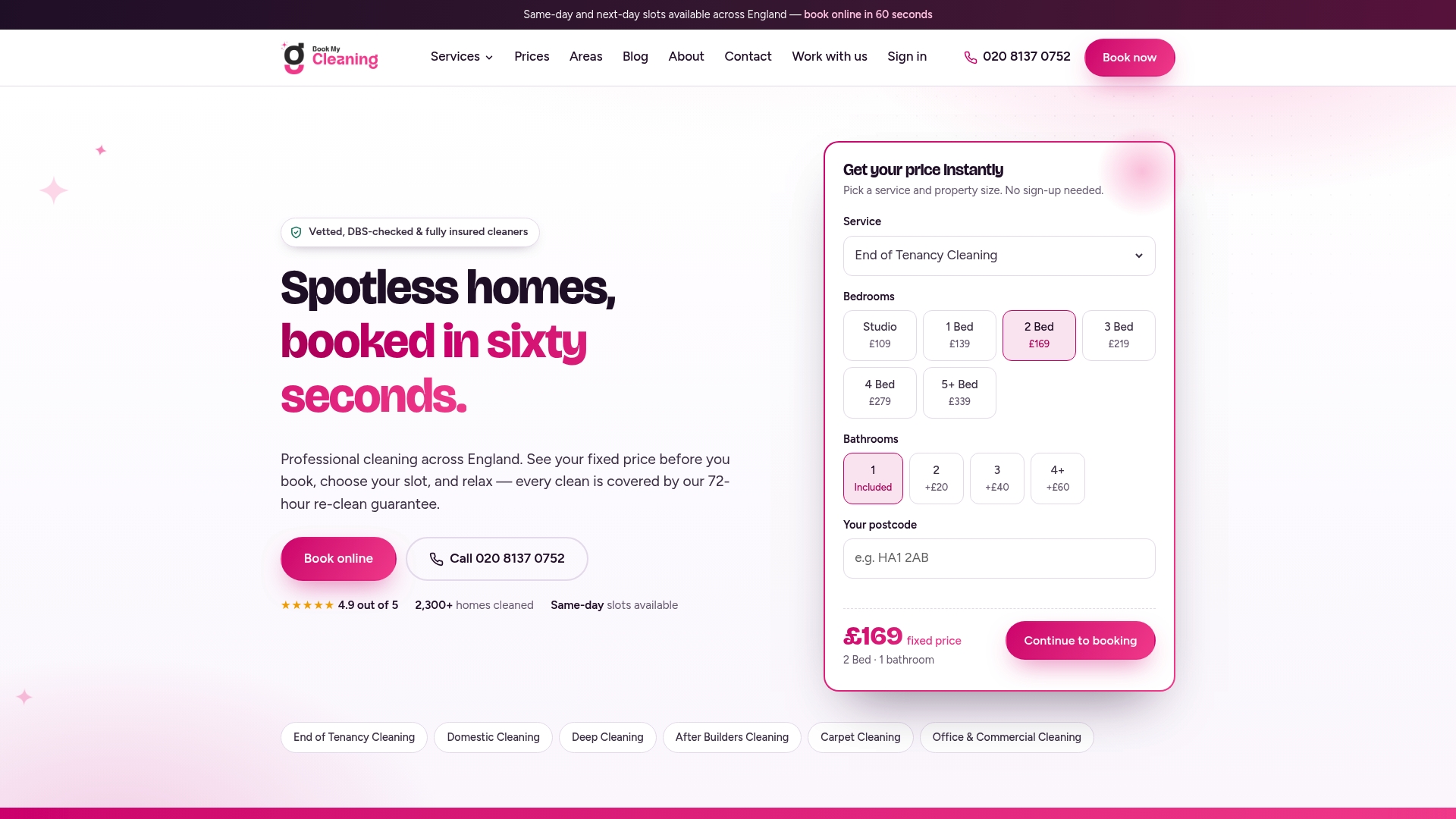
Our published prices are fixed and shown before you book. End of tenancy cleaning runs from £109 to £339 depending on the property, one-off. The extras below are priced separately, so you only add what your inventory calls for.
| Extra | Price |
|---|---|
| Inside oven | £25 |
| Inside fridge / freezer | £15 |
| Inside windows | £15 |
| Heavy limescale treatment | £20 |
| Wall spot cleaning | £20 |
| Carpet cleaning | £32 per room |
| Key pick-up from agency | £15 |
Full details are on our prices page.
Perspective: why we start with the inventory
We see the same pattern on checkout day again and again. Tenants clean hard, but not always where the inventory says it matters. The oven, the bathroom limescale and the details around frames and doors are where a deposit conversation usually begins.
That is why our service works from a written checklist, and why we say the standard is the condition recorded at move-in. We would rather you knew what a clean covers before you book than found out at the inspection.
Our approach is designed around that: fixed pricing you see online before booking, no hidden fees, vetted and DBS-checked cleaners who arrive in uniform, all products and equipment provided, and a 72-hour re-clean guarantee if standards are not met. For a tenant with a fixed handover date, that combination takes one stressful job off the list.
Book
Book your checkout clean
If you would rather spend your last weekend packing, we can take the clean off your hands. Choose your property size online, see the fixed price straight away and book in under a minute, with no card or deposit needed to reserve. Our cleaners bring everything with them, follow a written checklist and are backed by our 72-hour re-clean guarantee.
See our end of tenancy cleaning options and checkout guidance or book at bookmycleaning.co.uk. If you are in London, you can go straight to our end of tenancy cleaning in Ealing page, from £109. For a worked example of what a good result looks like, read the end of tenancy cleaning checklist that gets deposits back.
If the landlord still wants to deduct
Say the inspection goes badly and a charge appears. Do not pay it on the spot, and do not argue about it in person.
- Ask for it in writing, with the item, the reason and the evidence, such as photos, receipts or quotes.
- Compare with the inventory. Shelter says you should not be charged for fair wear and tear, damp or mould that is the landlord's responsibility, repairs the landlord did badly or late, or burglaries and vandalism you reported.
- Send your own evidence: your dated photos and any cleaning receipt.
- Use the scheme. If you cannot agree, Shelter points tenants to the free dispute resolution offered by the deposit protection scheme holding your deposit.
Without a signed check-in inventory, LLCR notes, a landlord has no documented baseline to compare the end of the tenancy against. LLCR also links fair wear and tear to expected deterioration over the tenancy, so deductions for ordinary ageing with no evidence of excess dirt or damage should be resisted.
The details of tenancy deposit rules differ across England, Wales, Scotland and Northern Ireland, so check the scheme's own guidance for your nation. For a complicated or high-value dispute, speak to Shelter or a housing adviser.
FAQ
How early should I start preparing for checkout?
Start one to two weeks before you leave. That gives you time to compare the property with your inventory and move-in photos, spot stains or damage, and book help if needed. The main clean should be finished before the tenancy ends, not on the final morning.
Do I have to pay for a professional clean when I move out?
No. A landlord cannot require professional cleaning, according to Shelter England, and a clause demanding it is only fair if the property was professionally cleaned before you moved in. You only need to return the property to the standard recorded at move-in. If you hire a cleaner anyway, keep the receipt.
Should I be there for the check-out inspection?
Yes, if you can. Shelter advises asking for a time when you can attend so that the property and inventory are checked together. That lets you point out items that were already marked at move-in and agree the condition on the spot.
What photos should I take on the last day?
Take dated photos of every room after cleaning, with close-ups of the oven, fridge, bathroom, carpets and anything already marked in the inventory. Photograph meter readings too. Keep the files together so the timestamps are easy to show if there is a dispute.
What if the landlord blames me for normal wear?
Ask for the charge in writing and compare it with the inventory. A landlord cannot keep deposit money for fair wear and tear, and in a dispute the landlord has to prove the claim. If you cannot agree, use your deposit scheme's free dispute resolution.
Sources
- Check out inspections, Shelter England
- Can landlords charge for cleaning and gardening?, Shelter England
- Deposit deductions for damage and missing items, Shelter England
- Moving out of a rental property checklist, Property Passport UK
- Moving out checklist, Edinburgh University Students' Association
- Renting off campus: moving out checklist, Loughborough University Students' Services
- End of tenancy clean: what you need to know, HomeLet
- Tenancy deposit disputes: how adjudication works, LLCR