
A "professional cleaning certificate" means one of two different things in the UK. For cleaners, it is a training qualification, such as a BICSc licence or a CPD-accredited course. For tenants, it is proof that a property was cleaned to a professional standard before moving out. Neither is a legal requirement for a tenant in England, and the thing that actually wins a deposit dispute is evidence, not a certificate.
This guide separates the two meanings, explains what the law says, and shows what to keep so your deposit is protected.
TL;DR
- A cleaning certificate is either a training qualification for cleaners or proof of cleaning for tenants. They are not the same document.
- No single UK-wide qualification is legally required to clean private homes or general workplaces.
- A tenant only has to return the home as clean as it was at check-in, as recorded on the inventory. A landlord cannot make you pay for professional cleaning.
- Your best protection is the check-in inventory, dated photos, and a written record of what was cleaned.
- If you do book a professional clean, keep the booking confirmation, the checklist and the receipt together with your photos.
Table of Contents
- Two meanings of "professional cleaning certificate"
- Is a cleaning qualification legally required?
- What professional cleaning training covers
- What a tenant actually has to prove
- What proof of cleaning should include
- What is standard and what is extra
- Cleaning standards by situation
- How to choose a cleaning service for hand-back
- Book a fixed-price end of tenancy clean
- Common mistakes with cleaning proof
- FAQ
- Sources
Two meanings of "professional cleaning certificate"
Search for this phrase and you will mostly find online courses: Level 3 and Level 5 awards, hospitality hygiene courses, CPD-point bundles for cleaners and diplomas about running a cleaning business. Those are training certificates. They show that a person has studied cleaning methods, health and safety or management.
Tenants searching for an "end of tenancy cleaning certificate" want something else. They want a document, receipt or report showing the property was professionally cleaned when they handed the keys back. That is proof of service, and it belongs to the booking, not to the cleaner's CV.
| Training certificate | Proof of cleaning | |
|---|---|---|
| Who holds it | The cleaner | The tenant or landlord |
| What it shows | Knowledge and skills | That a specific property was cleaned on a specific date |
| Legally required? | No, not for general domestic or commercial cleaning | No, not for tenants |
| Useful for | Employers, insurers, some commercial clients | Deposit discussions and agent check-outs |
Is a cleaning qualification legally required?
No. There is no single UK-wide qualification legally required for cleaning private homes or general commercial premises. Specialist settings such as healthcare, food production and care homes have their own sector standards, and employers usually provide their own induction training.
That does not make training worthless. A cleaner who has studied safe chemical handling and equipment use is a safer pair of hands in your home. It simply means you should judge a cleaning company on what it does, not on a single badge.
What professional cleaning training covers
The most widely known industry body in the UK is the British Institute of Cleaning Science (BICSc). Its Licence to Practice training covers:
- health and safety and COSHH (the rules on hazardous substances)
- dynamic risk assessment
- electrical safety
- safe use and care of equipment
- correct dilution of products
- housekeeping of cleaning stores
Other courses ranked for this topic go broader: hygiene in hospitality, supervising teams, or setting up a cleaning business. When you see a certificate quoted, ask what the course actually covered and whether it matches the work you are booking. A hospitality hygiene award says little about, say, cleaning an oven after a tenancy.
How to read a cleaner's credentials
BICSc says company membership can be checked in its official membership directory, so a claim of membership can be confirmed rather than taken on trust. For any certificate a company quotes, look for:
- The name of the awarding body, and whether you can look it up independently.
- The date, since some certificates and memberships are time-limited.
- Whether it applies to the company or to one individual who may not be the person arriving at your door.
For most households, a few practical checks matter as much as paperwork: are cleaners background-checked, insured, in uniform, and working from a written checklist with a guarantee behind it?
What a tenant actually has to prove
This is where most readers of this keyword get worried, so here is the position in England.
According to Shelter's guidance on cleaning and deposit deductions, tenants only need to clean the home to the same standard as when they moved in, as noted on the inventory or check-in report. Requiring tenants to pay for professional cleaning is unfair and banned. A "professional standard" clause is only reasonable if the property was professionally cleaned before you arrived.
So a certificate is never the legal test. The test is the condition at check-in compared with the condition at check-out.

Why the inventory comes first
The Tenancy Deposit Scheme explains in its guidance on cleaning disputes that the best evidence of condition at the start is a comprehensive inventory and schedule of condition that mentions cleanliness. If the check-in report does not mention cleanliness, TDS will not assume the property was clean. At the end, the best evidence is a comprehensive check-out report completed with reference to the check-in report.
In practice:
- Read your inventory carefully in the first days of the tenancy and challenge anything missing, especially cleanliness of ovens, carpets and bathrooms.
- Take dated photos at move-in and move-out.
- Keep everything until the deposit is back in your account.
Our guide to tenancy cleaning and why the inventory comes first walks through this in more detail.
What proof of cleaning should include
If you book a professional clean before moving out, build your own evidence file. There is no official template, so a sensible record includes:
| Item | Why it helps |
|---|---|
| Booking confirmation with date, address and service | Shows who cleaned what and when |
| The cleaning checklist used | Shows the scope: rooms, oven, windows, carpets |
| Payment receipt | Confirms the service was completed and paid for |
| Dated photos of each room after cleaning | Shows the condition at hand-back |
| Any guarantee terms | Shows what happens if the agent finds a problem |
| Check-out report from the agent or landlord | Lets you compare it against the check-in report |
Photos matter most. Our move-out checklist with photo evidence lists what to capture, room by room: oven interior, bath and shower, skirting boards, inside cupboards, windows and carpets.
What is standard and what is extra

Disputes often come from mismatched expectations. A basic clean may not include the inside of the oven, inside windows or carpet treatment. Before you book anyone, check which items are in the standard scope and which are add-ons. Our professional cleaning checklist sets out what is usually standard and what tenants tend to pay extra for.
On our own price list, for example, add-ons are shown separately: inside the oven is £25, inside the fridge or freezer £15, inside windows £15, professional carpet cleaning £32 per room and heavy limescale treatment £20. You see those figures online before you book, so there are no surprises on the day.
Our view: proof beats paperwork
We clean homes for tenants, landlords and homeowners across England, and the question we hear most is not "are you certified?" but "will this get my deposit back?"
Our honest answer is that the deposit depends on the match between your check-in inventory and your check-out condition. A cleaning company supports that in practical ways: vetted, DBS-checked cleaners who arrive in uniform, a written checklist so you know exactly what is covered, all products and equipment supplied, and a fixed price shown online before you commit.
We also stand behind the work with a 72-hour re-clean guarantee. If standards are not met, we come back. That is designed to take the stress out of the last days of a tenancy, when keys, removals and agent appointments all collide.
Our advice is simple: photograph everything, keep your checklist and receipt, and book a clean that is scoped to the condition your inventory describes.
Book
Cleaning standards by situation
Different readers need different things from the word "certificate".
If you are a tenant
You do not need a certificate to hand over a property. You need to match the inventory. If the inventory says the oven was spotless and carpets professionally cleaned, the agent can reasonably expect the same. If it says nothing, keep your photos and point to the TDS guidance above if a deduction is proposed.
Never ignore a deduction notice. Your deposit sits in a government-authorised protection scheme, and the scheme's dispute process looks at evidence from both sides.
If you are a landlord or agent
A landlord cannot require a tenant to pay for professional cleaning, but can expect the property back at its check-in standard. Clear, detailed inventories that mention cleanliness make everything simpler, for you and for the scheme adjudicator.
If you manage an office
For workplaces, clients tend to ask about insurance, vetting and methods rather than a named certificate. We offer office and commercial cleaning with a free site visit, so the scope and schedule are agreed in writing first. See our Kensington office cleaning page, or those for Watford and Paddington. Office cleaning has no published price, because it depends on the site.
If you want to become a cleaner
A recognised qualification can help you stand out with employers and insurers, and a short course is a reasonable first step. Check what it covers against the work you plan to do, and whether the awarding body can be verified independently.
How to choose a cleaning service for hand-back
When the aim is a clean that stands up at check-out, compare services on these points:
- Fixed price before booking. You should see the cost online, not receive a figure after the visit.
- A written checklist. It is your record of what was included.
- Vetted staff. DBS-checked, uniformed cleaners reduce risk when strangers enter your home.
- Products and equipment included. You should not have to supply anything.
- A guarantee with a time limit. Ours is 72 hours for a re-clean. Our page on the 72-hour re-clean guarantee explains how it works for tenants.
- Timing. Same-day slots can rescue a tight move-out.
Our end of tenancy cleaning checklist shows the tasks we work through.
Book a fixed-price end of tenancy clean
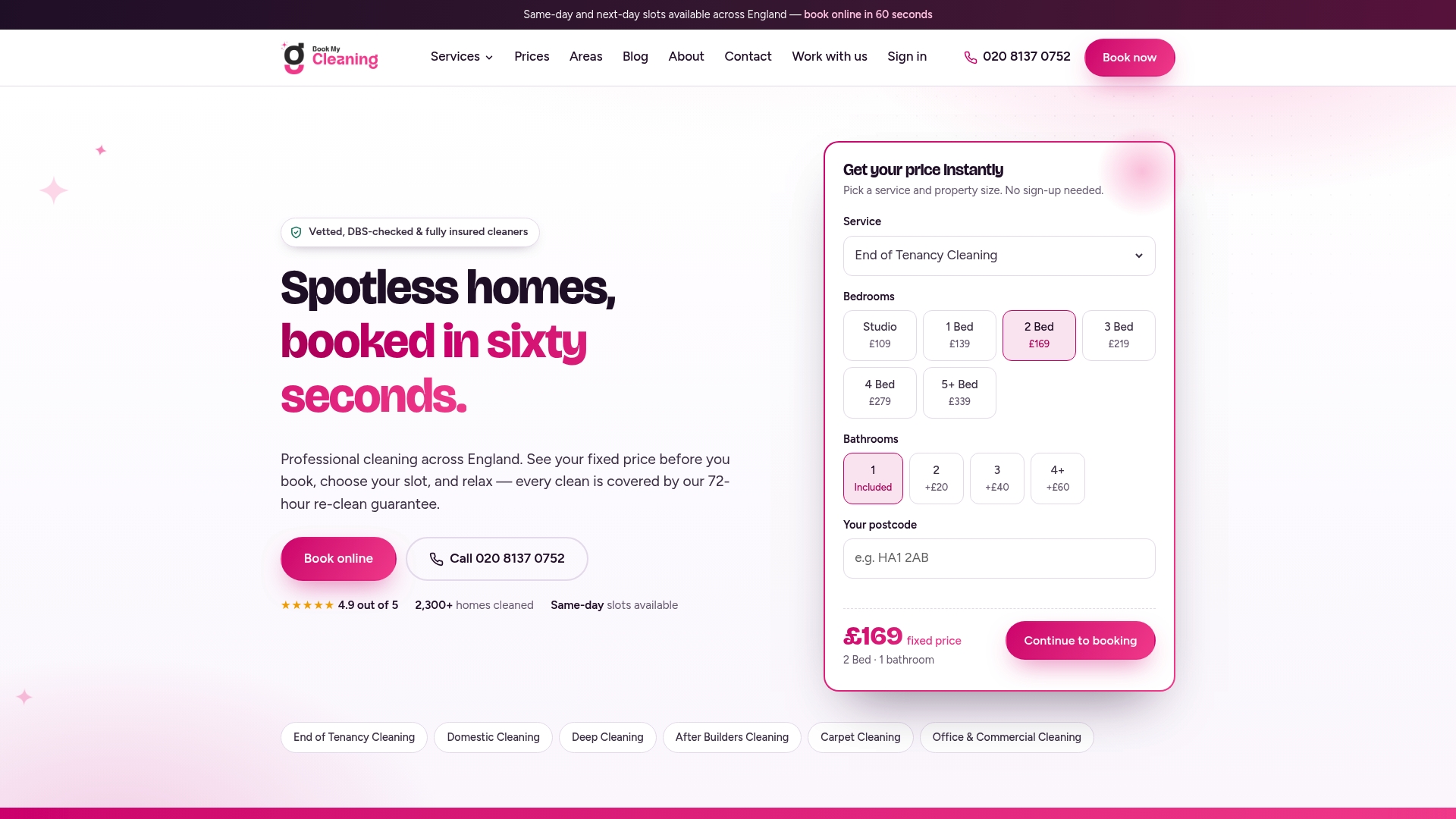
Our end of tenancy cleaning is priced between £109 and £339 as a one-off, depending on the property, and you see the fixed price online before you book. You can book in under a minute without a card or deposit, and the cleaners bring all products and equipment. Many tenants also add the oven (£25) or carpets (£32 a room) so the check-out matches an inventory that mentions both.
Ready to book? Choose your local page, such as end of tenancy cleaning in Ealing, Kensington or Acton, or start from bookmycleaning.co.uk. For a pre-check-out routine, see our guide to checkout cleaning for UK tenants.
Common mistakes with cleaning proof
- Assuming a certificate settles a dispute. Agents and schemes compare reports and photos, not badges.
- Photographing only at move-out. Without move-in images, you cannot show what changed.
- Skipping the oven and carpets. These are the most commonly queried items, and often an extra.
- Cleaning the day of the check-out. Leave time for a re-clean if something is missed.
- Throwing away paperwork. Keep the receipt and checklist until your deposit has been returned.
More practical advice is on our cleaning tips blog.
FAQ
Do I need an end of tenancy cleaning certificate to get my deposit back?
No. The standard is the condition recorded on your check-in inventory, not a certificate. A receipt, checklist and dated photos are far more useful if a landlord or deposit scheme questions the cleanliness.
Can my landlord force me to use a professional cleaner?
In England, no. Shelter says requiring tenants to pay for professional cleaning is banned, and that you only need to leave the property as clean as it was when you moved in. A professional-standard clause is fair only if the home was professionally cleaned before you arrived.
Do cleaners in the UK need a licence or qualification?
No single UK-wide qualification is legally required for private-home or general commercial cleaning. Healthcare, food production and care settings have their own standards. Many cleaners still take courses such as BICSc training, which covers health and safety, COSHH and safe equipment use.
How can I check that a cleaning company's accreditation is genuine?
Ask which body issued it and look it up independently. BICSc, for example, lets people verify company membership through its official membership directory. Check the date too, as memberships can expire.
What should I keep after a professional clean?
Keep the booking confirmation, the checklist, the payment receipt and dated photos of every room, plus the check-in inventory and check-out report. Hold on to them until your deposit is returned in full.
Sources
- Can landlords charge for cleaning and gardening? (Shelter England)
- How TDS approaches disputes involving cleaning (Tenancy Deposit Scheme)
- Licence to Practice (BICSc)
- Top 5 UK Online Cleaning Courses for Individuals in 2026