
A professional cleaning checklist covers room-by-room tasks such as kitchen degreasing, bathroom descaling, dusting, vacuuming and bin removal, plus optional add-ons like inside-oven or carpet cleaning. Our professional cleaning checklist is built around fixed pricing, vetted staff and a re-clean guarantee. For end-of-tenancy bookings, start preparing two weeks ahead and book the clean 3 to 7 days before check-out.
TL;DR:
- Oven interiors, fridge interiors, external windows, and deep carpet extraction fall outside standard cleaning; carpet cleaning starts at £32 per room.
- Before moving out, begin preparing two weeks ahead and book the clean 3 to 7 days before check out, leaving time to correct missed tasks.
- The guarantee covers missed tasks if you inspect within 72 hours, photograph the area, and contact the provider with your job reference.
- The Tenant Fees Act 2019 bars landlords from making professional cleaning a blanket condition, but tenants must return the property to its original condition.
Table of Contents
- Room-by-room professional cleaning checklist
- Which add-ons change the scope and the price?
- How should you prepare before the cleaners arrive?
- What do professional cleaners bring, and how do guarantees work?
- Getting the timing and evidence right for end-of-tenancy cleaning
- A detailed checklist for ceiling and wall cleaning
- Common allergens and how cleaning reduces them
- Using eco-friendly and hypoallergenic products
- What customers ask us most
- Booking with us: what's included and how the guarantee works
- FAQ
- Sources
Room-by-room professional cleaning checklist
A paid clean follows a fairly consistent pattern wherever you book it, moving from the kitchen through to hallways with the same logic each time: dust and surfaces first, floors last. Knowing what falls into the standard job helps you spot what counts as an add-on before you pay for it.
In the kitchen, cleaners wipe and sanitise worktops, degrease the hob, and clean the exterior of appliances such as the fridge, oven and microwave. Cupboard interiors get a wipe-down on request, and the extractor fan is cleaned as part of the standard visit. Inside the fridge or freezer sits outside the core job as a separate add-on in most bookings.
Bathrooms get similar close attention. Limescale on taps and shower screens, grout lines between tiles, and the toilet itself are all addressed as standard, along with mirrors, glass and extractor vents. The floor is mopped or vacuumed last, once everything above it has been dealt with.
Living areas and bedrooms follow a high-to-low dusting order, starting with light fittings and shelves and working down to skirting boards, before carpets are vacuumed. Cleaners typically move light furniture to reach underneath it, and wardrobe or cupboard interiors are cleaned when asked in advance rather than assumed.
A standard job across these spaces usually includes:
- Dusting surfaces, shelves and light fittings from high to low
- Wiping skirting boards, door frames and handles
- Vacuuming carpets and mopping hard floors, working towards the exit
- Sanitising kitchen and bathroom surfaces, taps and toilets
- Emptying and disinfecting bins, removing food waste
Floors and carpets get a standard vacuum and mop as part of every booking, but deeper work such as hot-water extraction carpet cleaning is a separate, per-room service. The same split applies to windows: internal glass is cleaned as standard, while external glass or a full inside-and-outside clean is usually booked separately.
Personal items, clutter and anything hazardous are generally left for you to deal with beforehand rather than something a cleaner removes. Think of this less as an exclusion and more as a prompt: clear surfaces first, and the time your cleaner has gets spent on cleaning rather than tidying.
Which add-ons change the scope and the price?
Add-ons cover the jobs that take real extra time or specialist kit, so they sit outside the standard visit. An oven clean involves pulling out racks and trays and degreasing the interior properly, a job that can take as long as the rest of the kitchen combined. Professional carpet cleaning, usually priced from £32 per room, uses hot-water extraction rather than a household vacuum, which lifts ground-in dirt a standard clean cannot reach.
Other common extras include:
- Inside fridge or freezer, priced separately from the standard kitchen clean
- Inside windows, useful when blinds or frames have not been touched in a while
- Upholstery and mattress deep cleans, which need drying time before furniture is used again
Pro Tip: If you're cleaning ahead of a deposit return, prioritise the oven, inside windows and a professional carpet clean first, since these are the items inspectors check most closely.
Booking add-ons in advance means the right equipment and extra time are scheduled from the start, rather than squeezed in on the day.
How should you prepare before the cleaners arrive?
A few minutes of preparation means your cleaner spends their time cleaning rather than clearing space. Following a short routine before they arrive gets you closer to the result you are paying for.
- Clear counters, tables and floors of loose items so surfaces can be wiped properly.
- Put away or secure valuables and anything fragile or sentimental.
- Gather laundry in one place if you have booked ironing or laundry services.
- Decide on access: be home to let the team in, leave a key with a neighbour, or arrange key pick-up from an agency.
- Leave parking or entry notes if the property is tricky to find or has restricted access.
- Secure pets in another room or outdoors, and mention any odours or stains they may have caused.
- Check the expected duration for your booking type, since a domestic clean, a deep clean and an end-of-tenancy clean take very different amounts of time, so you can plan around work, childcare or a landlord inspection.
- Take date-stamped photos of each room once the clean is finished, and keep any receipts if you need proof later.
What do professional cleaners bring, and how do guarantees work?
A fully equipped visit means you don't need to supply anything. Cleaners arrive with vacuums, mops, multi-surface cleaners, microfibre cloths and descaling products as standard, with specialist kit brought along when carpet or upholstery cleaning has been booked.
Vetting matters just as much as equipment. DBS-checked staff arriving in uniform and backed by insurance gives homeowners and landlords confidence that whoever is in their property has been through proper checks, something worth confirming before you book anyone.
Our standard offer includes:
- Vacuums, mops and multi-surface cleaning products provided on every visit
- Descalers and specialist tools for bathrooms and kitchens
- Staff who have undergone background checks, wear uniforms and are insured
- A re-clean guarantee if any task on the checklist was missed
If something falls short, the process is straightforward: inspect within 72 hours, photograph the area in question, and contact us with your job reference and photos attached. High customer satisfaction ratings reflect how consistently that standard gets met.
Getting the timing and evidence right for end-of-tenancy cleaning
End-of-tenancy cleaning carries higher stakes because your deposit depends on it. Preparing early and documenting the result properly is what separates a smooth handover from a dispute.
Start preparing at least two weeks before you move out, and book the professional clean for 3 to 7 days before check-out so there's still time to fix anything missed. This buffer matters because end-of-tenancy cleaning is the last real opportunity to reduce the risk of deposit deductions, and a rushed job on the final day leaves no room to correct mistakes.
Use your check-in inventory as the benchmark since landlords typically assess the property against the same document signed at move-in. A few habits make the difference:
- Take clear, dated photos of every room once cleaning is finished, matching the angles from your check-in inventory where possible
- Keep the job report and receipts from your cleaning booking as written proof
- Note any add-ons purchased, such as carpet cleaning or an oven clean, alongside the main service
Under the Tenant Fees Act 2019, landlords cannot force tenants to pay for a professional clean as a blanket condition, though they can expect the property returned to its original condition, and inventory evidence is what supports a fair outcome either way.
A detailed checklist for ceiling and wall cleaning
Ceilings and walls get overlooked far more often than floors or surfaces, yet cobwebs in corners, scuff marks near door frames and dust along picture rails are exactly what a thorough inspection catches. Going beyond a quick spot-clean means working the full surface methodically rather than just wiping visible marks.
A proper pass starts at the top: cobwebs are cleared from ceiling corners and light fitting recesses using a long-handled, soft-bristled tool that won't scratch paintwork. Ceiling fans, where fitted, get wiped on both sides of each blade, since dust builds up unevenly and falls onto furniture below once disturbed.

Walls are worked from top to bottom in sections, using a dry microfibre cloth for dust and a mild, non-abrasive solution for marks. Skirting boards and door frames get particular attention, since scuffs there are often the first thing an inspector or new occupant notices. Switch plates and door handles, both frequently touched, are wiped as part of the same pass rather than skipped as "just a wall".
For end-of-tenancy or pre-sale cleans, this level of detail matters more than usual: a landlord's inventory check will often note wall condition room by room, so matching that scrutiny during cleaning avoids a dispute later. Heavier marks such as scuffs from furniture or crayon require more than a cloth, and that's where a paint splash or wall spot-cleaning add-on earns its place in the booking rather than being left to chance.
Common allergens and how cleaning reduces them
Dust mites, pet dander, pollen carried in from outside and mould spores in damp corners are the allergens that build up fastest in a home, and they settle in places a quick tidy-up rarely reaches: carpets, soft furnishings, curtains and the tops of skirting boards. A professional clean tackles these systematically rather than just the visible mess.
Vacuuming with a machine fitted with a fine-particle filter lifts dust and dander out of carpets and upholstery instead of just redistributing it into the air, which is why the order of a clean matters: dusting high surfaces first means settled particles get vacuumed up afterwards rather than left to resettle on a freshly wiped floor.

Damp-wiping surfaces, rather than dry-dusting alone, traps particles in the cloth instead of sending them airborne, which makes a real difference for anyone sensitive to dust or pollen. Bathrooms and kitchens get particular attention around extractor fans and vents, since damp, poorly ventilated spots are where mould spores are most likely to gather.
For households with allergy sufferers, mentioning this when you book means cleaners can prioritise soft furnishings, mattresses and carpets, the areas allergens concentrate in most, rather than treating every room identically.
Using eco-friendly and hypoallergenic products
Standard cleaning chemicals can leave behind strong fragrances and residues that irritate sensitive skin or trigger reactions in people with asthma or allergies, which is why eco-friendly and hypoallergenic alternatives have become a regular request rather than a niche one. These products are typically free from harsh solvents and artificial fragrance, relying instead on plant-based surfactants and milder formulations that still lift grease and limescale effectively.
The trade-off some products carry is a slightly longer contact time to work on stubborn grime, which is one reason professional equipment, such as steam cleaners for grout and hob degreasing, helps close that gap without resorting to harsher chemicals.
For households with young children, pets or anyone with respiratory sensitivities, asking for fragrance-free or hypoallergenic products when you book means the result is just as thorough without the residue that triggers reactions. It's a simple request to make at booking stage, and one that shapes which products get packed for the visit rather than something to raise after the fact.
What customers ask us most
The questions we hear most are simple: what's included, what should be cleared beforehand, and whether cleaners bring their own equipment. Our printable, room-by-room checklists are built to mirror a landlord's check-in inventory, which cuts down on follow-up visits considerably. Our practical habit worth adopting: photograph every room once cleaning finishes, keep appliance receipts, and book the add-ons that actually affect a deposit return.
— Book
Booking with us: what's included and how the guarantee works
Booking a clean means fixed pricing shown upfront, same-day availability where slots allow, and vetted, uniformed staff on every visit, backed by a re-clean guarantee within a few days if anything on the checklist gets missed.
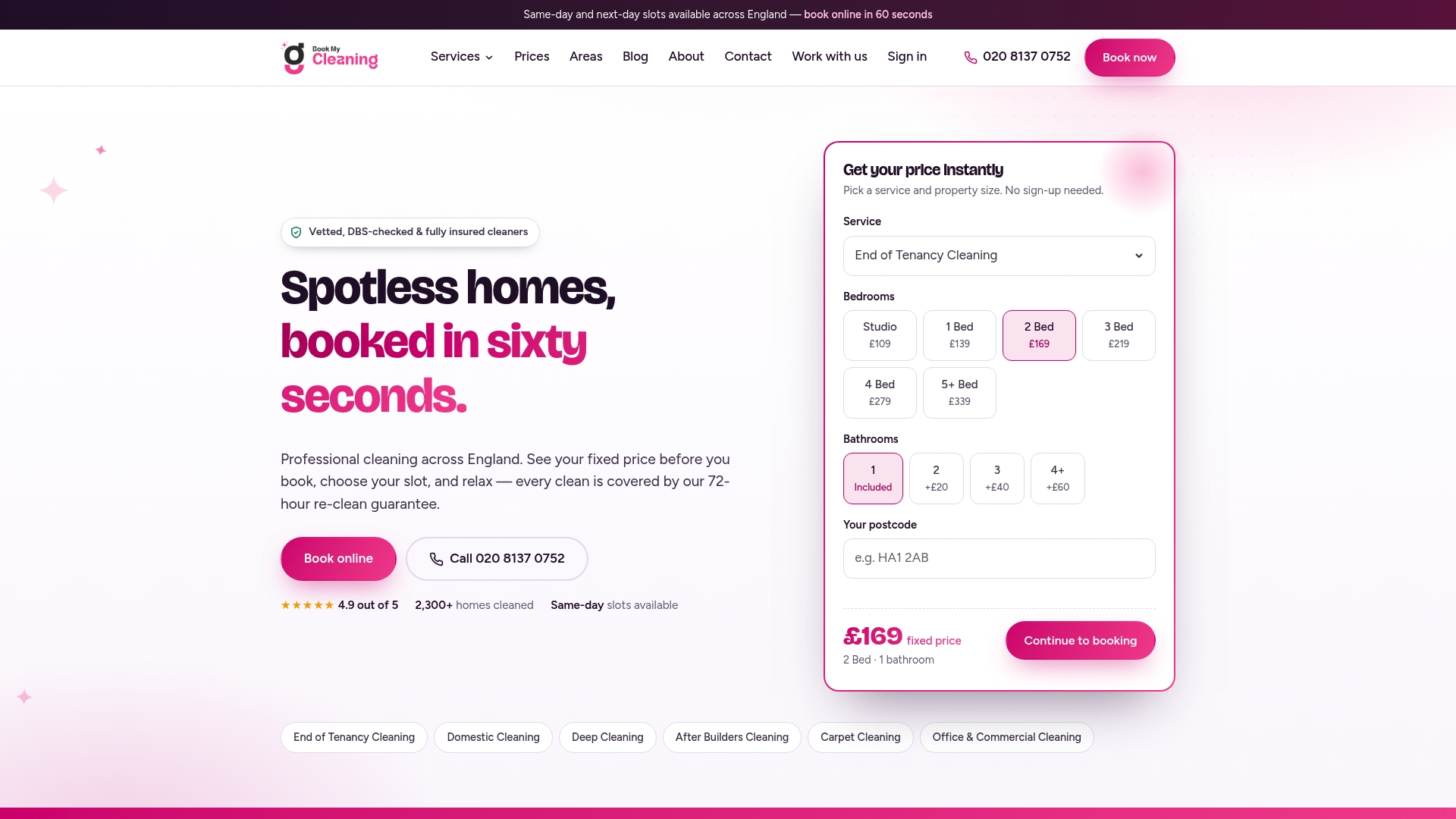
Your booking confirmation sets out the service summary, an estimated duration, and any add-ons you've chosen, so there's nothing to guess at before the team arrives.
| Service | Price |
|---|---|
| End of Tenancy Cleaning | £109 to £339 one-off |
| Deep Cleaning | £119 to £329 one-off |
| Professional carpet cleaning | £32 one-off per room |
Check current pricing and book your slot on our end-of-tenancy and cleaning prices page.
FAQ
What does a standard professional cleaning checklist include?
A standard checklist covers dusting, wiping and sanitising surfaces, vacuuming and mopping floors, cleaning kitchen and bathroom fixtures, and emptying bins, done room by room from high surfaces down to the floor. Add-ons such as inside the oven, inside windows or professional carpet cleaning sit outside this core job and are booked separately.
How far in advance should I book an end-of-tenancy clean?
Start preparing at least two weeks before you move out, and aim to book the clean itself 3 to 7 days before check-out so there's time to address anything missed before handover. This window also gives you time to photograph the result against your check-in inventory.
Can a landlord force me to pay for a professional clean?
Under the Tenant Fees Act 2019, a landlord cannot make professional cleaning a blanket mandatory charge, though they can still expect the property returned to its original condition. Keeping dated photos and a cleaning receipt is the simplest way to show that condition has been met.
What happens if something gets missed during a professional clean?
Most reputable providers, including us, offer a re-clean guarantee, typically giving you 72 hours to inspect, photograph the issue and get in touch with your job reference. This turns a missed task into a quick fix rather than a dispute.
Do professional cleaners bring their own equipment and products?
Yes, a professional clean typically includes vacuums, mops, cloths, descalers and multi-surface products as part of the booking, with specialist equipment such as carpet extraction machines brought for add-on services. You can request eco-friendly or hypoallergenic products at the time of booking if that matters to your household.
Sources
- End of tenancy cleaning and inventory checklist
- The Landlord's Guide to End-of-Tenancy Cleaning and Inventory Checks