
A good UK cleaning contract says six things in plain words: what is cleaned and how often, what it costs and what counts as extra, how either side can cancel, what happens if the standard is missed, what insurance sits behind the work, and how a complaint is raised. If a draft is vague on any of these, ask for it to be fixed before the first visit. This guide covers private homes, end-of-tenancy cleans and offices, so you can check an agreement line by line.
TL;DR
- Scope is the heart of any cleaning agreement: list rooms, tasks, exclusions, frequency and access, so nobody argues later about what "clean" meant.
- Fixed prices, written variation rules and clear cancellation notice protect you from surprise charges.
- Look for a defined re-clean or complaints process with a deadline, and for public and employers' liability insurance.
- Consumer bookings are covered by the Consumer Rights Act 2015, and unfair terms may not be enforceable against you.
- Tenants should treat the clean as evidence for the deposit: keep the checklist, photos and receipt.
Table of Contents
- Why the contract matters more than the quote
- What every cleaning contract should include
- Scope: rooms, tasks, exclusions and frequency
- Price, payment and extra work
- Duration, renewal, cancellation and rescheduling
- Quality standards, complaints and re-cleans
- Insurance and liability
- The legal rules behind the paperwork
- Tenants: what to check in an end-of-tenancy agreement
- A perspective from Book My Cleaning
- Booking with clear terms
- Red flags in a cleaning agreement
- FAQ
- Sources
Why the contract matters more than the quote
Most disputes with cleaners are not about dirt. They are about assumptions: whether the oven was included, whether a missed visit is charged, who pays when the cleaner cannot get in. One UK legal guide makes the same point, saying the scope is the heart of the agreement because precise descriptions of work, timing, cost and risk allocation prevent disputes over access, performance and payment (Sprintlaw UK, service agreements for cleaning companies).
The size of the paperwork depends on the job:
| Type of job | Usual paperwork | What to focus on |
|---|---|---|
| One-off home clean (deep, after builders) | Online booking terms and a checklist | Scope, fixed price, re-clean guarantee |
| End-of-tenancy clean | Booking terms and a written checklist | Match to tenancy requirements, guarantee window, evidence |
| Regular domestic clean | Booking terms, sometimes a standing agreement | Hourly rate, cancellation notice, keys, supplies |
| Office or commercial clean | Written contract with schedules | Term, notice, insurance, quality checks, liability |
What every cleaning contract should include
A UK cleaning agreement should identify the parties and premises. It should define areas, tasks, exclusions, frequency and access, and state who supplies equipment and consumables. It then sets price, invoicing and payment, and covers quality standards, complaints and remedies. It also deals with health and safety, insurance, liability and data, and explains term, renewal and cancellation (Sprintlaw UK).
In a home booking much of that is handled by the booking page. For an office it is usually a main agreement with schedules attached. Either way, use this list as your checklist.
Scope: rooms, tasks, exclusions and frequency
The scope should name each room or zone, the task performed there, what is excluded, how often each task happens and the permitted service window. UK guidance gives rooms, frequency, time windows, specialist tasks and exclusions as the typical items (Sprintlaw UK, cleaning contract template).
In practice, that means asking:
- Is it a checklist or a promise of "a good clean"? A written checklist is better. Ours is attached to the booking so you can see what is covered before you pay. See what cleaners do in UK homes for a typical list.
- What is standard and what is an extra? Inside the oven, inside the fridge, inside windows, balcony cleaning and heavy limescale treatment are often separate line items. Our standard versus extra checklist explains the split.
- Who brings the products and equipment? The contract should say. With Book My Cleaning, all products and equipment are provided.
- Who has keys or codes? For offices, the contract should cover access hours, keys, fobs, alarm codes, restricted areas, on-site contacts and who secures the premises (Sprintlaw UK, commercial cleaning contracts).
For commercial sites, the same guide recommends a main agreement supported by schedules covering site addresses, opening hours, cleaning days and times, task lists by room or zone, consumables, equipment, inspections, site rules and escalation contacts. If a supplier cannot produce a task list by zone, the quote is not yet a contract.
Price, payment and extra work
The contract should state whether the price is hourly, per visit, per square metre, fixed, tiered or a mix, along with minimum charges, call-out fees, deposits, invoice timing, due dates, payment methods and late-payment rights (Sprintlaw UK). For a business customer, it should also say whether VAT applies, how disputed invoices are handled, whether the supplier can review the price, and whether a visit missed because of no access is still chargeable (Sprintlaw UK).
Fixed price versus hourly
Neither is better in every case. A fixed price suits jobs with a clear scope, such as a move-out or post-renovation clean, because you know the total before you book. Hourly suits regular upkeep where the tasks vary. Our published prices show both models:
| Service | Published price |
|---|---|
| End of tenancy cleaning | £109 to £339, fixed, by property size |
| Deep cleaning | £119 to £329, fixed |
| After builders cleaning | £159 to £419, fixed |
| Domestic cleaning | £17.50 to £20.95 per hour |
| Carpet cleaning | £32 per room |
Add-ons are listed separately, for example inside the oven at £25, inside the fridge or freezer at £15, and heavy limescale treatment at £20. Full details are on our prices page.
Variations: how extra work should be agreed
Extra or changed tasks should go through a written variation process: the client asks, the supplier quotes, and the client approves before the work is done (Sprintlaw UK). Public bodies are strict about it. A Transport for London cleaning contract says variations follow the contract variation procedure and that the supplier must not implement one without a variation order (TfL cleaning contract). A household does not need that formality, but the principle is the same: no surprise extras on the bill.
If you pay in advance or leave a deposit, know what it covers and when it is due back. This short piece on when to pay deposits is a useful way to think about timing before you hand money over.
Duration, renewal, cancellation and rescheduling
For ongoing work, the term clause should state the initial term, renewal mechanics, the ordinary notice period, and termination rights for serious breach, non-payment or health-and-safety risk. It should also set exit arrangements for keys, equipment and unpaid invoices (Sprintlaw UK).
Rescheduling and cancellation terms should give the notice period, any fee, how a no-show or no-access visit is treated, and remedies for delay (Sprintlaw UK). Ask these questions of any provider:
- How much notice do I need to give to move or cancel a visit, and is there a fee?
- If nobody is home when the cleaner arrives, am I charged?
- For regular cleans, am I locked in to a minimum period?
- What happens to my keys if I stop the service?
A commercial office usually needs a defined initial term with notice to leave. A household clean is better kept flexible, with no long lock-in.
Quality standards, complaints and re-cleans
A vague promise of quality is hard to enforce. The terms to look for are measurable standards, inspection or audit arrangements, complaint notification, response and remedy times, re-cleaning and escalation (Sprintlaw UK, commercial cleaning contracts).
For a home or a tenancy, the most useful version is a re-clean guarantee with a clear window and a written checklist to measure against. Ours is 72 hours: if standards are not met, we come back. For tenants, that window matters because an agent's check-out inspection can happen soon after you hand back the keys.
Insurance and liability
The contract should say what insurance the cleaner holds, and the limits should fit the site. Public bodies set clear examples. Lancashire County Council's call-off terms for cleaning and facilities services ask for public liability cover of at least £5,000,000 per claim, employer's liability of at least £10,000,000, and product liability of at least £2,000,000 where goods are supplied, held for six years after the contract ends (Lancashire County Council). Cumberland Council recommends £2 million and £5 million for low-value administrative contracts under £100,000, and £5 million and £10 million for larger or non-administrative ones (Cumberland Council guidance). Those are public-sector benchmarks, not rules for every household, but they show the scale to ask about for an office.
On liability caps, there are legal limits. A party cannot exclude liability for personal injury or death caused by its negligence, and under section 57 of the Consumer Rights Act 2015 a business cannot contract out of its duty to provide services with reasonable care and skill (QuestGates). If a clause caps liability at the cost of the service, it can still be challenged under the reasonableness test.

The legal rules behind the paperwork
Consumers: homes and tenants
For consumer services, the Consumer Rights Act 2015 requires reasonable care and skill, a reasonable time where none is agreed and a reasonable price where none is agreed. Online or phone bookings can also bring the Consumer Contracts Regulations 2013 into play, including the 14-day cancellation right, subject to what happens when you ask for the service to start early or it has been completed (Sprintlaw UK, UK legal essentials). Consumer terms must also be fair and transparent, and unfair terms may not be enforceable against you (Sprintlaw UK). If a contract has a one-sided penalty or an exit that only the supplier can use, question it.
Businesses: health and safety
The Health and Safety at Work etc. Act 1974 places a duty on employers under section 2 for employees and under section 3 for non-employees affected by their work. The Management of Health and Safety at Work Regulations 1999 require suitable and sufficient risk assessments, and COSHH requires assessments for hazardous substances, with safety data sheets available to staff (BossBot UK summary). For an office contract, ask the supplier to confirm risk assessments, COSHH controls, training and protective equipment in writing. Chemical compliance is a management system, not a promise to use products carefully (Logbook). The precise duties depend on the parties, premises and work, so for a large or high-risk site take advice from a solicitor or a health and safety adviser.
Tenants: what to check in an end-of-tenancy agreement
For tenants, the clean is both a job and evidence. The government's How to Rent guide advises removing possessions and rubbish, cleaning the property, taking meter readings and photographs, returning all keys and attending the inspection where possible (How to Rent guide, October 2023). Comparing the property with the inventory and keeping photographs helps establish its condition.
So when you book a tenancy clean, check that:
- The checklist covers the areas your inventory mentions, including oven, bathroom limescale and carpets if relevant.
- Extras are priced before you book, not added on the day.
- A re-clean window exists and is written down.
- You get a receipt or booking confirmation to keep with your photos.
Our guides help here: tenancy cleaning, inventory first, the room-by-room move-out checklist with photo evidence and how checkout cleaning protects your deposit.
A perspective from Book My Cleaning
Most people do not need a 30-page contract to book a home clean. They need five answers up front: what is included, what it costs in total, what happens if they need to move the visit, what we do if something is missed, and who is coming through the door.
That is how we built our booking. The price is shown online before you book, with no hidden fees. The checklist is written. If standards are not met, our 72-hour re-clean guarantee applies. Our cleaners are vetted, DBS-checked and arrive in uniform, and all products and equipment are provided. You can book online in under a minute without a card or deposit.
For landlords, tenants and busy households, clear terms are not paperwork for its own sake. They are what turns a cleaning visit into a result you can rely on, and we think every provider should make them this easy to read.
Book
Booking with clear terms
If you want fixed prices, a written checklist and a re-clean guarantee in one place, you can see what applies to your property on the Book My Cleaning site. Tenants moving out can book end of tenancy cleaning in Ealing from £109, and households wanting regular help can look at domestic cleaning in Kensington from £17.50 per hour.
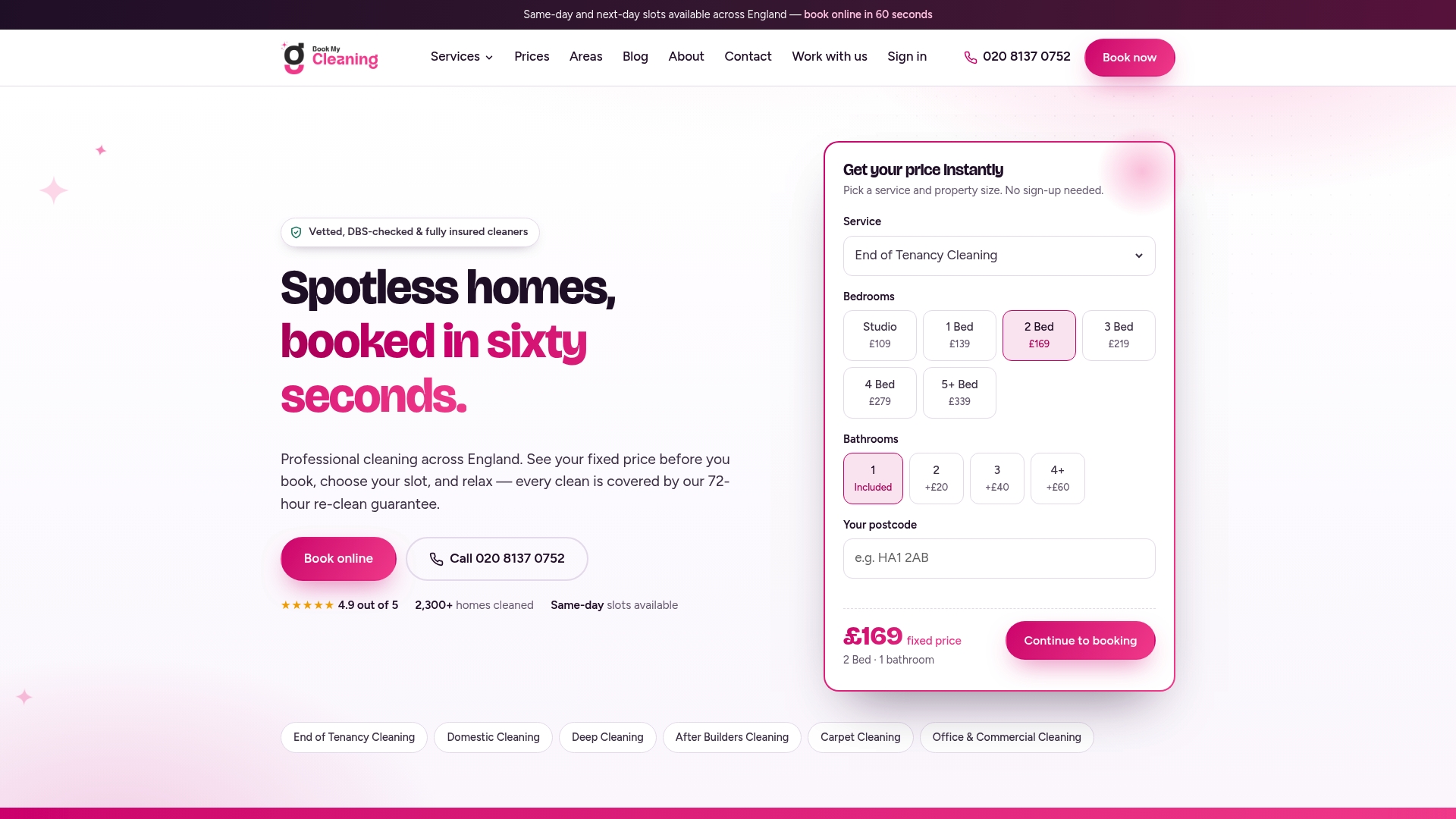
Our 4.9-star rating comes from over 2,300 cleaned homes, and same-day slots are available. Before choosing any provider, our hire a cleaner checklist gives you 11 questions to ask, and the five-step booking guide shows how a fixed-price booking works.
Red flags in a cleaning agreement
Watch for these in any draft or set of terms:
- No task list, only "general cleaning".
- Prices described as "from" with no way to work out the final total.
- Charges for extras that are not agreed in writing first.
- A long minimum term with no notice period you can use.
- No mention of insurance, or cover limits that look too low for the site.
- No complaints route, or a re-clean window so short you cannot inspect the work.
- Terms that try to remove liability for injury or for poor workmanship altogether, which the law restricts.
FAQ
Do I need a written contract for a domestic cleaner?
A contract exists once you agree a booking, even if it is only online terms and a confirmation email. A written record of the scope, price and cancellation rules protects both sides. For a regular cleaner, ask for these in writing so you can refer back to them.
Can I cancel a cleaning booking after paying?
Often yes, but it depends on the terms. Online and phone bookings can bring a 14-day cancellation right under the Consumer Contracts Regulations 2013, with consequences if you asked for the work to start early or it has been completed. Check the provider's cancellation notice and any fee before booking.
What insurance should a cleaning company have?
At least public liability insurance, and employers' liability if it has staff. The right limits depend on the site. Public bodies set benchmarks of several million pounds, which is a useful reference for offices. Ask for the cover details in writing.
What should a tenant check before booking an end-of-tenancy clean?
Check that the checklist matches your inventory, that extras such as the oven are priced upfront, and that a re-clean window is stated. Keep your photos, meter readings and booking confirmation for the check-out inspection.
Can a cleaner limit their liability in the terms?
Only within limits. Liability for death or personal injury caused by negligence cannot be excluded, and consumers keep the right to services with reasonable care and skill. Other caps must be reasonable.
Sources
- Sprintlaw UK: Service agreements for cleaning companies
- Sprintlaw UK: Cleaning contract template and key clauses
- Sprintlaw UK: Commercial cleaning contracts, key terms
- Sprintlaw UK: Cleaning company contracts, UK legal essentials
- TfL cleaning and associated services contract
- Lancashire County Council call-off terms
- Cumberland Council liability insurance guidance
- QuestGates: Can a business exclude its liability for negligence?
- How to Rent: the checklist for renting in England
- BossBot UK: health and safety duties for cleaning companies
- Logbook: COSHH for cleaning products
- When to pay deposits